Going Beyond Compliance: Making Outdoor Events Genuinely Accessible
Providing an accessible toilet at an outdoor event is a legal requirement. The Equality Act 2010 mandates reasonable adjustments for disabled people, and toilet provision falls squarely within that obligation. But the legal minimum is exactly that — a minimum. Meeting it does not mean you have made your event genuinely accessible. It means you have avoided breaking the law.
This guide is about going further. It covers what the law requires, where most events fall short, and what genuinely inclusive toilet provision looks like in practice.
What the Law Actually Requires
The Equality Act 2010 requires event organisers to make reasonable adjustments to ensure that disabled people are not placed at a substantial disadvantage compared with non-disabled people. In the context of toilet provision, this means:
- Providing at least one accessible toilet unit at every public event
- Ensuring the accessible unit is usable — not merely present but locked, broken, or inaccessible due to poor positioning
- Positioning the unit on the most accessible ground, with a clear, step-free path from the main event area
- Ensuring the unit is maintained to the same standard as other facilities throughout the event
The key phrase is "reasonable adjustments." What is reasonable depends on the size, nature, and resources of the event. A parish fete with 200 visitors has different obligations from a festival with 10,000 attendees. But the principle applies equally: disabled attendees must not be disadvantaged.
Where Most Events Fall Short
Positioning
The most common failure is positioning. The accessible unit is included in the order — box ticked — but placed at the far end of the toilet row, on rough ground, behind a guy rope, or up a slope. It is technically present but practically unusable for the people who need it most.
Accessible units should be positioned on the firmest, flattest ground available, with the shortest and smoothest path from the main event area. This often means positioning them separately from the main toilet row, closer to the venue entrance or the accessible viewing area.
Ground Surface
An accessible toilet is useless if the approach is across a muddy field. Wheelchair users, people using walking frames, and attendees with mobility impairments need a firm, even surface from the parking area or drop-off point to the toilet.
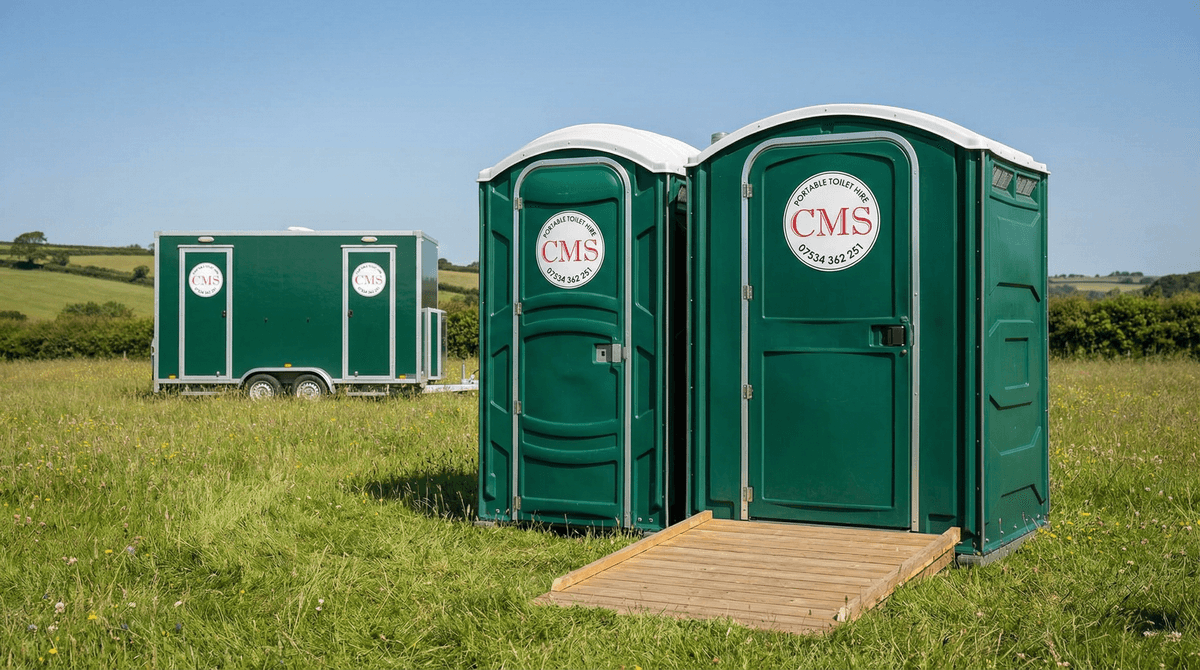
For events on grass, trackway panels or temporary matting can provide a firm surface. This is an additional cost, but it is the difference between accessible provision that works and accessible provision that exists only on paper.
Signage and Wayfinding
Accessible toilets need clear, visible signage from the main event area. Standard portable toilets are usually obvious — a row of units is hard to miss. A single accessible unit positioned separately is not obvious at all, especially to someone unfamiliar with the site.
Use clear signage with the international symbol of access. Position signs at decision points along the route. Consider the needs of visually impaired attendees — high-contrast signs and verbal directions from stewards.
Maintenance During the Event
Accessible toilets are often used by non-disabled attendees who want a larger, more comfortable unit. This means they can deteriorate faster than standard units. Check accessible facilities more frequently during the event — at least every two hours — and prioritise them for cleaning and restocking.
Station a steward near the accessible facilities if practicable. This serves a dual purpose: ensuring the units are available for those who need them and providing assistance to anyone who requires it.
What Genuinely Inclusive Provision Looks Like
Multiple Accessible Units
One accessible unit is the minimum for small events. For larger events, provide accessible units in proportion to attendance — a ratio of one accessible unit per 75 disabled attendees is a reasonable starting point, with a minimum of two.
Multiple units reduce queuing, provide a backup if one unit develops a fault, and allow positioning at different points across the event site.
Changing Places Facilities
Standard accessible toilets meet the needs of many disabled people but not all. People with profound and multiple learning disabilities, as well as some people with other complex physical disabilities, need Changing Places facilities — larger spaces with an adult-sized changing bench, a hoist, and sufficient room for two carers.
Providing a Changing Places facility at an outdoor event is challenging but increasingly possible. Specialist trailer-mounted Changing Places units are available for hire. For larger events, this provision can be the difference between a disabled person attending or staying home.
Companion Access
Many disabled attendees visit events with a personal assistant or carer. Accessible toilet provision should accommodate this. Ensure the unit is large enough for two people, that the approach path is wide enough for a wheelchair plus a walking companion, and that stewards are aware that companions may need to enter the accessible facility.
Information in Advance
Publish detailed information about your accessible toilet provision before the event. Include:
- The number and type of accessible units
- Their position on the site map
- The surface condition of the approach path
- Whether Changing Places facilities are available
- A contact number for accessibility queries on the day
Disabled people and their families plan visits carefully. Detailed advance information enables them to plan with confidence and demonstrates that your event takes accessibility seriously.
Planning and Procurement
Briefing Your Hire Company
When booking portable toilets for an event, brief your hire company on your accessibility requirements specifically. Do not assume they will automatically provide appropriate accessible units in appropriate positions. Specify:
- The number of accessible units required
- Any requirement for Changing Places specification
- The ground conditions and positioning requirements
- The servicing frequency during the event
- Any specific features required (grab rails, alarm cords, hearing loops)
Site Visit
Invite your hire company to conduct a site visit before the event. Walking the ground together allows both parties to identify potential issues — slopes, soft ground, access barriers — before they become problems on the day.
Contingency Planning
Have a plan for what happens if an accessible unit develops a fault during the event. Can your hire company provide a replacement within a reasonable timeframe? Is there an alternative accessible facility nearby (a venue building, for example) that can be used as a backup?
The Business Case
Beyond legal compliance and basic decency, genuinely accessible events attract a wider audience. The purple pound — the spending power of disabled people and their families — is estimated at over £270 billion per year in the UK. Disabled people attend events when they are confident the facilities will meet their needs. They avoid events where past experience or inadequate information suggests otherwise.
Investing in proper accessible toilet provision is not just the right thing to do. It is commercially sensible.
Summary
The legal minimum is one accessible unit at your event. The practical minimum for a genuinely inclusive event is considerably more. Position accessible facilities on the best ground, with clear signage and a firm approach path. Maintain them more frequently than standard units. Provide information in advance. Brief your hire company properly.
Accessible toilet provision is not an add-on. It is a core part of your event infrastructure, and it deserves the same attention as your stage, your bar, and your car parking.