Everything You Need to Know About Hiring Accessible Portable Toilets
Accessible toilet provision is not optional. It is a legal requirement for public events, a welfare obligation on construction sites, and a basic expectation for any situation where people gather. This guide covers what accessible portable toilets look like, when you need them, how to position them properly, and how to ensure they actually serve the people they are designed for.
What Is an Accessible Portable Toilet?
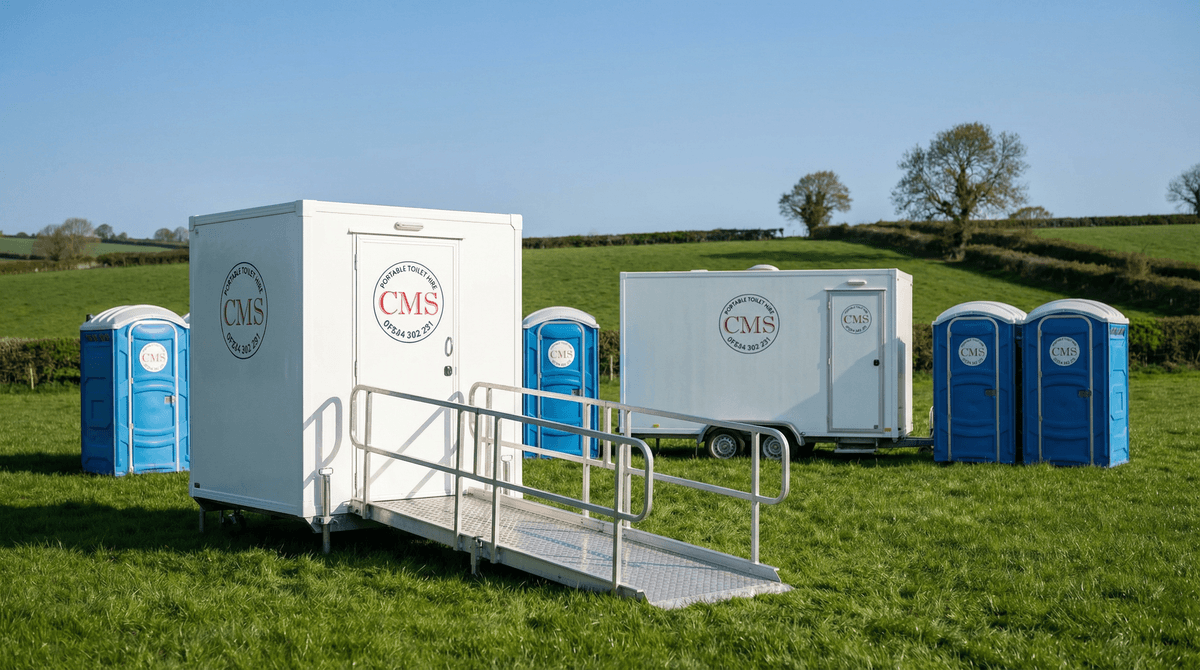
An accessible portable toilet — sometimes called a disabled access unit or a wheelchair-accessible unit — is a larger portable toilet designed to accommodate wheelchair users, people with mobility impairments, and people who require assistance from a carer.
Key features include:
- Wider doorway: Minimum 900mm clear opening, compared with approximately 600mm on a standard unit
- Level or ramped access: No step at the entrance — a ramp provides wheelchair access from ground level
- Internal space: Minimum 1500mm x 1500mm internal floor area, sufficient for a wheelchair to turn
- Grab rails: Positioned either side of the toilet to assist with transfer from wheelchair to seat
- Lower toilet seat: Positioned at wheelchair seat height for easier lateral transfer
- Non-slip flooring: Essential for safety, particularly when the floor is wet
- Accessible lock: A lock that can be operated with limited hand dexterity — typically a large lever rather than a small thumb turn
Some units include additional features such as an alarm cord, a mirror at seated height, and a baby changing shelf. The specification varies between manufacturers and hire companies.
When Do You Need One?
Public events
Every public event should have at least one accessible portable toilet. The Equality Act 2010 requires event organisers to make reasonable adjustments for disabled people, and toilet provision is explicitly included. For larger events, the ratio should be approximately one accessible unit per 75 disabled attendees, with a minimum of two units to provide redundancy.
Construction sites
The Construction (Design and Management) Regulations 2015 require adequate welfare facilities for all workers, including those with disabilities. If any worker on site has a mobility impairment, an accessible unit must be provided. Even if no disabled workers are currently on site, providing an accessible unit is good practice — visitors, inspectors, and subcontractors may need accessible facilities.
Private events
While private events are not subject to the same legal obligations as public events, providing accessible facilities for guests with disabilities is a matter of basic courtesy. If you know — or reasonably anticipate — that any guest will need accessible facilities, include an accessible unit in your booking.
Long-term hire
Farmyards, allotments, marinas, and other sites with long-term portable toilet provision should consider accessible units, particularly if the site is open to the public or used by a community with diverse needs.
Positioning: Where You Put It Matters as Much as What You Put There
An accessible portable toilet that is poorly positioned is an accessible portable toilet that does not work. Positioning is where most event organisers and site managers fail.
Firm, level ground
The unit must sit on firm, level ground. This is even more important for accessible units than for standard units, because wheelchair users cannot safely approach or enter a unit on soft, uneven, or sloping ground. Concrete, tarmac, compacted gravel, or temporary trackway panels over grass are all suitable.
Clear approach path
The path from the main event area or site entrance to the accessible toilet must be:
- At least 1200mm wide (ideally 1500mm)
- Free from steps, kerbs, and trip hazards
- Surfaced with a firm, even material
- Well-lit if the event or site operates after dark
A beautifully specified accessible unit at the end of a muddy, rutted track is not accessible. The approach path is as important as the unit itself.
Closest to the main area
Accessible toilets should be positioned closer to the main activity area than standard toilets. Disabled users often have the greatest difficulty covering distance, so placing accessible facilities furthest from the action — which happens at a depressing number of events — is exactly wrong.
Separate from the main toilet row
Consider positioning accessible units slightly apart from the main toilet row. This reduces the likelihood of non-disabled users occupying the accessible unit (though signage and stewarding are more effective deterrents) and provides a quieter, more dignified experience for users who may need more time.
Booking and Briefing Your Hire Company
When booking accessible portable toilets, provide your hire company with specific information:
- Number of accessible units required — based on expected attendance and disabled attendee estimates
- Ground conditions — surface type, slopes, firmness
- Access route for the delivery vehicle — width, height, weight restrictions
- Positioning requirements — where on site the units will go and the approach route for users
- Event or site duration — for servicing schedule planning
- Any specific requirements — alarm cords, baby changing facilities, particular grab rail configurations
A good hire company will ask these questions if you do not volunteer the information. If they do not ask, they may not be thinking carefully enough about accessible provision.
Maintenance During Use
Accessible toilets require the same servicing as standard units — emptying, cleaning, restocking, and chemical treatment. However, they also benefit from more frequent checks during events, because:
- They are often used by non-disabled attendees seeking a larger, more comfortable unit
- Users with disabilities may need more time and may create different cleaning requirements
- Any fault or supply shortage has a disproportionate impact on users who cannot easily use an alternative
Assign someone to check the accessible units at least every two hours during an event. Ensure they are stocked, clean, and functioning. Report any issues to the hire company immediately.
Common Mistakes
- Providing only one accessible unit when the event size justifies more
- Positioning on soft or sloping ground that wheelchair users cannot navigate
- No approach path preparation — expecting wheelchair users to cross a ploughed field
- Inadequate signage — the accessible unit is present but nobody can find it
- No stewarding — the accessible unit is occupied by non-disabled users throughout the event
- Treating it as a tick-box exercise — ordering the unit but giving no thought to how it will actually be used
What We Provide
We stock accessible portable toilets as a standard part of our fleet. Our accessible units include wide doorways, ramped access, grab rails, non-slip flooring, and accessible locking mechanisms. We deliver, position, and service them to the same standard as every other unit in our fleet.
When you book an accessible unit, we will discuss positioning, ground conditions, and approach routes with you. If a site visit is needed, we will arrange it. We want the unit to actually work for the people who need it — not just be present on site.
The Bigger Picture
Accessible toilet provision is part of a broader commitment to inclusion. It sends a message to disabled attendees, workers, and visitors: you are welcome here, and we have thought about your needs. That message matters — and it starts with practical, properly positioned, well-maintained facilities that genuinely serve their purpose.