
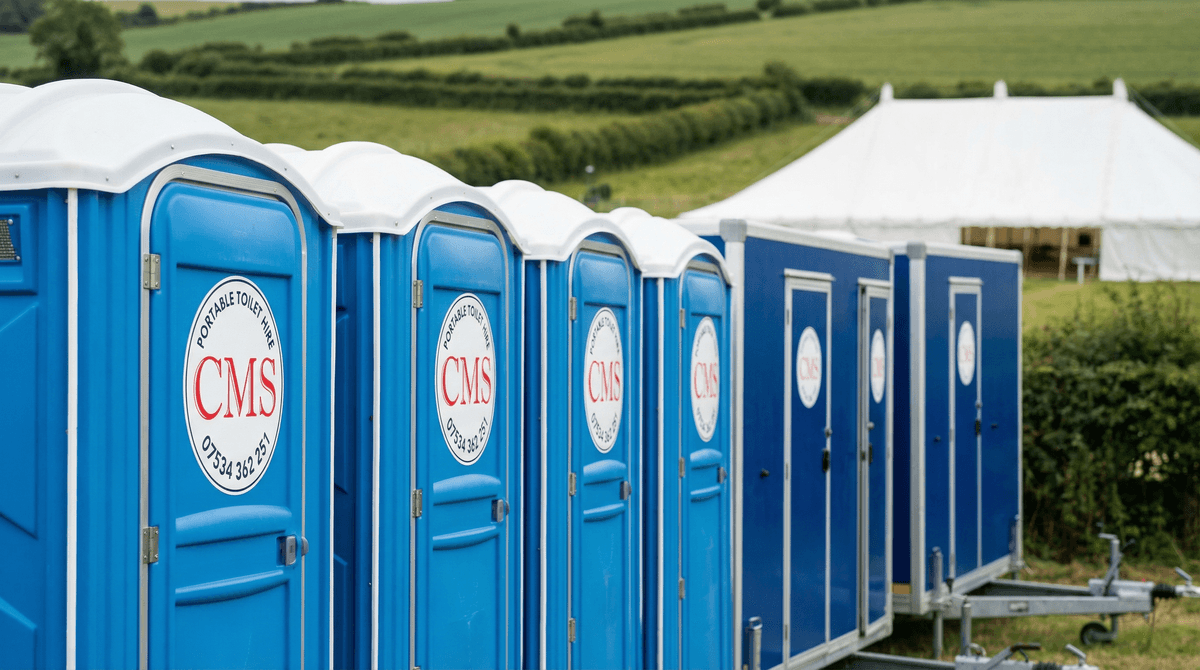
Five hundred guests changes the calculus
At five hundred guests, toilet provision moves beyond the realm of a quick calculation and into genuine event infrastructure planning. This is the scale where getting it wrong becomes conspicuously visible — thirty-minute queues, frustrated guests, and complaints that overshadow whatever the event was actually about.
It is also the scale where getting it right is entirely achievable, provided you plan with realistic numbers and account for the specific characteristics of your event rather than applying a crude formula.
The baseline formula
The standard ratios for portable toilet provision at events are well-established across the industry:
- Short events (under 4 hours, no alcohol): 1 toilet per 100 guests = 5 units for 500 guests
- Standard events (4-8 hours, alcohol served): 1 toilet per 75 guests = 7 units for 500 guests
- Long events (8+ hours, heavy alcohol consumption): 1 toilet per 50 guests = 10 units for 500 guests
These are starting points — useful for initial budgeting but insufficient for actual planning. Several factors specific to your event will push the numbers up or down, and understanding those factors is the difference between comfortable provision and a queuing disaster.
Factors that increase the requirement
Alcohol consumption
Alcohol increases toilet usage by thirty to forty percent compared to a dry event. The effect is consistent and well-documented. A 500-guest event with a free bar running from noon until midnight needs materially more provision than a 500-guest afternoon tea.
Beer and cider festivals are particularly demanding — the combination of high fluid volume and extended duration creates peak demand that standard ratios do not adequately capture. If your event is centred on alcohol consumption, plan for the upper end of the range.
Female-heavy attendance
Female guests use toilet facilities more frequently and for longer than male guests. Events with a higher proportion of female attendees — certain charity events, women's conferences, hen parties, bridal showers — need additional provision above the standard ratios.
The standard ratios assume a roughly equal male-female split. If your event skews significantly (seventy percent female, for example), increase the overall provision by fifteen to twenty percent.
All-day events
An event running from ten in the morning until ten at night generates approximately double the total toilet usage of one running from two until six. The peak demand at any given moment may be similar, but the cumulative usage across the full day is substantially higher — affecting tank capacity, consumable supply, and the overall condition of the units as the day progresses.
For all-day events, plan for the higher end of the capacity range and consider mid-event servicing to maintain standards through the evening.
Significant catering and drinks service
Events with substantial food and drink provision generate more toilet demand than those without. Barbecues, hog roasts, drinks-focused events, and multi-course meals all contribute to increased usage. Factor catering into your planning rather than treating it as incidental to toilet demand.
A worked example: 500-guest summer festival
Scenario: A one-day community festival in Cheshire or Shropshire, running from 11am to 9pm. Beer tent, food stalls, live music across two stages. Mixed age group, roughly equal male and female attendance. Good weather forecast.
Recommended provision:
- 6 standard portable toilets distributed across the site in clusters of 2 or 3
- 1 six-position urinal block positioned near the beer tent
- 1 accessible portable toilet near the main event area, on firm level ground
- Optional: 1 luxury toilet trailer (2+1 configuration) for a VIP or backstage area
Why this configuration works:
The urinal block handles the heaviest male demand — the area around the bar — freeing up standard units for all guests. The accessible unit ensures inclusive provision as required by the Equality Act. The standard units, distributed in clusters rather than a single bank, reduce walking distances and prevent any single queue from becoming unmanageable.
Total provision breakdown:
- Standard units: 6
- Urinal positions: 6
- Accessible unit: 1
- Optional luxury trailer: 1 (2+1 configuration)
The power of urinal blocks
Adding urinal blocks is the single most cost-effective way to manage toilet provision at a 500-guest event. One six-position handles male demand equivalent to five or six standard portable toilets, at a fraction of the cost and a fraction of the footprint.
Without urinals: You might need 8 to 10 standard units, all serving both male and female guests.
With a urinal block: 6 standard units plus the block provides better service for everyone — shorter queues for female guests at the standard units, fast throughput for male guests at the urinals.
The urinal block should be positioned near the highest concentration of male demand — typically adjacent to the main bar or drinks service area.
The luxury trailer option
For 500-guest events where presentation matters — large weddings, corporate hospitality, milestone celebrations — consider replacing some standard units with a luxury toilet trailer:
- A 3+1 luxury trailer comfortably serves up to 200 guests as the primary facility
- Supplement with standard portable toilets for overflow, staff areas, and distant parts of the venue
- The core guest experience is elevated; the wider provision ensures adequate capacity
This mixed approach balances quality with cost. Not every guest needs a luxury experience — but the impression created by the primary facility sets the tone for the event as a whole.
Accessible provision
Every event open to the public should provide at least one accessible portable toilet — a larger unit with ramp access, grab rails, and sufficient internal space for a wheelchair user and a carer.
For 500 guests, one accessible unit is the minimum. Position it on level, firm ground near the main event area, with a clear path suitable for wheelchair access.
If your event specifically attracts a higher proportion of disabled attendees — disability sports, accessible festivals, events at venues known for accessibility — provide two or more accessible units.
Distribution and positioning
Where you place the units matters as much as how many you provide. The principles are straightforward:
- Near bars and food service: This is where demand peaks. Position the highest concentration of units (including the urinal block) within easy walking distance of the main bar.
- Near stages and activity areas: Guests use toilets during breaks between performances. A cluster of units near each stage prevents a mass migration to one central location.
- At entrance and exit points: Guests use toilets on arrival and before leaving. A small cluster near the main entrance captures this demand.
- Signposted clearly: Five hundred guests will not find toilets by exploration. Clear, visible signage from every part of the venue reduces confusion and distributes usage evenly.
Our recommendation
Call us on 07534 362 251 with the details of your event — type, duration, alcohol provision, venue layout, expected attendance profile — and we will provide a specific recommendation.
The worked example above is a guide, but every event is different. A 500-guest wedding in a marquee has different requirements from a 500-guest beer festival in a field, even though the guest count is identical.
Chelford Mobile Services supplies portable toilets, urinal blocks, accessible units, and luxury toilet trailers for events across Cheshire, Shropshire, Staffordshire, and Greater Manchester.