
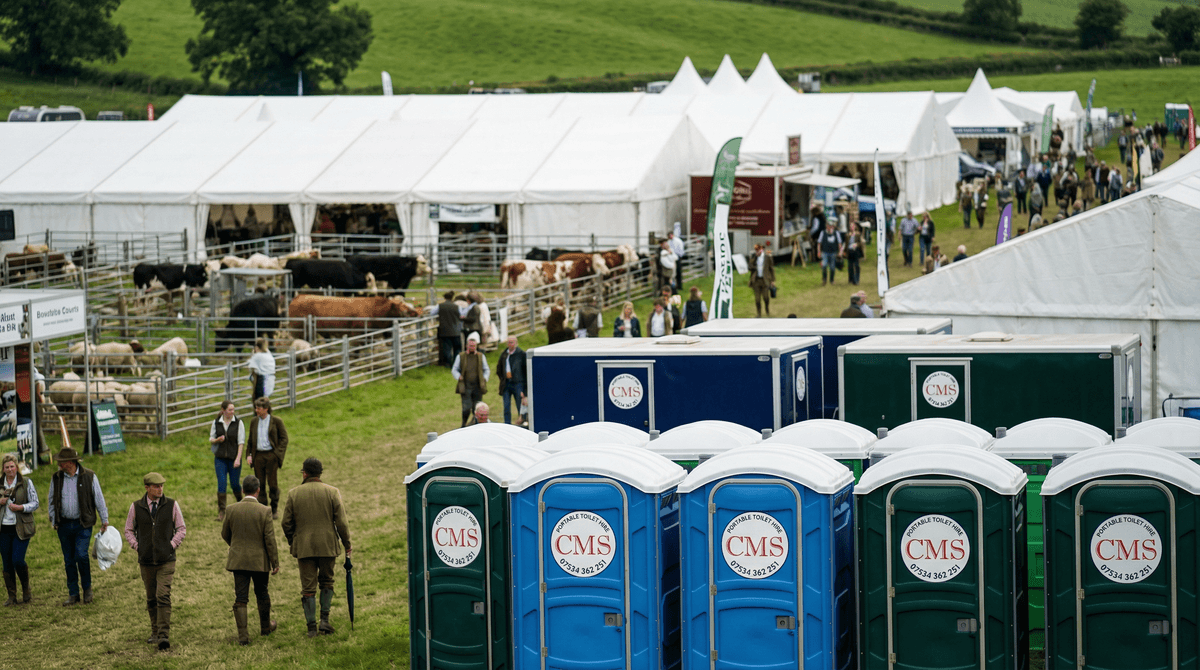
County shows and agricultural fairs are among the largest and most complex outdoor events in the UK calendar. Thousands of visitors, hundreds of exhibitors, livestock across multiple rings, food halls, trade stands, equestrian competitions, and entertainment — all taking place over two or three days on a rural showground that was pasture last month.
The toilet provision for these events must be comprehensive, well-distributed, and robustly maintained. Here is how to plan it.
---
The Scale of the Challenge
Multi-Day Duration
Most county shows run for 2-3 days. Some, like the Royal Welsh Show, run for four. This means:
- Units must be serviced daily
- Wear and tear accumulates over the show
- Consumables must be replenished reliably
- Ground conditions deteriorate with foot traffic and weather
Large, Diverse Attendance
A mid-size county show attracts 10,000-30,000 visitors per day. A major show (Great Yorkshire, Royal Welsh, Royal Highland) can attract 100,000+ over its run. The audience includes:
- Families with young children and elderly relatives
- Agricultural professionals
- Trade visitors
- Tourists and day-trippers
- Exhibitors, competitors, and their support teams
Multiple Zones
A county show is not a single event — it is a collection of events spread across a large site:
- Main ring
- Livestock lines and judging areas
- Equestrian arenas
- Food hall and catering areas
- Trade stand avenues
- Countryside and craft areas
- Children's entertainment
- Car parks and entrances
Each zone needs its own toilet provision. A single central block is not adequate for a show that stretches over 50-100 acres.
---
Calculating the Requirement
Visitor Provision
Use the Purple Guide ratios, adjusted for the all-day, mixed-demographic nature of a county show:
- Female visitors: 1 toilet per 100
- Male visitors: 1 toilet per 500 plus 1 urinal per 150
- Accessible units: At least 1 per cluster (minimum 3-4 per day across the show)
Calculate based on peak concurrent attendance, not total daily attendance. At most shows, peak concurrent attendance is approximately 60-70% of total daily visitors.
Exhibitor and Staff Provision
Separate provision for:
- Livestock exhibitors: 1 toilet per 25, positioned near the livestock lines
- Trade stand operators: 1 toilet per 20-30, near the trade avenues
- Show officials and stewards: 1 toilet per 15-20
- Setup and breakdown crews: provision during the build and de-rig days
Example: County Show, 15,000 Daily Visitors
Peak concurrent attendance: approximately 10,000
Assuming 50/50 gender split:
- Female: 5,000 ÷ 100 = 50 toilets
- Male: 5,000 ÷ 500 = 10 toilets + 5,000 ÷ 150 = 34 urinals
- Accessible: 5-6 units across the site
- Exhibitors/staff: 15-20 additional units
- Total: approximately 75-80 toilets, 34 urinals, 6 accessible units
---
Distribution Across the Site
Zone-Based Clusters
Divide the showground into zones and provide a toilet cluster for each:
- Main entrance: 2-3 units plus accessible
- Main ring/grandstand: 8-10 units plus urinal block plus accessible
- Food hall/catering area: 6-8 units plus urinal block plus accessible
- Livestock lines: 4-6 units (exhibitor priority) plus hand-wash stations
- Trade avenues: 4-6 units spread along the avenue
- Equestrian area: 3-4 units (competitor and spectator)
- Countryside/craft area: 2-3 units
- Children's area: 2-3 units (family-friendly)
- Car parks: 2-3 units near each main car park
Spacing
No visitor should need to walk more than 3-4 minutes to reach a toilet cluster. On a large showground, this means 6-10 separate clusters.
---
Hand Washing: The Non-Negotiable
At any event with livestock, hand washing is a public health priority. HSE, Defra, and local authority environmental health teams all emphasise this point.
Requirements
- Portable hand-wash stations at every toilet cluster with warm water, liquid soap, and paper towels
- Additional hand-wash stations at exits from all animal contact areas — livestock lines, petting farms, animal handling areas, milking demonstrations
- Prominent signage: "Wash Your Hands After Touching Animals and Before Eating"
Hand sanitiser is a supplement, not a replacement. Soap and running water are the standard.
---
Servicing
Daily Professional Service
Every unit on the showground must be professionally serviced before gates open each morning:
- Waste tanks emptied
- Interiors cleaned
- Consumables restocked (toilet paper, soap, sanitiser, paper towels)
- Units checked for damage
Mid-Day Service
On peak days, a second professional service at midday keeps facilities to standard.
On-Site Monitoring
Station a volunteer or staff member at each of the busiest toilet clusters:
- Check supplies every 30-60 minutes
- Spot clean as needed
- Report damage, blockages, or overflows immediately
- Manage queues during peak periods
Consumables
County shows consume vast quantities of toilet paper and soap. Stock generously and have a reserve supply at a central point on the showground.
---
Ground Protection
County showgrounds are predominantly grass, and the weather in the British show season (May-September) is unpredictable.
- Trackway on all approach paths and around toilet clusters
- Additional matting for deployment as conditions deteriorate
- Entrance mats at every unit to reduce mud being tracked inside
- Drainage management — channel surface water away from toilet areas
After rain, ground conditions can change rapidly. Assign someone to inspect toilet areas and deploy additional matting as needed.
---
Accessible Provision
County shows attract visitors of all abilities. Accessible provision must be:
- Available at every major toilet cluster
- Positioned on the firmest, most level ground
- Approached by a path suitable for wheelchairs and mobility scooters (common at county shows)
- Clearly signed from a distance
- Regularly checked and maintained
---
Regulatory Considerations
Environmental Health
The local authority environmental health team will inspect the show. They check:
- Toilet numbers and condition
- Hand-washing provision, particularly in relation to animal contact
- Food handler hygiene facilities
- Waste disposal arrangements
Defra Guidance
Defra's advice on preventing E. coli and other zoonotic infections at animal events applies to all county shows. Compliance is not optional — outbreaks at shows attract significant negative publicity and regulatory scrutiny.
Waste Disposal
Waste must be collected by a registered waste carrier and disposed of at a permitted facility. For multi-day shows, waste collection will need to happen during the event, not just at the end.
---
VIP and Sponsor Provision
Major county shows often include a members' enclosure, president's tent, or sponsor hospitality area. These require:
- Luxury toilet trailer provision
- Higher servicing frequency
- An attendant to maintain the facilities
- Interior standard that matches the hospitality experience
---
Costs
For a mid-size county show (10,000-20,000 daily visitors, 2-3 days):
| Item | Estimated Cost |
|------|---------------|
| Standard toilets (60-80 units, 3 days) | £4,000-8,000 |
| Urinal blocks (6-8 blocks, 3 days) | £800-1,500 |
| Accessible units (5-6 units, 3 days) | £500-1,000 |
| Luxury trailers for VIP (1-2 trailers) | £800-2,000 |
| Hand-wash stations (10-15 stations) | £500-1,500 |
| Servicing (daily, plus mid-day on peak days) | £2,000-4,000 |
| Trackway and ground protection | £1,000-3,000 |
| Total | £9,600-21,000 |
This is a significant budget item, but it is proportionate to the scale and reputation of a county show. Cutting corners on toilet provision risks public health, regulatory censure, and damage to the show's reputation.
---
Checklist
- Peak concurrent attendance calculated
- Toilet numbers calculated by zone
- Accessible units included in every major cluster
- Hand-wash stations at every cluster AND animal contact area exits
- Exhibitor, staff, and setup provision arranged separately
- Ground protection planned and ordered
- Daily servicing confirmed with hire provider
- Mid-day servicing for peak days arranged
- On-site monitors assigned to busiest clusters
- Consumables stocked generously with central reserve
- VIP/hospitality provision arranged
- Environmental health requirements confirmed
- Defra guidance on animal events complied with
- Food handler hand-washing arranged separately
- Signage prepared — directional, hand washing, accessible
- Waste disposal arrangements confirmed
- Weather contingency in place
A county show is a showcase for rural life. The toilet provision should be a quiet, competent part of that showcase — providing comfort and hygiene without drawing attention to itself.