
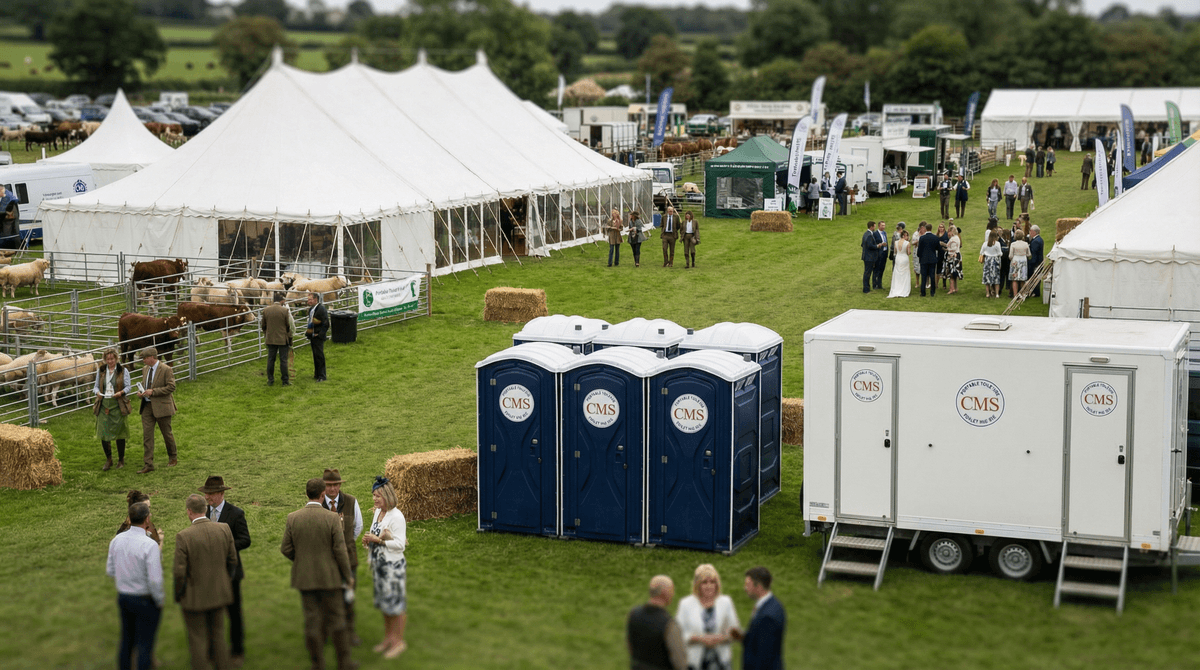
Trade shows and exhibitions — whether in purpose-built halls, outdoor showgrounds, or temporary venues — often need supplementary toilet provision. Permanent facilities may be insufficient for peak attendance, outdoor exhibition areas may have no facilities at all, and exhibitor setup crews need welfare provision before the public arrives.
Here is what organisers and exhibitors need to know.
---
When Do You Need Portable Toilets at a Trade Show?
Common Scenarios
- Outdoor exhibition areas alongside an indoor venue — product demonstrations, vehicle displays, plant and machinery exhibitions
- Setup and breakdown periods when permanent facilities are locked, restricted, or overwhelmed by contractors
- Peak attendance days when venue toilets cannot handle the footfall
- Exhibitor-specific provision for stands with large teams who need facilities nearby
- VIP and hospitality areas requiring a higher standard of facility than the main venue offers
- Pop-up and temporary trade shows in venues not designed for exhibitions (warehouses, car parks, fields)
The Business Case
At a trade show, every attendee is a potential customer or business contact. If they spend 15 minutes queuing for the toilet, they are not spending that time on your exhibition floor. Adequate toilet provision keeps attendees on the show floor longer and in a better frame of mind.
---
How Many Units?
For Outdoor Exhibition Areas
Use standard event ratios:
- Female visitors: 1 toilet per 100 attendees
- Male visitors: 1 toilet per 500 plus 1 urinal per 150
- Accessible units: At least 1 per toilet cluster
For trade shows with a predominantly male audience (construction, automotive, engineering), adjust the gender ratio accordingly.
For Setup and Breakdown
During setup (typically 1-3 days before the show), contractors and exhibitor teams need facilities:
- 1 toilet per 25 workers on site
- Hand-washing facilities with running water, soap, and towels
- Available from the first day of setup until the last day of breakdown
For Supplementary Indoor Provision
If the indoor venue toilets are insufficient for peak days:
- Calculate the shortfall based on peak concurrent attendance minus the capacity of permanent facilities
- Position supplementary units at exits or junctions leading to outdoor areas
---
Types of Unit
Standard Portable Toilets
The practical choice for setup/breakdown periods, large outdoor exhibitions, and general supplementary provision.
Luxury Toilet Trailers
For VIP and hospitality areas, exhibitor lounges, and premium exhibition sections. The interior finish matches the professional standard of the event.
Urinal Blocks
Effective for male-dominated trade shows where speed of throughput matters more than luxury.
Accessible Units
Required at every public event under the Equality Act 2010. Position on firm, level ground near the main exhibition entrance.
Mains-Connected Units
For multi-day trade shows, mains-connected portable toilets offer superior hygiene and comfort compared to chemical units. They flush like domestic toilets and are connected to the venue's water and drainage.
---
Placement
Outdoor Exhibition Areas
- Position toilet clusters near the entrance/exit to the outdoor area
- Additional clusters near food concessions and seating areas
- Clearly signed from the main exhibition hall and from within the outdoor area
- On hardstanding or well-drained ground with matting on approach paths
Setup Period
- Position near the goods entrance and contractor welfare area
- Available from the start of each setup day (often 6-7am)
- Keep provision in place throughout setup, including the day before the show opens
VIP/Hospitality
- Dedicated luxury provision near the hospitality lounge or VIP entrance
- Separate from general attendee provision
- Serviced more frequently than general units
---
Servicing
Multi-Day Shows
Daily professional servicing is essential:
- Service before the venue opens each day
- Mid-day service on peak attendance days
- Post-show service for setup/breakdown crews working late
Key Consumables
Trade show attendees notice quality. Ensure:
- Toilet paper is consistently stocked (not running out by midday)
- Hand soap dispensers are full
- Paper towels are available (not just air dryers or hand sanitiser)
- Units are clean, dry, and free from litter
On-Site Monitoring
For shows with more than 2,000 daily visitors:
- Assign a member of staff to monitor the toilet areas throughout the show
- Equip them with cleaning supplies for spot cleaning
- Provide a radio or phone for reporting issues to event management
---
Exhibitor Welfare
Exhibitors and their stand staff spend long days at trade shows — typically 8-10 hours on the show floor. If the nearest toilet is a 10-minute walk to the far end of the venue, they will leave their stand unattended or try to avoid using the facilities.
Solutions
- Provide toilet clusters at regular intervals around the exhibition floor
- For outdoor exhibitions, ensure provision is within a 3-minute walk of every stand
- Consider providing a small, exhibitor-only facility near the organiser's office or exhibitor lounge
---
Outdoor Considerations
Weather
Trade shows with outdoor elements face the usual British weather challenges:
- Rain: trackway on approach paths, matting around units, shelter over queuing areas
- Wind: secure lightweight units, position in sheltered locations
- Heat: more frequent servicing to manage odour, drinking water provision
Lighting
For shows that extend into the evening (networking events, award dinners):
- Pathway lighting from the exhibition area to the toilet cluster
- Adequate area lighting around the units
- Internal unit lighting checked and operational
Ground Protection
Outdoor exhibition areas are often on hardstanding (car parks, concrete pads) or grass. For grass areas:
- Lay trackway on approach paths
- Position units on the firmest ground available
- Remove matting and check for ground damage at the end of the show
---
Regulatory Requirements
Licensing
Some trade shows operate under a premises licence (if they serve alcohol or provide entertainment). Check licence conditions for toilet provision requirements.
Health and Safety
The event organiser has a duty to provide adequate welfare facilities. For outdoor areas, this includes toilets, hand washing, and drinking water.
Equality Act 2010
Accessible toilet provision is required at any event open to the public. Include accessible units in every toilet cluster.
Waste Disposal
All toilet waste must be collected by a registered waste carrier and disposed of at a permitted facility.
---
Costs
| Provision | Typical Cost |
|-----------|-------------|
| Standard portable toilet (per week) | £60-100 |
| Luxury toilet trailer (per weekend or show) | £500-1,500 |
| Urinal block (per week) | £80-150 |
| Accessible unit (per week) | £80-150 |
| Mains-connected unit (per week) | £100-200 |
For a 3-day outdoor trade show with 5,000 daily visitors: budget £1,500-4,000 for toilet provision depending on the mix of unit types and the level of servicing.
---
Checklist
- Peak concurrent attendance estimated
- Setup/breakdown crew numbers estimated
- Toilet numbers calculated for each area (outdoor, supplementary, VIP, exhibitor)
- Accessible units included
- Hand-washing stations at every cluster
- Servicing schedule confirmed — daily plus mid-day for peak days
- On-site monitor assigned
- Ground protection planned
- Lighting arranged for evening events
- Signage in place — directional, accessible
- Setup-period welfare confirmed (available from day one of build)
- Collection arranged for the day after the show closes
- Waste disposal confirmed with hire provider
Trade show toilet provision is a logistical detail that directly affects the attendee experience and, by extension, the success of the show. Get it right, and attendees focus on the exhibition. Get it wrong, and the toilets become the talking point.