
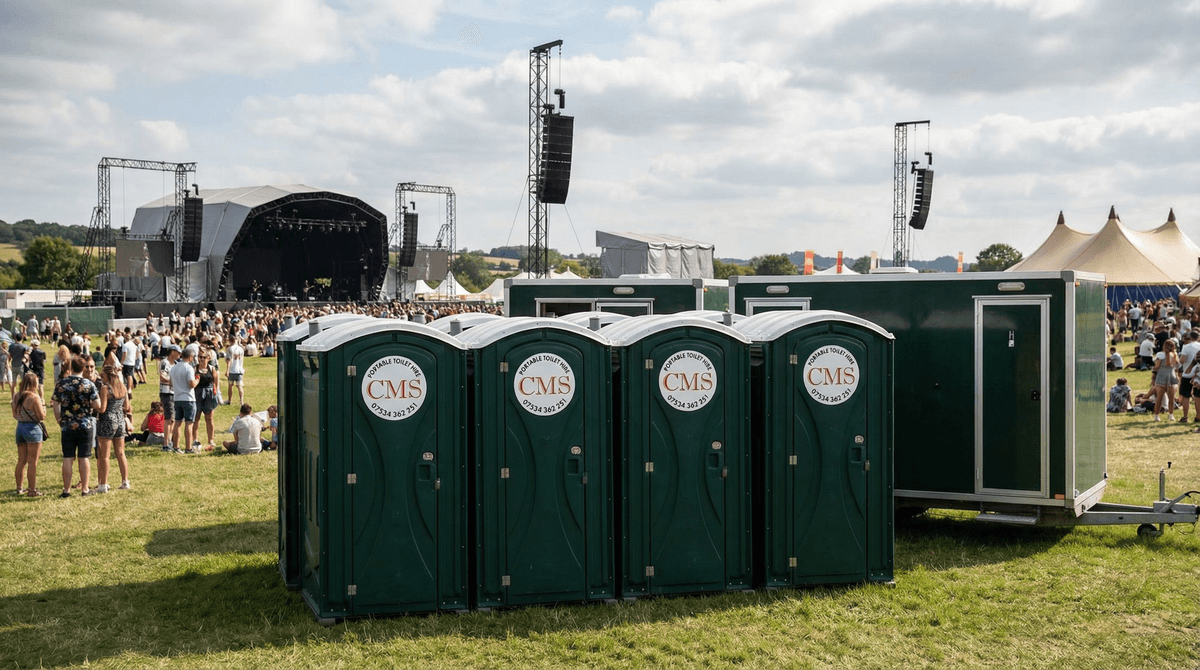
Festival and large-event toilet provision is industrial-scale logistics. Getting it right means thousands of satisfied attendees who never think about the facilities. Getting it wrong means public backlash, social media fury, regulatory action, and a reputation that takes years to rebuild.
This is the comprehensive checklist that experienced promoters use to plan, deliver, and manage toilet provision at scale.
---
Phase 1: Planning (6-12 Months Before)
Establish the Numbers
- [ ] Confirm the licensed capacity of the event
- [ ] Determine the expected peak concurrent attendance (typically 70-80% of licensed capacity for multi-day camping festivals; 90-100% for single-day events)
- [ ] Break down attendance by gender (or use 50/50 if unknown)
- [ ] Identify the proportion of camping vs day-ticket attendees
- [ ] Estimate alcohol consumption levels
Calculate the Requirement
Apply the Purple Guide ratios, adjusted for your event:
Female provision:
- 1 toilet per 100 female attendees (baseline)
- Adjust to 1 per 75-80 for events with heavy alcohol consumption
Male provision:
- 1 toilet per 500 male attendees plus 1 urinal per 150 (baseline)
- Adjust to 1 toilet per 400 plus 1 urinal per 120 for heavy alcohol consumption
Accessible provision:
- At least 1 accessible unit per toilet cluster
- Minimum 1 per 75 disabled attendees if specific numbers are known
Backstage and VIP:
- Separate provision for artists, crew, VIP, and press
- Luxury toilet trailers for hospitality and backstage
Camping:
- Additional provision in each camping field, separate from arena provision
- Approximately 1 toilet per 50-75 campers in each camping zone
Choose the Mix
- [ ] Standard chemical toilets for general arena and camping provision
- [ ] Urinal blocks for male-heavy areas (near stages, bars)
- [ ] Luxury toilet trailers for VIP, backstage, and hospitality
- [ ] Accessible units at every cluster
- [ ] Compost toilets (if part of the event's environmental commitment)
- [ ] Baby changing facilities in family areas
Select the Provider
- [ ] Tender or invite quotes from at least two providers
- [ ] Assess fleet quality — request photos of actual units, not stock images
- [ ] Confirm waste carrier registration
- [ ] Check public liability insurance
- [ ] Confirm servicing capability — can they service the full site at the required frequency?
- [ ] Agree contract terms, including emergency call-out provisions
---
Phase 2: Site Planning (3-6 Months Before)
Map the Clusters
- [ ] Divide the site into zones: arena stages, food/bar area, entrance, camping zones, backstage, VIP
- [ ] Assign a toilet cluster to each zone
- [ ] No attendee should be more than a 3-minute walk from the nearest cluster
- [ ] Mark cluster locations on the site plan
Plan Servicing Access
- [ ] Map servicing routes for vacuum tankers and service vehicles
- [ ] Servicing routes must not cross pedestrian-only zones during operating hours
- [ ] Confirm that servicing vehicles can reach every cluster
- [ ] Plan service bay or waste discharge point (if on-site discharge is permitted)
Ground Protection
- [ ] Identify ground conditions at each cluster location
- [ ] Order trackway or matting for all approach paths and cluster areas
- [ ] Plan drainage at each cluster — surface water must not pool around units
- [ ] Order additional matting as contingency for wet weather
Power and Water
- [ ] Confirm power supply for luxury trailers and any powered lighting
- [ ] Confirm water supply for luxury trailers and hand-wash stations
- [ ] Plan generator positions (away from audience areas for noise)
- [ ] Plan cable routes and cable protection for pedestrian crossings
Signage
- [ ] Design a signage scheme for the entire site
- [ ] Directional signs at every major junction
- [ ] Cluster identification signs ("Toilets A," "Toilets B," etc.)
- [ ] Accessible unit signs at each cluster
- [ ] Illuminated or reflective signs for night-time use
- [ ] Include toilet locations on the event map (printed and app)
---
Phase 3: Regulatory Compliance (3-6 Months Before)
Licensing
- [ ] Check premises licence conditions for toilet provision requirements
- [ ] Submit toilet provision details to the Safety Advisory Group (SAG) if required
- [ ] Address any conditions or feedback from the licensing authority
Environmental Health
- [ ] Discuss provision with the local authority environmental health team
- [ ] Confirm food handler hand-washing arrangements (separate from public provision)
- [ ] Plan for environmental health inspection during the event
Waste Disposal
- [ ] Confirm waste disposal arrangements with a registered waste carrier
- [ ] Identify the permitted receiving facility
- [ ] Plan waste transfer note procedures for every collection during the event
Equality Act 2010
- [ ] Confirm accessible provision meets the requirements
- [ ] Include accessible toilets on the event accessibility guide
- [ ] Ensure approach paths are suitable for wheelchair users
---
Phase 4: Build and Pre-Event (1-2 Weeks Before)
Delivery and Positioning
- [ ] Confirm delivery schedule with the hire provider
- [ ] Sequence delivery to avoid blocking other build activities
- [ ] Position all units according to the site plan
- [ ] Level and secure all units
- [ ] Deploy trackway and matting
Testing
- [ ] Test every unit — flush, lock, internal light
- [ ] Test luxury trailers — water, heating, lighting, flush
- [ ] Test hand-wash stations — water flow, soap, towels
- [ ] Confirm accessible units are level, accessible, and signed
- [ ] Photograph each cluster for the record
Staffing
- [ ] Recruit and brief on-site toilet attendants (at least 1 per 2 clusters during operating hours)
- [ ] Recruit and brief night-time monitoring staff for camping toilet clusters
- [ ] Brief stewards on toilet locations, emergency contacts, and escalation procedures
- [ ] Provide all toilet staff with radio or phone contact to event control
---
Phase 5: During the Event
Servicing Schedule
- [ ] Pre-gates service — all units cleaned and stocked before attendees arrive each day
- [ ] Rolling service during operating hours — target every cluster every 4-6 hours
- [ ] Night service for camping clusters — at least one pass between 12am and 5am
- [ ] Emergency service capability — a tanker and crew available for call-out
Monitoring
- [ ] Attendants checking and cleaning units at least every 30-60 minutes
- [ ] Radio reports from attendants to event control on queue lengths and issues
- [ ] Event control maintaining a live status board for all toilet clusters
- [ ] Environmental health team walkaround at least once per day
Consumables
- [ ] Central consumables store stocked and staffed
- [ ] Resupply runs to clusters at least twice per day
- [ ] Consumables to include: toilet paper (bulk), hand sanitiser, soap, paper towels, bin liners, cleaning spray, disposable gloves, cable ties, duct tape
Issue Resolution
- [ ] Damaged or non-functioning units taken out of service and signed accordingly
- [ ] Replacement units deployed from reserve stock
- [ ] Blockages cleared by servicing crew
- [ ] Spillages cleaned immediately and area decontaminated
---
Phase 6: De-Rig and Review
Post-Event
- [ ] Maintain facilities until the last attendees and campers have left
- [ ] Final service of all units
- [ ] Remove all units, trackway, matting, signage, and consumables
- [ ] Inspect ground at each cluster location for damage
- [ ] Remediate any ground damage as required
- [ ] Complete final waste transfer notes
Review
- [ ] Collect feedback from attendees (survey, social media, customer service reports)
- [ ] Debrief with toilet attendants and servicing crew
- [ ] Review queue length data and incident logs
- [ ] Identify what worked, what did not, and what should change
- [ ] Document lessons learned for next edition
- [ ] Adjust the plan for next year based on evidence
---
Key Metrics to Track
| Metric | Target |
|--------|--------|
| Maximum queue time (arena, daytime) | Under 5 minutes |
| Maximum queue time (arena, peak/night) | Under 10 minutes |
| Maximum queue time (camping, night) | Under 5 minutes |
| Unit downtime (out of service) | Under 5% of total units at any time |
| Consumables run-out incidents | Zero |
| Regulatory notices or complaints | Zero |
| Attendee satisfaction (toilets) | Above 70% positive in post-event survey |
---
Common Failures at Scale
Under-Provision
The most common and most damaging error. Cutting 10% from the toilet budget can result in a 50% increase in complaints and negative coverage. The numbers in the Purple Guide exist for a reason.
Insufficient Servicing
Delivering the right number of units but failing to service them frequently enough. Full, dirty, or unsupplied units are as bad as not having them.
Poor Distribution
Concentrating all provision in one location creates a single bottleneck. Distribute clusters across the site.
Neglecting Camping Areas
Campers need facilities 24 hours a day. Under-serving camping zones is a common blind spot.
Ignoring Night-Time
Demand does not stop when the main stage shuts down. Night-time servicing and monitoring are essential.
---
Summary
Festival toilet provision is a logistics discipline. It requires:
- Accurate demand forecasting
- The right mix and number of units
- Thoughtful site distribution
- Robust servicing infrastructure
- Dedicated on-site staff
- Regulatory compliance
- Continuous monitoring and rapid issue resolution
- Post-event review and improvement
This checklist is the framework. Adapt it to your event, refine it each year, and treat toilet provision as what it is: one of the most important elements of the attendee experience.