
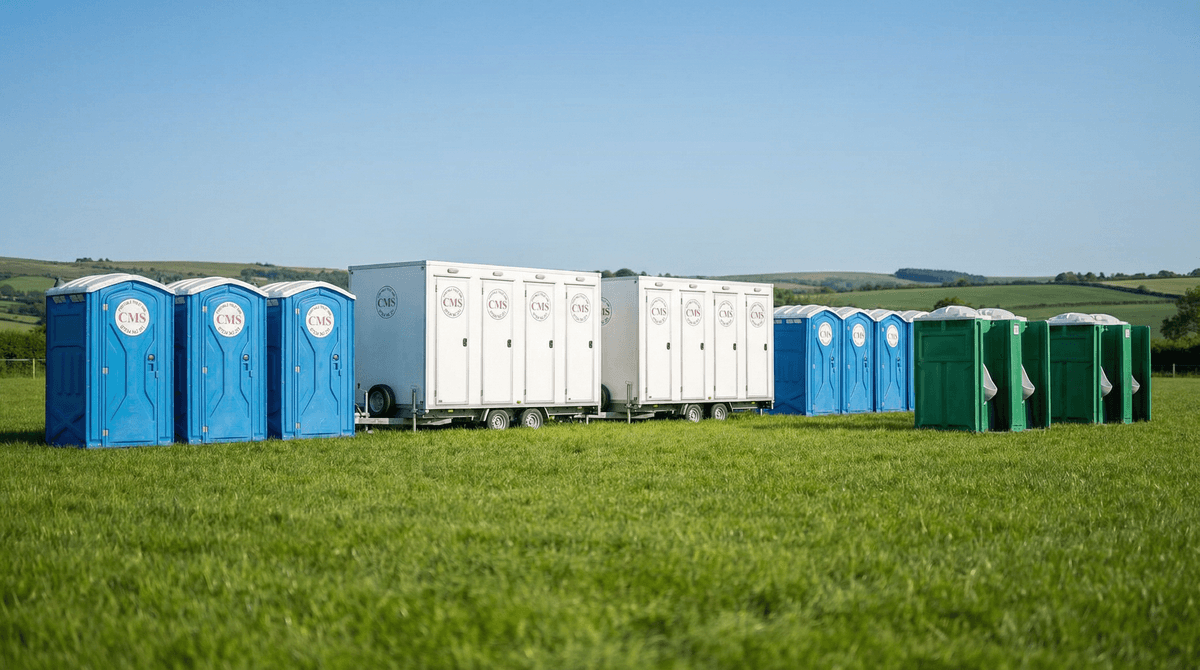
Long queues at portable toilets are the most common sanitation complaint at outdoor events. They frustrate attendees, generate negative reviews, and — at events where people are drinking — lead to antisocial behaviour. Urinal blocks are the single most effective tool for reducing those queues, and they are significantly cheaper per user than adding more toilet cubicles.
This guide explains how urinal blocks work at large events, how many you need, and how to deploy them effectively.
Why Urinal Blocks Work
The maths is compelling. A standard portable toilet cubicle handles approximately 20 to 25 uses per hour. Each visit takes 2 to 3 minutes. A single urinal bay handles approximately 60 uses per hour — each visit takes under a minute.
A 6-bay urinal block therefore processes roughly 360 uses per hour. To achieve the same throughput with standard cubicles, you would need 15 to 18 units. The cost of a 6-bay is a fraction of 15 toilet cubicles, and the footprint is vastly smaller.
For any event with a significant male attendance, urinal blocks divert the majority of male visitors away from the main toilet queue. This shortens queuing times for everyone — male and female attendees alike.
Types of Urinal Block
Standard Freestanding Urinal Blocks
The most common configuration. A self-contained unit with 4 to 8 urinal bays arranged around a central waste tank. Privacy screens separate the bays. No water or power connections are required — chemical deodoriser in the collection tank controls odour.
Configurations:
- 4-bay: Compact, suitable for smaller events or as supplementary provision
- 6-bay: The standard choice for most large events
- 8-bay: For major events with very high male attendance
Trough Urinals
An open trough with a privacy screen, draining into a waste tank. Higher capacity than bay urinals but less private. These are cost-effective for festivals and events where throughput is the absolute priority and privacy is a secondary concern.
Trailer-Mounted Urinals
Urinal bays mounted on a wheeled trailer. Easy to deliver and reposition. Some trailer-mounted units include lighting and are suitable for events running after dark.
Mains-Connected Urinals
For events with a mains water supply, water-flushed urinals provide a more conventional experience. These produce cleaner conditions and less odour than chemical units, but require a water connection and drainage.
How Many Bays Do You Need?
The Calculation
Start with the total expected male attendance.
| Event Type | Bays per Male Attendees |
|-----------|------------------------|
| Daytime event, no alcohol | 1 bay per 75–100 male attendees |
| Event with alcohol | 1 bay per 30–50 male attendees |
| Festival (multi-day with camping) | 1 bay per 25–40 male attendees |
| Sporting event | 1 bay per 40–60 male attendees |
Worked Examples
Beer festival, 2,000 attendees, 65% male:
- 1,300 male attendees
- At 1 bay per 40: 33 urinal bays
- Configuration: 5 x 6-bay blocks, plus standard toilet cubicles for female attendees and male cubicle needs
Family fun day, 3,000 attendees, 50% male:
- 1,500 male attendees (but many are children, who use cubicles)
- Estimate 1,000 adult males using urinals
- At 1 bay per 75: 13 urinal bays
- Configuration: 2 x 6-bay blocks
County show, 5,000 attendees, 55% male:
- 2,750 male attendees
- At 1 bay per 60: 46 urinal bays
- Configuration: 7 to 8 x 6-bay blocks, distributed across the showground
Important: Urinals Supplement, Not Replace
Urinals only serve male attendees who need to urinate. You still need standard portable toilet cubicles for:
- All female attendees
- Male attendees who need a cubicle
- Accessible toilet provision
- Baby-changing facilities
The urinal calculation should run alongside your standard toilet calculation, not replace it.
Positioning for Maximum Effect
Separate from the Main Toilet Queue
This is the most important positioning decision. Urinals must be clearly separated from the main toilet bank. If male attendees see a queue at the toilets and do not know the urinals exist (or cannot see them), they join the main queue — defeating the entire purpose.
Signage
Large, clear, impossible-to-miss signs are essential:
- At the main event area: "URINALS →" with directional arrow
- At the toilet bank: "URINALS AVAILABLE — NO QUEUE — 50 METRES →"
- At the urinal block: "URINALS" in large text
Good signage is the difference between urinal blocks that get used and that stand empty while the main queue stretches 30 minutes long.
Multiple Locations
For events spread across a large site, position urinal blocks at multiple points:
- Near each bar or drinks area
- Near each stage or main attraction
- At the edge of each major gathering area
- At entrances/exits
Proximity to Bars
The highest urinal demand is generated by alcohol consumption. Positioning urinal blocks near bar areas — close enough to be convenient, far enough to be hygienic — maximises uptake and minimises the distance people need to walk.
Away from Food Areas
Maintain at least 20 metres between urinal blocks and any food preparation or serving area. This is both a hygiene requirement and common sense.
Wind Direction
Position urinal blocks downwind of the main event area. On a hot day, chemical urinals produce odour. Upwind placement carries the smell into the event.
Servicing
Capacity
A standard 6-bay urinal block holds approximately 300 to 500 litres of waste. At a busy event, this can fill within a single day. Some larger events fill a block in half a day.
Servicing Frequency
- Single-day events (under 8 hours): Pre-event preparation is usually sufficient for events under 1,000 attendees. For larger events, arrange mid-event emptying.
- Full-day events (8+ hours): At least one mid-event service, ideally during a quieter period.
- Multi-day events: Daily emptying at minimum. Twice-daily for heavily used blocks.
What Servicing Includes
- Emptying the waste tank via vacuum tanker
- Cleaning the bays and privacy screens
- Replenishing chemical deodoriser
- Checking for blockages (cigarette ends, debris)
- Checking structural integrity
Emergency Servicing
If a urinal block fills to capacity during an event, it becomes unusable and unpleasant. Have your provider's emergency contact number to hand. For very large events, consider having a servicing vehicle on standby.
Night-Time Operation
Lighting
Urinal blocks used after dark need adequate lighting:
- Internal lighting (battery-powered or connected to the event's power supply)
- Pathway lighting from the event area to the urinal block
- Lighting around the unit to deter antisocial behaviour
Security
Unlit, unsupervised urinal blocks at night-time events attract problems. Position stewards or security staff nearby, or ensure CCTV coverage.
Cost
Urinal blocks represent exceptional value for money at large events:
| Item | Typical Cost |
|------|-------------|
| 4-bay urinal block (weekend hire) | £80–£130 |
| 6-bay urinal block (weekend hire) | £100–£200 |
| 8-bay urinal block (weekend hire) | £150–£250 |
| Trough urinal (weekend hire) | £60–£120 |
| Delivery and collection | Usually included or £30–£60 |
| Mid-event servicing | £30–£50 per visit |
Compare this with the cost of 15 standard toilet cubicles (£1,200 to £2,250 for a weekend) to achieve similar male throughput. The savings are substantial.
Integrating Urinals Into Your Overall Plan
1. Calculate total toilet requirement using standard ratios based on attendance and event type.
2. Identify the male proportion of attendees.
3. Allocate 50% to 70% of the male requirement to urinals. This is the portion of male usage that is urination only.
4. Convert this to urinal bays using the ratios above.
5. Retain sufficient cubicles for female attendees, male cubicle needs, and accessible provision.
6. Position urinals separately from the main toilet bank, near bars and high-footfall areas.
7. Sign them clearly.
8. Arrange servicing based on expected demand.
Common Mistakes
- Not hiring urinals at all. The biggest and most common error. Every large event benefits from urinal provision.
- Placing urinals next to the main toilets. Separate them. Sign them. Make them visible.
- Insufficient signage. If people cannot find the urinals, they do not get used.
- No servicing during the event. A full urinal block is worse than no urinal block.
- Underestimating demand at events with alcohol. Double the provision compared to a dry event.
Summary
Urinal blocks are the most cost-effective upgrade to any large event's sanitation plan. They reduce queues, lower costs per user, take up less space than equivalent cubicle provision, and improve the experience for all attendees — not just the people using them. The key is separation from the main toilet bank, clear signage, and adequate servicing. Get these three things right, and will transform your event's sanitation performance.