
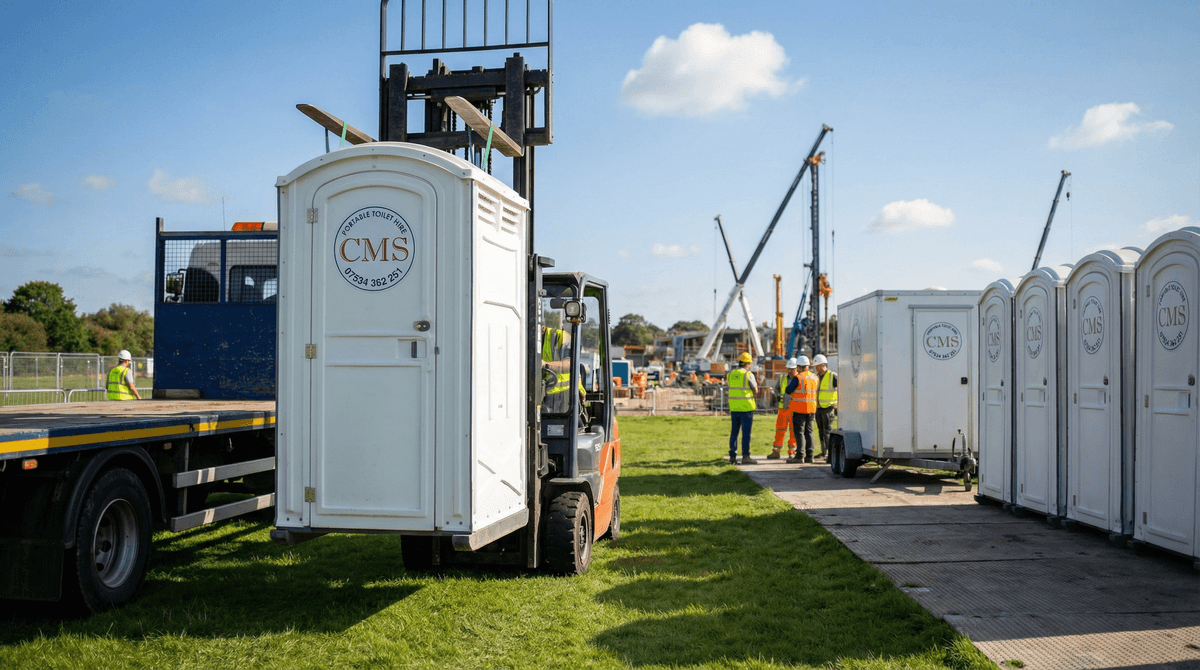
A welfare unit is a self-contained portable building that provides the legally required welfare facilities for workers on construction sites and other temporary workplaces. In plain terms, it is a toilet, a hand-wash basin, a kitchen area, a seating area, and a drying room — all in one unit that can be delivered to your site on the back of a lorry.
If you manage a construction site, a highways project, or any temporary workplace where workers need facilities that do not exist on site, this is the guide for you.
What Does a Welfare Unit Contain?
A standard welfare unit includes the following compartments:
Toilet
A flushing toilet with a hand-wash basin. Some units have a separate toilet compartment for each gender; others have a single unisex toilet. The toilet flushes using fresh water from an onboard tank or a mains connection.
Washing Facilities
A hand-wash basin with hot and cold running water, soap, and paper towels or a hand dryer. Some larger units include a separate shower cubicle.
Canteen / Rest Area
A seating area with a table, chairs or bench seating, a microwave, a kettle, and a small worktop. This provides a space for workers to eat meals and take breaks out of the weather.
Drying Room
A heated space for drying wet clothing and PPE. On many construction sites, workers arrive wet and need to dry their gear during the day. Not all welfare units include a dedicated drying room — check the specification.
Heating
The unit is heated, typically by an electric convector or fan heater. This is a legal requirement — the Workplace (Health, Safety and Welfare) Regulations 1992 specify that rest areas must be maintained at a reasonable temperature.
The Legal Requirements
Site managers often ask what they are legally obliged to provide. The answer comes from two primary pieces of legislation:
Construction (Design and Management) Regulations 2015 (CDM)
Schedule 2 of the CDM Regulations specifies the minimum welfare facilities for construction sites:
- Toilets: At least 1 per 7 workers. Must include hand-washing facilities.
- Washing facilities: With hot and cold (or warm) running water, soap, and towels.
- Drinking water: A supply of wholesome drinking water, clearly marked.
- Rest facilities: A suitable place to rest and eat meals, with a means of boiling water and heating food.
- Changing facilities and storage: Where workers need to change into or out of work clothing.
- Drying facilities: For drying clothing and PPE.
Workplace (Health, Safety and Welfare) Regulations 1992
These apply to all workplaces, including temporary ones. They cover temperature, lighting, cleanliness, space, and the provision of facilities.
What the HSE Inspects
HSE inspectors visiting construction sites routinely check welfare provision. Inadequate facilities are one of the most common findings during site inspections. Enforcement actions range from verbal advice to improvement notices and, in serious cases, prohibition notices that stop work until the problem is resolved.
Getting welfare wrong does not just risk prosecution — it costs you time and money while the site is shut down.
Types of Welfare Unit
Towable Welfare Units
The most common type. A self-contained unit on wheels, towed to site and stabilised with adjustable legs. These range from compact 2-person units to large 12-person configurations.
Advantages:
- No crane required for delivery
- Easily repositioned on site
- Road-legal for towing between sites
- Available in a wide range of sizes
Static Welfare Units
Larger units delivered by lorry and lifted into position by crane or HIAB. These are used on bigger sites with higher headcounts and longer project durations.
Advantages:
- More spacious
- Better-equipped kitchens and rest areas
- Suitable for larger workforces
Anti-Vandal Welfare Units
Steel-clad units designed to resist break-ins and vandalism. Used on sites in areas with a high risk of theft or criminal damage, or on unoccupied sites where the unit is left overnight without security.
Advantages:
- Steel doors and shutters
- Heavy-duty locks
- Resistant to forced entry
Eco / Solar-Powered Welfare Units
Newer units designed to operate off-grid using solar panels and battery storage. These reduce or eliminate the need for a generator, lowering fuel costs and noise levels.
Advantages:
- No generator needed (or reduced generator use)
- Lower running costs
- Quieter operation
- Reduced carbon footprint
What Power Does a Welfare Unit Need?
Most welfare units require a 240V power supply. This can come from:
- Mains electricity: If available on site, this is the simplest and cheapest option. Connect via a temporary supply from the distribution network operator.
- Generator: A diesel generator is the standard alternative. A typical welfare unit requires a 10kVA to 20kVA generator, depending on the unit's specification and heating load.
- Solar/battery: Eco units with integrated solar panels and battery storage. These work well in summer but may need generator backup during short winter days.
Fuel Costs
Generator fuel is a significant ongoing cost. A 10kVA diesel generator running 8 hours per day consumes approximately 15 to 25 litres of fuel per day. At current fuel prices, this adds up. Budget for it and arrange reliable fuel delivery.
What Water Supply Does It Need?
Fresh Water
Welfare units need a supply of clean water for the toilet flush, hand-wash basins, and kitchen sink. This can come from:
- Mains connection: Ideal. A simple hose connection from the site's temporary mains supply.
- Onboard water tank: Most welfare units have a built-in fresh water tank (typically 200 to 500 litres) that is topped up during servicing or by a site operative.
Waste Water
Used water (grey water) and toilet waste are collected in onboard holding tanks. These are emptied during regular servicing — typically weekly. Some units can be connected to mains drainage if available.
Servicing
Welfare units need regular servicing to remain functional and compliant:
- Weekly servicing is standard. This includes emptying waste tanks, replenishing fresh water, cleaning the interior, restocking consumables (toilet roll, soap, paper towels), and checking all equipment (heating, lighting, water heater).
- More frequent servicing may be needed on sites with large workforces or heavy usage.
- Servicing is usually included in the hire rate. Confirm this when booking.
How Many Workers Can a Welfare Unit Support?
This depends on the size of the unit and the number of toilets and washbasins:
| Unit Size | Typical Capacity |
|-----------|-----------------|
| Small (compact/towable) | 4–6 workers |
| Medium | 6–12 workers |
| Large | 12–20 workers |
| Extra-large / linked units | 20+ workers |
For sites with more than 20 workers, you may need multiple units or a large static unit. The toilet ratio (1 per 7 workers) is usually the limiting factor.
Costs
| Item | Typical Cost |
|------|-------------|
| Small welfare unit (weekly hire) | £80–£150 |
| Medium welfare unit (weekly hire) | £120–£200 |
| Large welfare unit (weekly hire) | £180–£300 |
| Delivery and collection | £100–£250 |
| Generator hire (weekly) | £80–£200 |
| Generator fuel (per day) | £20–£50 |
| Servicing | Usually included |
Long-term hires (3 months+) attract lower weekly rates. Negotiate a fixed rate for the project duration.
Choosing a Welfare Unit Provider
What to Look For
- Range of unit sizes. Your workforce may grow or shrink during the project. A provider with a range of sizes can adapt.
- Servicing included in the hire rate. No hidden charges for routine maintenance.
- Waste carrier licence. For the removal and disposal of waste from the unit.
- Delivery and setup. The provider should deliver, position, level, and connect the unit.
- Responsive service. If the heater fails in January or the toilet blocks, you need a rapid response. Ask about response times for emergency call-outs.
- Clean, well-maintained units. Inspect the unit on delivery. If it arrives dirty or poorly maintained, report it immediately.
Questions to Ask
- What is included in the weekly hire rate?
- How often is the unit serviced?
- What power supply does the unit need?
- What is the fresh water tank capacity?
- What is the waste tank capacity?
- What is your emergency call-out response time?
- Can the unit be repositioned during the hire if the site layout changes?
Summary
A welfare unit is a portable, self-contained building that provides the toilet, washing, kitchen, rest, and drying facilities required by law on construction sites. It needs power and water, it needs regular servicing, and it needs to be properly specified for the number of workers on site. Get it right and it is invisible — workers have what they need, the HSE is satisfied, and the site runs smoothly. Get it wrong and you face enforcement action, unhappy workers, and a site manager's worst morning.