
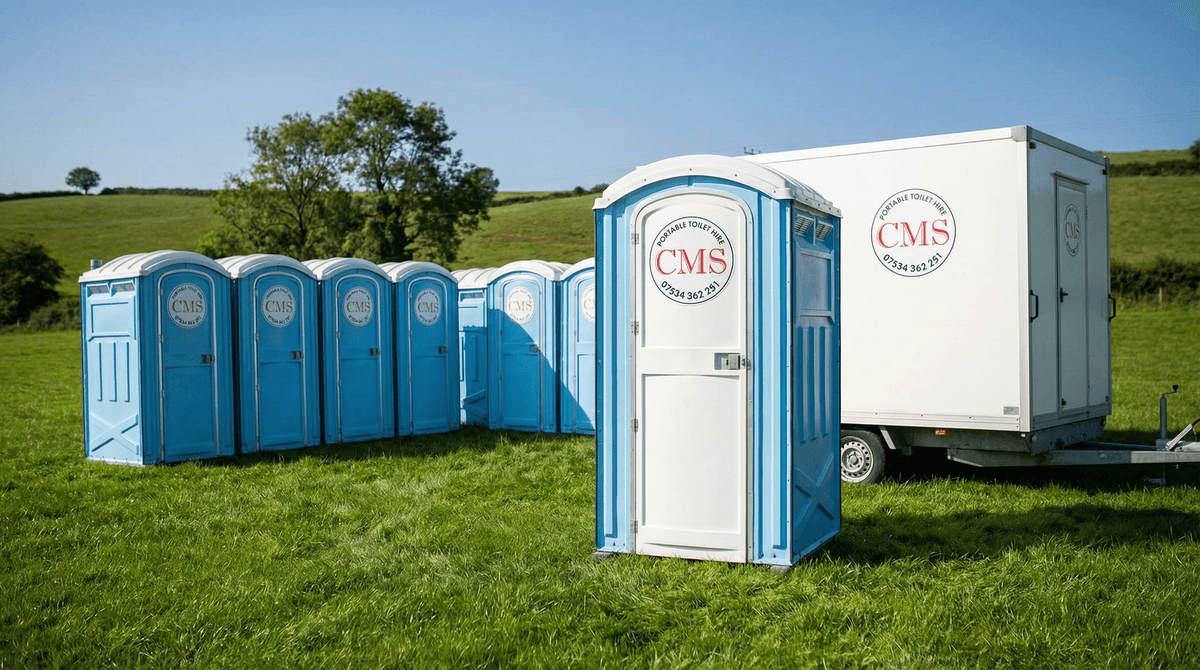
Luxury toilet trailers are a significant step up from standard portable toilets. They offer flushing toilets with running water, vanity units with mirrors and lighting, climate control, and interior finishes that would not look out of place in a smart restaurant. But unlike a standard chemical toilet — which needs no external connections whatsoever — a luxury trailer needs power to function.
Get the power supply wrong and you have a very expensive, very heavy box with no flushing toilets, no running water, no lighting, and no heating. This guide explains exactly what power supply you need and how to provide it.
What Uses Power in a Luxury Toilet Trailer?
Water Heating
The hot water system is the single largest power draw. Luxury trailers provide hot running water to the sinks (and in some units, the toilet flush). This requires a water heater — either an electric immersion heater or an instantaneous (combi-style) water heater.
Typical power draw: 2kW to 6kW depending on the heater type.
Climate Control
Most luxury trailers include heating and many include air conditioning. In winter, the heating system keeps the interior comfortable and prevents pipes from freezing. In summer, air conditioning is what distinguishes a from a standard unit baking in the sun.
Typical power draw:
- Heating: 1kW to 3kW
- Air conditioning: 2kW to 5kW
Lighting
Interior lighting, mirror lights, exterior approach lighting, and sometimes decorative lighting. LED systems are standard on modern trailers, which keeps the draw relatively modest.
Typical power draw: 200W to 500W total.
Water Pump
A mains-pressure water pump supplies water from the onboard tank (or mains connection) to all the taps and cisterns. This runs intermittently.
Typical power draw: 300W to 800W when running.
Extraction Fans
Ventilation fans remove moisture and odour. These run continuously during use.
Typical power draw: 100W to 300W.
Total Power Requirement
Adding these together, a typical luxury toilet trailer requires:
| Component | Minimum | Maximum |
|-----------|---------|---------|
| Water heater | 2,000W | 6,000W |
| Climate control | 1,000W | 5,000W |
| Lighting | 200W | 500W |
| Water pump | 300W | 800W |
| Extraction | 100W | 300W |
| Total | 3,600W | 12,600W |
In practice, not all components run simultaneously at peak draw. A typical operational draw is 5kW to 8kW, with peaks reaching 10kW to 12kW when the water heater and climate control cycle on together.
Power Supply Options
Option 1: Mains Electricity (240V)
The preferred option if available.
If your venue has a mains electricity supply, this is the simplest and most cost-effective power source. You need:
- A dedicated circuit. Do not share the trailer's supply with other equipment. A luxury trailer on a shared circuit will trip the breaker when the water heater cycles on.
- Adequate amperage. Most luxury trailers require a 32A single-phase supply. Larger trailers (8+ cubicles) may require 63A or even a 3-phase supply.
- An appropriate connection. The standard connector is a blue 32A CEE industrial plug (BS EN 60309). Your venue may need to provide this — a standard 13A domestic socket is not sufficient.
- A weatherproof connection. The connection point must be protected from rain. Use IP-rated connectors and keep cable runs off the ground.
- An RCD (residual current device). For electrical safety, the supply must be protected by a 30mA RCD.
Cable runs:
If the mains connection point is some distance from the trailer, you need an appropriately rated extension cable. For a 32A supply, this means an armoured cable or a heavy-duty extension rated for outdoor use. Domestic extension leads are not suitable — they are undersized, not weatherproof, and present a fire and electrocution risk.
Maximum recommended cable run without voltage drop issues: approximately 50 metres with 4mm² cable. For longer runs, use a heavier gauge cable or consult an electrician.
Option 2: Generator
The standard alternative when mains power is unavailable.
A portable diesel generator provides independent power wherever you need it. This is the normal solution for outdoor weddings, field events, and rural venues without mains supply.
Generator sizing:
- For a standard luxury trailer (4 cubicles): 10kVA to 15kVA generator
- For a larger trailer (6 to 8 cubicles): 15kVA to 25kVA generator
- Always allow at least 20% headroom above the trailer's peak demand. A generator running at 100% capacity continuously will overheat and fail.
Fuel consumption:
A 10kVA diesel generator running under moderate load consumes approximately 2 to 4 litres of fuel per hour. Over a 10-hour event day, that is 20 to 40 litres of diesel.
- Budget for fuel and arrange delivery or carry sufficient reserves.
- A full day's fuel for a medium generator costs approximately £30 to £60 at current fuel prices.
Noise:
Generators produce noise. This matters enormously at weddings, corporate events, and any occasion where background noise levels are important.
- Standard open-frame generators: 70 to 85 dB at 7 metres. This is roughly the volume of a busy road. Unacceptable near a wedding reception.
- Super-silent (canopied) generators: 55 to 65 dB at 7 metres. Noticeable but acceptable at moderate distance.
- Position the generator as far from the event as cable length allows. Behind a building, in a service area, or screened by fencing.
- Use a super-silent generator for any event where noise matters. The additional cost is modest compared to the impact of generator drone during speeches or music.
Positioning:
- On firm, level ground
- At least 3 metres from the trailer (for cooling and safety)
- Downwind of the event area (exhaust fumes)
- Accessible for refuelling
- Away from pedestrian routes
- Protected from rain (a canopy or purpose-built housing)
Option 3: Battery / Inverter Systems
Emerging technology, limited current application.
Some luxury trailer operators are beginning to use lithium battery packs with inverters as an alternative to generators. These provide silent, emission-free power.
Current limitations:
- Battery capacity limits runtime. A 10kWh battery pack provides approximately 1 to 2 hours of full-load operation — insufficient for most events.
- Cost is significantly higher than generator hire.
- Recharging between sessions requires mains power or a generator.
This technology is improving rapidly and may become a viable mainstream option in the coming years, but for now, generators remain the practical choice for off-grid events.
Venue Considerations
Questions to Ask Your Venue
- Is there a mains power supply available for the toilet trailer?
- What is the amperage and phase of the available supply?
- What type of connector is fitted (13A domestic, 32A CEE, or other)?
- How far is the connection point from the planned trailer position?
- Are there any restrictions on generator use (noise limits, positioning, operating hours)?
- Is there a dedicated distribution board or consumer unit for temporary connections?
Questions to Ask Your Trailer Provider
- What is the total power requirement of the trailer?
- What connection type do you need (13A, 32A, 63A)?
- Can you supply a generator? If so, is it super-silent?
- What is the maximum cable run from the power source to the trailer?
- Do you provide the connection cables or do I need to supply them?
- What happens if the power fails during the event?
Common Mistakes
Using a domestic extension lead
A 13A domestic extension lead cannot safely carry the load required by a luxury trailer. It will overheat, trip the fuse, or — in the worst case — catch fire. Use appropriately rated cables with industrial connectors.
Undersized generator
A generator that is too small will struggle under peak load, causing voltage drops that damage the trailer's electrical components. It may trip, shut down, or simply fail. Always size the generator with 20% headroom.
Generator too close to the event
Noise and exhaust fumes. Position the generator as far as the cable run allows, screened from the event area.
No fuel plan
Running out of fuel mid-event shuts down the entire trailer. Calculate consumption, carry reserves, and have a refuelling plan.
No backup plan
Power failures happen. Have a contingency — a backup generator, a rapid-response agreement with the generator hire company, or standard chemical toilets on standby.
Summary
A luxury toilet trailer needs a reliable power supply of approximately 5kW to 12kW. Mains electricity is the first choice; a correctly sized, super-silent diesel generator is the standard alternative. Do not undersize the supply, do not use domestic extension leads, and do not position the generator where it will be heard or smelled. Get the power right and the trailer performs flawlessly. Get it wrong and you have a very expensive problem at the worst possible moment.