
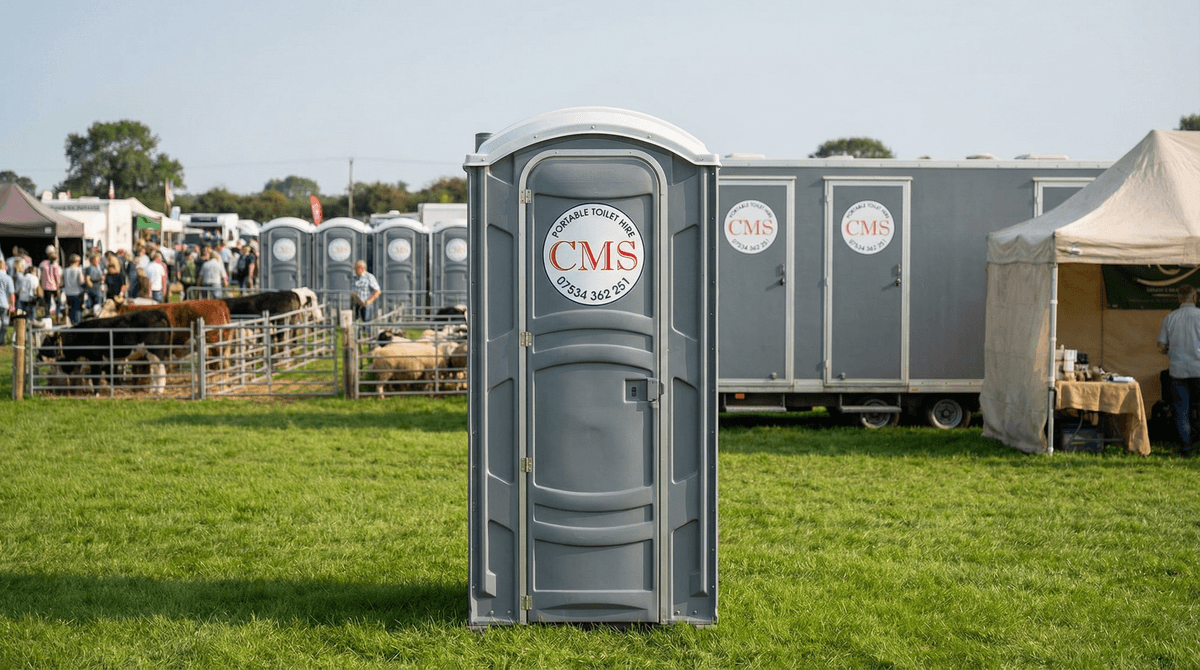
A shower trailer without adequate power and water is an empty metal box. Unlike portable toilets — which are entirely self-contained — depend on external infrastructure to function. Get the power and water supply wrong and you have cold water (or no water), failed boilers, and very unhappy event attendees.
This guide provides the technical detail you need to plan the power and water supply for a shower trailer hire.
Water Supply Requirements
How Much Water Does a Shower Trailer Use?
Each shower uses approximately 30 to 50 litres of water. The exact figure depends on:
- Shower duration. A quick rinse uses 20 to 30 litres. A longer shower uses 40 to 50 litres.
- Shower head flow rate. Standard flow rates are 8 to 12 litres per minute. Eco shower heads reduce this to 6 to 8 litres per minute.
- Water pressure. Higher pressure increases flow and therefore consumption.
Calculating Total Water Demand
Multiply the expected number of showers per day by the average consumption per shower.
Example: Scout camp, 60 participants, 5 days
- 60 showers per day x 40 litres = 2,400 litres per day
- Over 5 days: 12,000 litres total
Example: Music festival, 3,000 campers, 3 days, 30% showering daily
- 900 showers per day x 40 litres = 36,000 litres per day
- Over 3 days: 108,000 litres total
These are substantial volumes. Plan accordingly.
Water Supply Options
#### Mains Water
The ideal solution. Connect the shower trailer to the site's mains water supply via a standard hose connection.
Requirements:
- Flow rate: Most shower trailers need a minimum flow rate of 15 to 20 litres per minute. Check with your provider for the specific requirement.
- Pressure: Minimum 1.5 to 2.0 bar. Low-pressure supplies may need a booster pump.
- Connection type: Standard ¾-inch or 1-inch BSP hose fitting. The provider typically supplies the connection hardware.
- Metered supply: If you are paying for metered water, budget for the consumption. At current water rates, 10,000 litres costs approximately £15 to £30 depending on your water company.
#### Water Bowser (Static Tank)
If mains water is unavailable — common at rural events, festival sites, and remote locations — a water bowser provides a static supply.
Bowser sizes:
- 1,000 litres (IBC — Intermediate Bulk Container): Inexpensive, easy to deliver, but needs frequent refilling. Suitable for very small events only.
- 2,500 to 5,000 litres: Suitable for small to medium events (up to 50 showers per day).
- 10,000 litres: Suitable for medium events (up to 250 showers per day).
- 20,000+ litres: For large events. May require multiple bowsers or tanker deliveries.
Pump requirement: A bowser does not have mains pressure. You need a pump to supply water to the shower trailer at the required flow rate and pressure. Some trailers have an onboard pump; others require an external pump.
Refilling: Bowsers need refilling. Arrange tanker deliveries on a schedule that ensures you never run dry. Running out of water mid-event is a failure of planning, not bad luck.
#### Borehole or Natural Source
Some event sites have borehole water supplies. These can work well if:
- The yield (litres per hour) is sufficient for the demand
- The water quality is adequate (filtration may be needed)
- You hold an abstraction licence from the Environment Agency (if required for the volume)
Natural water sources (rivers, streams) require an abstraction licence and treatment. This is rarely practical for short-term events.
Water Quality
Shower water does not need to be drinking-water quality, but it should be clean and free from visible contamination. If using a bowser, ensure the tank is food-grade and has been cleaned before filling. If using a borehole, test the water before the event.
Power Supply Requirements
What Uses Power in a Shower Trailer?
| Component | Power Draw |
|-----------|-----------|
| Water heater (boiler) | 6kW–24kW |
| Water pump | 300W–800W |
| Lighting | 200W–500W |
| Extraction fans | 100W–300W |
| Total (4-cubicle trailer) | 8kW–15kW |
| Total (8-cubicle trailer) | 15kW–30kW |
The water heater is by far the dominant load. It runs continuously or cycles on and off to maintain the hot water temperature.
Power Supply Options
#### Mains Electricity
The preferred option if available. Shower trailers typically require:
- 4-cubicle trailer: 32A single-phase (240V) supply
- 6-cubicle trailer: 63A single-phase or 32A three-phase supply
- 8-cubicle trailer: 63A three-phase supply
Connection requirements:
- Dedicated circuit (not shared with other equipment)
- Blue CEE industrial connector (BS EN 60309)
- RCD protection (30mA)
- Weatherproof connection point
- Cable run kept as short as practical (voltage drop over long runs reduces performance)
#### Generator
The standard alternative for sites without mains power.
Generator sizing:
| Trailer Size | Minimum Generator Size | Recommended Size |
|-------------|----------------------|-----------------|
| 3-4 cubicles | 15kVA | 20kVA |
| 5-6 cubicles | 25kVA | 30kVA |
| 7-8 cubicles | 35kVA | 40kVA |
Always size the generator at least 20% above the trailer's peak demand. A generator running at full capacity will overheat and fail.
Fuel consumption:
- 15kVA generator: approximately 3 to 5 litres per hour
- 30kVA generator: approximately 6 to 10 litres per hour
- Over a 12-hour operating day, a 20kVA generator consumes approximately 50 to 70 litres of diesel
Fuel budget: For a 5-day event, a single 20kVA generator uses approximately 250 to 350 litres of diesel. At current prices, that is £350 to £550. This is a significant cost — include it in your budget from the outset.
Noise: Super-silent (canopied) generators are recommended for events. Standard open-frame generators produce 70 to 85 dB — equivalent to a busy road — which is unacceptable near camping areas.
Positioning:
- Minimum 3 metres from the shower trailer
- Downwind of the accommodation and event areas
- On firm, level ground
- Accessible for refuelling
- Protected from rain
- Screened from view where practical
#### Gas-Heated Trailers
Some shower trailers use LPG (gas) water heaters rather than electric. These dramatically reduce the electrical load — the power supply only needs to run the pump, lights, and fans.
Advantages:
- Much smaller generator required (5kVA to 10kVA vs 20kVA to 40kVA)
- Lower fuel costs
- Quieter operation
Considerations:
- LPG bottles need replacing during longer events
- Gas connections must be installed by a Gas Safe registered engineer
- Gas safety certification may be required
Ask your shower trailer provider whether they offer gas-heated units. For events where power supply is limited or generator noise is a concern, gas heating is an excellent alternative.
Drainage: The Third Requirement
Grey water (used shower water) is the third infrastructure requirement.
Volume
The grey water volume equals the water consumption — approximately 30 to 50 litres per shower. At a busy event with 500 showers per day, that is 15,000 to 25,000 litres of grey water daily.
Drainage Options
- Mains drainage: Connect to a site drain. Ideal but not always available.
- Holding tank: Onboard or external grey water tanks collected by tanker. Tank sizes range from 500 to 5,000 litres. Arrange emptying before they fill.
- Soakaway: A prepared soakaway (a gravel-filled pit) can absorb grey water. Check with the landowner and Environment Agency. Not suitable for large volumes.
- Surface discharge: Generally not acceptable without treatment. Grey water contains soap, shampoo, and body matter. Do not allow it to run into watercourses.
Infrastructure Checklist
Before booking a shower trailer, confirm the following:
Water
- [ ] Source identified (mains, bowser, borehole)
- [ ] Flow rate adequate (15–20 litres per minute minimum)
- [ ] Pressure adequate (1.5–2.0 bar minimum) or booster pump arranged
- [ ] Total volume calculated and supply arranged for the full event duration
- [ ] Connection hardware confirmed with the provider
- [ ] Refill schedule arranged (for bowsers)
Power
- [ ] Source identified (mains, generator, gas heating)
- [ ] Amperage and phase confirmed with the provider
- [ ] Generator sized with 20% headroom (if applicable)
- [ ] Fuel supply arranged for the full event duration
- [ ] Connection cables confirmed (provider-supplied or venue-supplied)
- [ ] RCD protection in place
Drainage
- [ ] Grey water disposal method confirmed
- [ ] Holding tank capacity adequate, or emptying schedule arranged
- [ ] No discharge to watercourses without treatment
- [ ] Soakaway approved by landowner and Environment Agency (if applicable)
Common Mistakes
- Insufficient water supply. The most common failure. Calculate the total volume needed and confirm the supply before booking.
- Undersized generator. A generator running at capacity will overheat and shut down. Size with headroom.
- No fuel plan. Running out of diesel mid-event stops everything. Calculate consumption and arrange delivery.
- Ignoring grey water. It has to go somewhere. A shower trailer producing 10,000 litres of grey water per day cannot just drain onto the ground.
- Long cable runs without voltage drop calculation. Voltage drops over long cable runs reduce the power available at the trailer, causing the boiler to underperform.
- Sharing power with other equipment. The shower trailer should have its own dedicated circuit.
Summary
A shower trailer needs three things: water, power, and drainage. Get all three right and the trailer provides reliable hot showers for the duration of your event. Get any one of them wrong and the system fails. Calculate your water volume, size your power supply with headroom, plan your drainage, and budget for fuel. The infrastructure planning takes more effort than booking the trailer itself, but it is the difference between a facility that works and one that does not.