
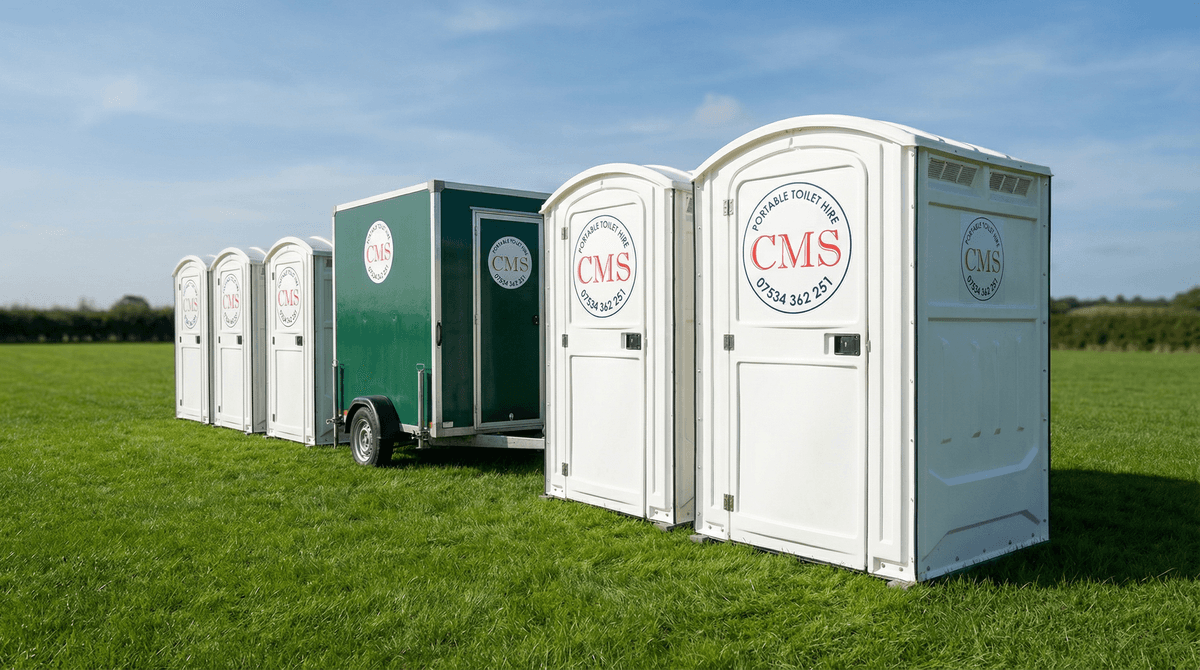
The position of your portable toilets can make or break the guest experience. Too close to the dining area and the visual impact is off-putting. Too far away and guests cannot find them, or worse, they avoid the walk and find alternatives.
Getting the positioning right requires working closely with your venue manager and thinking through a few practical considerations.
The basic principles of toilet positioning
Away from food areas but not too far from guests
The guideline is simple: far enough from food preparation and dining that there is no visual or olfactory connection, but close enough to the main gathering area that guests can reach them within a reasonable walk — ideally under two minutes.
For most venues, this means positioning behind a building, around a corner, or beyond a hedge rather than on the opposite side of the site.
Level ground
Portable toilets and luxury trailers must sit on level ground. Even a slight slope makes the unit uncomfortable to use and can cause the door to swing open or shut unexpectedly. If the only available ground has a slope, boards or packing can level the unit.
Luxury trailers are less tolerant of uneven ground than individual portable toilets. The trailer has a longer footprint and will rock or lean if the ground is not reasonably flat.
Vehicle access for delivery
The delivery vehicle needs to reach the positioning point — or get close enough for the unit to be carried the remaining distance. Standard portable toilets can be moved by hand over short distances (10 to 20 metres on flat ground). Luxury trailers must be towed to their final position.
Consider the delivery route when choosing a position. Is there a gate wide enough for the vehicle? Are there overhanging trees? Is the surface firm enough to support the vehicle's weight?
Screened from the main event area
Guests prefer not to see the toilets from the dance floor or the dining area. Natural screening is ideal — hedges, walls, fences, or buildings between the main area and the facilities. Where natural screening is not available, temporary fencing, hessian screens, or planting can provide a visual barrier.
The goal is not to hide the toilets entirely — guests need to find them — but to remove them from the immediate visual field of the main event.
Well-lit paths
If your event continues into the evening, the path to the toilets must be lit. Guests walking across an unlit field to reach portable toilets is a safety hazard and a frequent source of complaints.
Options include festoon lighting along the path, solar-powered stake lights, battery-operated lanterns, or temporary floodlighting. The path should be lit from the main area all the way to the toilet entrance.
Signage
Clear, visible signs directing guests to the facilities prevent confusion and reduce the number of guests asking staff for directions. Position signs at decision points — where paths fork, at the exit from the main area, and near the facilities themselves.
For evening events, illuminated or reflective signs are more effective than printed paper.
Downwind considerations
This is often overlooked. In warm weather, chemical toilets can produce odour, particularly toward the end of a long event. Positioning the units downwind of the main gathering area means any odour is carried away from guests rather than toward them.
Check the prevailing wind direction for your venue — in the UK, the prevailing wind is from the southwest. Positioning toilets to the northeast of the main event area takes advantage of this.
Working with venue managers
Experienced venue managers have hosted many events and know what works at their site. Before your event:
- Ask the venue manager for their recommended toilet positioning areas
- Conduct a joint site visit with the venue manager and your hire company
- Walk the route from the main event area to the proposed toilet position
- Check for any venue restrictions — some venues prohibit vehicles on certain areas or restrict where temporary structures can be placed
- Agree vehicle access routes and timings for delivery and collection
Mapping out positions in advance
Create a simple site map showing the proposed toilet positions, the walking routes, lighting, signage, and vehicle access. Share this with the venue manager and your hire company before the event.
This avoids confusion on delivery day and ensures everyone agrees on the plan. It also forms part of your event safety documentation and can be submitted with your event licence application if required.
Free site visits from Chelford Mobile Services
We offer free site visits for events across Cheshire, Shropshire, Staffordshire, and Greater Manchester. We will walk the venue with you, recommend positions, check vehicle access, and agree the logistics. There is no obligation.
Call us on 07534 362 251 to arrange a site visit before your event.