The question that matters most — and the one most people get wrong
The decision between buying and hiring a portable toilet looks like a straightforward financial comparison. A new unit costs six hundred to nine hundred pounds. Hiring costs forty-five to sixty pounds per week. By week fifteen or twenty, the cumulative hire cost exceeds the purchase price. After that, buying looks cheaper every week.
The maths is correct. The conclusion is wrong — for most people. Because the purchase price is the beginning of the cost of ownership, not the end of it.
Purchase costs: the upfront numbers
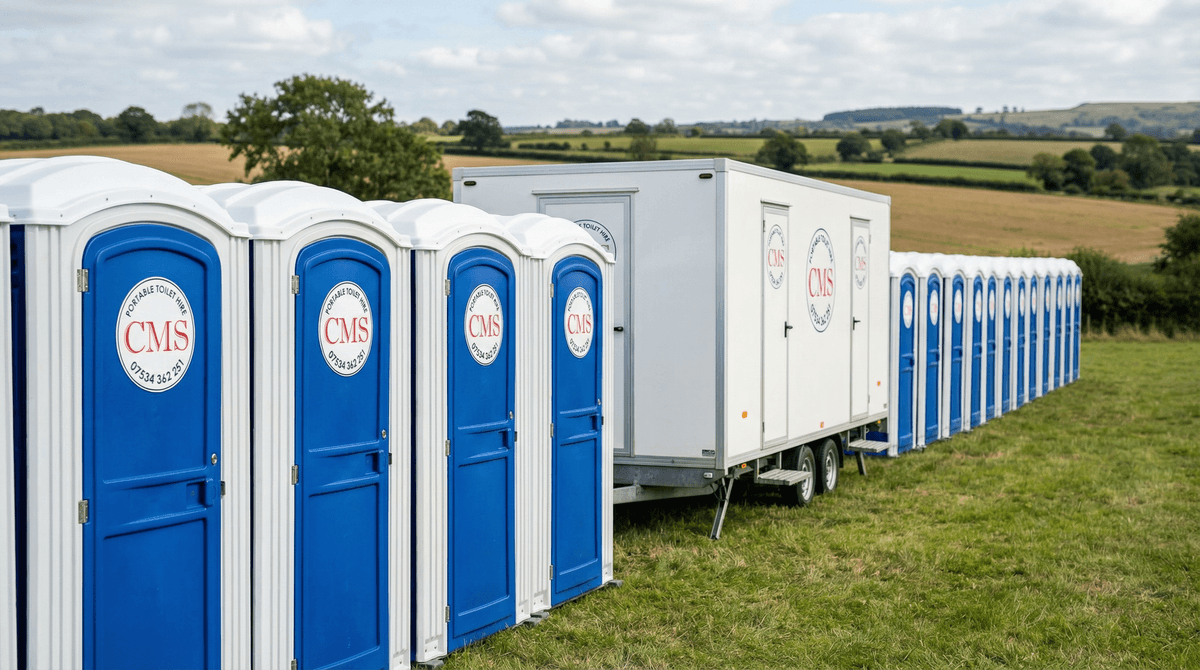
A new standard portable toilet — the type used on construction sites, at events, and for domestic projects — costs approximately:
- New, from a manufacturer or distributor: £600 to £900
- Second-hand, in good condition: £300 to £500
- Ex-hire fleet units (cosmetically worn but functional): £200 to £400
These prices get you the unit itself: the cabin, the door, the seat, the tank, and the fittings. They do not get you a functioning toilet facility. That requires consumables, chemical treatment, servicing, waste disposal, storage, transport, and maintenance — all of which are additional, ongoing costs.
Hire costs: what you actually pay
At a typical hire rate of forty-five to sixty pounds per week including servicing, a year's continuous hire costs approximately two thousand three hundred to three thousand one hundred pounds. That is significantly more than the purchase price of a new unit.
But the hire cost is all-inclusive. It covers:
- The unit itself
- Delivery to your site
- Weekly servicing — waste removal, cleaning, restocking, chemical treatment
- All consumables — toilet paper, hand sanitiser, hand wash, tank chemicals
- Mechanical maintenance and repairs
- Documented service records
- Collection at the end of the hire
- Replacement of the unit if it deteriorates beyond acceptable condition
The hire price is the total cost. There is nothing else to budget for.
The break-even calculation — and why it misleads
On pure purchase price versus cumulative hire cost, buying breaks even at around fifteen to twenty weeks. After that point, every additional week of hire represents money that you would not have spent had you bought the unit outright.
This is the calculation that convinces some people to buy. And for a small number of use cases, it is the right decision. But the calculation is misleading because it compares the purchase price (a partial cost) with the hire price (a complete cost).
The hidden costs of ownership
Servicing
A portable toilet needs emptying, cleaning, and restocking regularly — typically weekly for a unit in regular use. You have two options:
Do it yourself: You need a way to empty the waste tank (a portable pump or manual emptying), somewhere legal to dispose of the waste (not a drain, not a ditch, not the nearest field), cleaning chemicals, consumables, and the time to do it every week.
Disposing of sewage waste requires a waste carrier licence. Transporting it in an unlicensed vehicle or disposing of it to an unlicensed facility is a criminal offence under environmental regulations. The Environment Agency enforces this, and the penalties are not trivial.
Pay someone else: A professional waste disposal service will empty and clean the unit. The cost varies by location and frequency but is typically thirty to fifty pounds per visit. At weekly frequency, that is one hundred and twenty to two hundred pounds per month — which, combined with the consumable costs, quickly approaches the hire rate from a professional company.
Storage
When the unit is not in use, it needs to be stored. A standard portable toilet is approximately 1.2 metres by 1.2 metres by 2.3 metres tall. It does not fold, it does not disassemble, and it does not fit in a domestic garage alongside a car.
You need yard space, a storage facility, or a corner of a field. Wherever it is stored, it is exposed to weather, potential vandalism, and gradual deterioration. Covered storage in a commercial facility costs money. Open-air storage is free but accelerates wear.
Transport
Moving the unit between sites — or from storage to the site and back — requires a vehicle capable of carrying a seventy-five-kilogram, 2.3-metre-tall object. A large van works. A flatbed trailer with appropriate securing points works. A hatchback does not.
If you do not already own a suitable vehicle, the transport cost for each deployment needs to be factored in. Even if you do, the time and fuel for each move are real costs.
Maintenance
Portable toilets are robust, but they are not maintenance-free. Over time:
- Door locks wear and fail
- Hinges develop play and sag
- Vent panels crack or detach
- The polyethylene body becomes UV-damaged and brittle at the edges
- The flush mechanism may need repair or replacement
- Tank seals can deteriorate and leak
None of these are expensive individually, but collectively they represent an ongoing maintenance commitment that ownership requires.
Consumables
Toilet paper, hand sanitiser, hand wash, and tank chemical all need purchasing, storing, and replenishing. The cost is modest per unit but cumulates over months of use.
When buying makes sense
For a specific set of circumstances, purchasing is the better option:
- You own a farm or rural property and need a permanent facility in a yard, field, or compound — where it will stay in one place for years and you have the means and willingness to service it regularly
- You run a construction or plant hire business and deploy toilets continuously across your own sites — where the volume of use justifies owning a small fleet and you already hold the necessary waste carrier licences
- You manage an allotment, community garden, or outdoor facility and need a permanent seasonal facility — where the unit is in one location, community members share the maintenance responsibility, and the usage pattern is predictable
In these cases, the long-term economics favour ownership, and the servicing burden is manageable within existing operations.
When hiring makes sense
For everyone else — which is the vast majority of people who need a portable toilet — hiring is the better option:
- You need a toilet for a defined period: A project, an event, a season, a renovation. The need has a start date and an end date.
- You do not want to deal with waste disposal: The legal requirements, the licensing, the logistics — all handled by the hire company.
- You want a clean, well-maintained unit: Professional servicing delivers a higher standard of cleanliness and maintenance than most owners achieve on their own.
- You have no suitable storage: When the hire ends, we collect. You do not need to find somewhere to put a 2.3-metre plastic cabin.
- You value flexibility: Need an extra unit? We deliver one. Need to extend the hire? It extends. Need to end early? We collect. Ownership offers none of this flexibility.
Our honest assessment
For most people considering this question, hiring is the practical, cost-effective, and lower-hassle option. The servicing obligations, waste disposal requirements, storage needs, and maintenance demands of ownership are hidden costs that the purchase price alone does not reveal.
Hiring gives you a clean, professionally serviced unit, complete with consumables and documented maintenance, for a known weekly cost. When you are done, we take it away.
Chelford Mobile Services provides portable toilet hire across Cheshire, Shropshire, Staffordshire, and Greater Manchester. Call 07534 362 251 for a quote.