
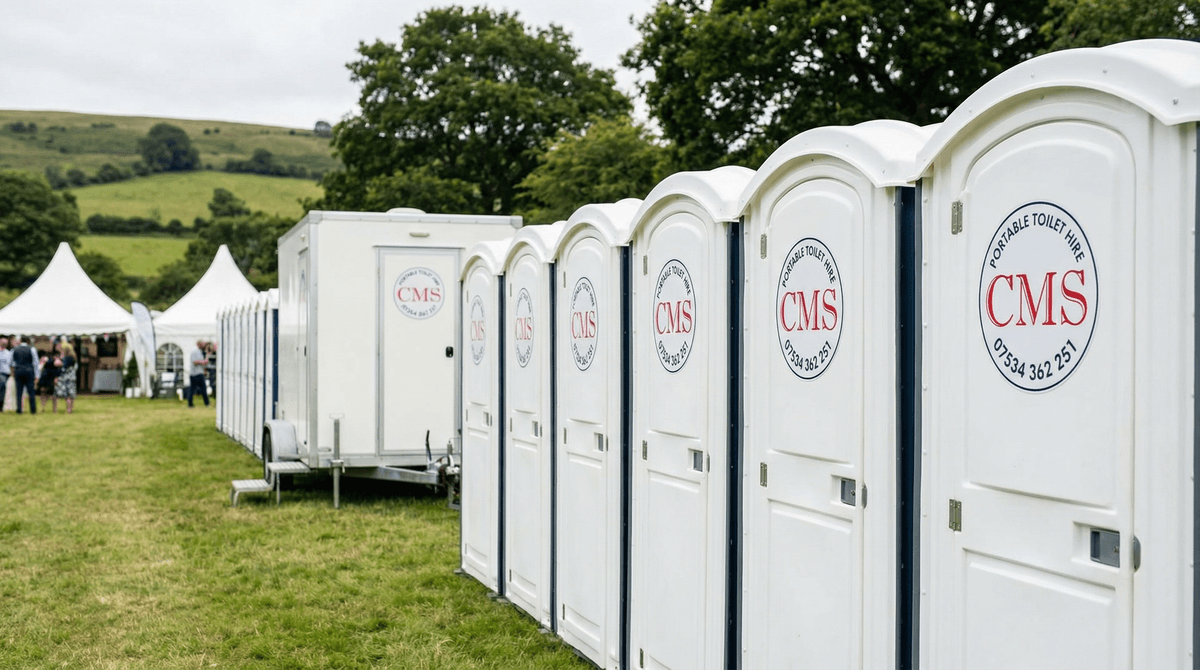
Large-scale events require large-scale thinking
Once your event crosses the one-thousand-guest threshold, toilet provision stops being a line item on a checklist and becomes a genuine logistics operation. The numbers are larger, the consequences of miscalculation are more visible, and the planning needs to start considerably earlier than most organisers realise.
At this scale, the question is no longer simply how many toilets. It is where they go, how they are serviced during the event, how they are coordinated with the wider event infrastructure, and what your contingency plan looks like when things go wrong.
Chelford Mobile Services has provided sanitation for events with over one million guests. This guide shares what works at scale.
The scaling formula
The baseline ratios remain the foundation, but at one thousand guests and above, you need to think in terms of zones and distribution rather than raw totals.
Starting ratios
- Standard events with alcohol (4-8 hours): 1 toilet per 75 guests
- Heavy drinking events (8+ hours): 1 toilet per 50 guests
- Urinal blocks: 1 block per 300 to 400 male guests
- Accessible provision: Minimum 1 unit per 500 guests, or 5 percent of total provision
Worked numbers by event size
1,000-guest event with alcohol, 8+ hours:
- 13 to 15 standard portable toilets
- 2 to 3 urinal blocks (six-position)
- 2 accessible units
- Optional: luxury trailer for VIP or backstage area
2,000-guest event:
- 25 to 30 standard portable toilets
- 4 to 6 urinal blocks
- 3 to 4 accessible units
- Distribution across at least 4 zones
5,000-guest event:
- 65 to 75 standard portable toilets
- 10 to 15 urinal blocks
- 8 to 10 accessible units
- Distribution across 6 to 8 zones
- Multiple luxury trailers if the event warrants it
These numbers scale proportionally, but the logistics do not — they scale exponentially. Delivering, positioning, and servicing seventy toilets across eight zones requires planning that a seven-toilet event does not.
Why distribution matters more than total numbers
At one thousand guests and above, having the correct total number of units is necessary but nowhere near sufficient. Where you position them determines whether the provision actually works or whether half the units sit empty while the other half have twenty-minute queues.
The principle is simple: put toilets where people gather. In practice, this means:
Near every bar and food service area
This is where demand peaks. Alcohol consumption is the single biggest driver of toilet usage, and the demand spike occurs fifteen to thirty minutes after drinks are served. Position the densest cluster of units — including urinal blocks — within sixty seconds' walk of every major bar.
Near every stage or activity area
Audiences use toilets during breaks between acts. The gap between a headline act finishing and the next one starting creates a predictable surge of demand at the nearest facilities. Position a cluster of units within easy reach of each stage.
At entrance and exit points
Guests use toilets on arrival (especially after a journey) and before leaving. A cluster near the main entrance and exit captures this demand without requiring guests to walk deep into the venue.
In camping areas for multi-day events
Overnight guests need toilet access without walking to the main event area in the dark. Dedicated provision in or adjacent to camping zones is essential for multi-day events.
The cluster principle
Distribute units in clusters of three to five rather than one large bank. Each cluster should include a mix of standard units and at least one urinal block. This approach:
- Reduces maximum queue length at any single location
- Provides redundancy — if one unit goes out of service, the cluster still functions
- Matches provision to the natural gathering points across the venue
Logistics of delivery and positioning
Delivering fifteen to thirty or more toilet units to a single venue is a significant logistical operation that needs advance planning.
Vehicle access
Our delivery vehicles carry multiple units per load. The vehicles are substantial — equivalent to a large lorry — and they need clear, unobstructed routes to each positioning point across the venue. Confirm access routes in advance and ensure they remain clear on delivery day.
Ground conditions
Heavy vehicles carrying multiple units can damage soft ground, particularly after rain. If the venue is a field or parkland, consider the ground conditions and — if necessary — lay temporary trackway or identify hard-standing routes for delivery vehicles.
Timing
Allow a full day for delivery and positioning at large events. Attempting to squeeze thirty-plus unit deliveries into the morning before gates open creates unnecessary pressure and risks delays that cascade into the event start.
For multi-zone events, we work from a site plan showing each cluster position. Providing coordinates, reference points, or a marked-up plan in advance means the delivery team can work efficiently without searching for positions.
Phased delivery for multi-day events
For festivals and events where the site builds up over several days:
- Phase 1: Construction and build crew welfare — portable toilets for the setup team, positioned at the build compound
- Phase 2: Main event provision — positioned once the site layout is confirmed and the infrastructure is in place
- Phase 3: Additional units if required — added if ticket sales exceed initial projections or if usage patterns during early days reveal under-served areas
Phased delivery avoids expensive units sitting unused on site during the build days.
Servicing during events
Single-day events (1,000+ guests)
If the provision is correctly sized for a single-day event, mid-event servicing is usually unnecessary for events under twelve hours. The units arrive fully prepared with sufficient capacity for the full event.
However, for events at the larger end (3,000+ guests over a full day), consider a mid-event service during a lull in activity — typically mid-afternoon before the evening peak.
Multi-day events
Daily servicing is essential. Our service team attends during quiet hours — typically early morning before the day's activities begin — and services every unit on site:
- Emptying waste tanks
- Cleaning all units thoroughly
- Restocking consumables
- Reporting any damage, vandalism, or maintenance issues
- Adjusting provision if usage patterns reveal under-served areas (moving units from low-use to high-use zones)
For large multi-day events, we assign a dedicated service crew who become familiar with the site, the positioning, and the specific demands of the event.
Coordinating with event management
At the one-thousand-guest scale and above, toilet provision is a component of the wider event infrastructure and needs coordination accordingly.
Licensing requirements
Local authority licensing may specify minimum toilet provision as a condition of your event licence. The numbers they specify are sometimes conservative — based on industry standards that may not account for the specific characteristics of your event. Discuss the licensing requirements with us and we will advise on whether the specified numbers are adequate or whether additional provision is needed.
Health and safety plans
Your event health and safety plan should include:
- Total toilet provision (units, urinals, accessible units, luxury trailers)
- Cluster locations marked on a site plan
- Servicing schedule for multi-day events
- Contingency plan for unit failure, damage, or unexpected demand
- Contact details for our team in case of issues during the event
Event control coordination
Event control — your operations team, stewards, security — should know the location of every toilet cluster and have a direct contact number for us in case of problems during the event. A blocked toilet, a vandalised unit, or a cluster that is overwhelmed by unexpected demand needs a rapid response.
Contingency planning
At scale, problems will happen. Units can be damaged by guests, vandalised during evening events, knocked over, or blocked by foreign objects. The question is not whether something will go wrong, but how quickly you can respond when it does.
Spare units
Include one or two spare units in the provision — positioned but not signposted. If a unit in a critical cluster goes out of service, the spare can be brought into use within minutes.
Rapid response
We provide a contact number that is monitored during events. If a unit goes out of service, call us and we will respond — either by servicing the problem unit, bringing a spare into service, or deploying a replacement.
Post-event
After the event, all units are serviced and removed from the site. For venues with specific grounds management requirements, we coordinate removal timing to minimise ground damage and disruption.
Planning timeline
- Six months before: Confirm the total provision, agree the unit mix, and reserve availability. Peak season weekends book up well in advance.
- Three months before: Share the site plan with cluster positions. Confirm access routes and delivery timing.
- One month before: Final confirmation of numbers, servicing schedule, and logistics. Add or reduce units based on updated ticket sales.
- One week before: Final briefing with the delivery team. Confirm any last-minute changes.
Get in touch early
Large-scale event provision requires early planning. The logistics, the fleet commitment, and the coordination all benefit from time.
Call Chelford Mobile Services on 07534 362 251 as early as possible in your planning process. We cover events across Cheshire, Shropshire, Staffordshire, and Greater Manchester and can handle events of any scale.