
What Happens on Delivery Day
You have booked a portable toilet. The date is confirmed. Now what? If you have never had a portable toilet delivered before, you might not know what to expect — and a few minutes of preparation makes the whole process smoother for everyone.
This guide covers what happens before, during, and after delivery, and what you need to do to ensure the unit arrives, gets positioned, and is ready to use without any fuss.
Before Delivery Day
Confirm the delivery details
A day or two before the scheduled delivery, confirm the following with your hire company:
- Delivery date: The specific day the unit will arrive
- Delivery window: The approximate time range — most companies give a morning or afternoon window rather than an exact time
- Contact number: A mobile number for someone who will be available on delivery day to answer calls from the driver
- Site address: Confirm the full address and postcode, especially if the site is rural or hard to find on sat nav
- Any specific instructions: Gate codes, key collection points, access restrictions, or special directions
If you need the unit for a specific time — for example, it must be in place before 9am for workers arriving on site — make this clear when you book, not the day before.
Prepare the site
Before the delivery vehicle arrives:
- Clear the access route: Ensure the path from the road to the placement area is free from parked vehicles, stored materials, or other obstacles. The delivery vehicle needs approximately 2.5 metres width and 3.5 metres height clearance.
- Unlock gates: If the site has locked gates, ensure they are open or that the driver has the code or key.
- Prepare the placement area: The ground where the unit will sit should be firm, level, and accessible. Clear any debris, fill any potholes, and check that the surface will support the unit's weight (approximately 80 to 100kg empty, more when in use).
- Mark the position: If you have a specific location in mind, mark it with a cone, stake, or spray paint. This saves time and prevents the driver from having to guess.
Designate a contact person
Someone needs to be available — either on site or by phone — during the delivery window. The driver may need to confirm the placement position, discuss access options, or report an issue. If nobody is available and the driver cannot reach anyone, the delivery may need to be rescheduled.
What Arrives
The unit
A standard portable toilet arrives clean, serviced, and ready to use. The unit has been prepared at the depot — pressure-washed externally, cleaned and sanitised internally, stocked with toilet paper and hand sanitiser, and charged with fresh chemical in the waste tank.
When it arrives, the unit should be:
- Clean inside and out
- Free from damage (no cracks, dents, or broken components)
- Fully stocked with toilet paper and hand sanitiser
- Equipped with a functioning door lock and occupied/vacant indicator
- Properly ventilated (vent pipe intact, low-level vents clear)
The delivery vehicle
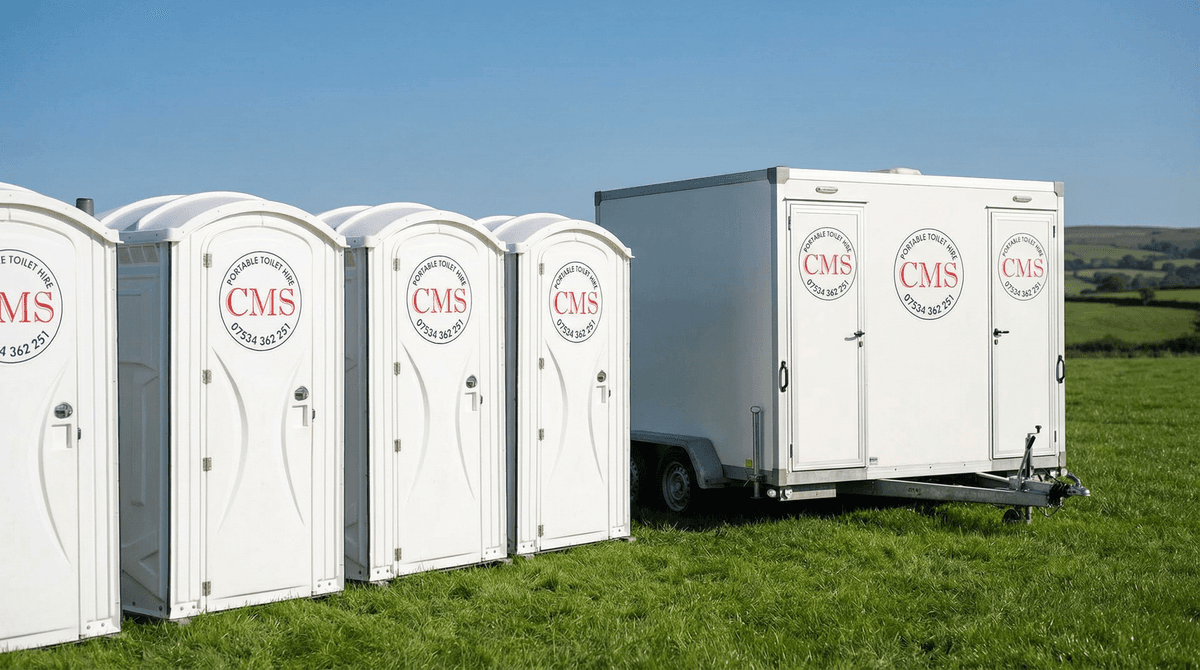
Portable toilets are delivered on flatbed trucks, trailers, or vans depending on the unit size and the hire company's fleet. The driver will position the vehicle as close to the placement area as access allows.
Standard portable toilets are typically moved from the vehicle to the placement position by hand — either rolled on a sack truck or carried. This is practical for distances up to about 30 metres. For longer distances, mechanical handling may be needed, which takes more time and may incur additional charges.
Toilet blocks and luxury trailers are delivered on larger vehicles with cranes (Hiab-equipped lorries) or towed directly to the position. These deliveries require more space and firmer ground.
During Delivery
Placement
The driver will position the unit in the location you have specified. If you are on site, direct them. If you are not on site, the driver will use any instructions you have provided or choose the most practical position near the access point.
The driver will ensure:
- The unit is on firm, level ground
- The door opens and closes freely without obstruction
- The unit is stable and will not rock or shift
- The vent pipe is upright and unobstructed
- The unit is accessible for users and for future servicing
If the ground is not ideal — too soft, too sloped, or obstructed — the driver will discuss alternatives with you. They may suggest an alternative position, recommend boards under the unit, or advise on ground preparation.
Inspection
When the unit is in position, check it. This takes two minutes and prevents problems later:
1. Open the door — does the lock work smoothly? Does the occupied/vacant indicator function?
2. Step inside — is it clean? Does it smell clean (fresh chemical, no odour)?
3. Check the toilet paper and hand sanitiser — are they full?
4. Check the toilet seat — clean, undamaged, properly attached?
5. Look up — is the translucent roof panel intact? Is there natural light?
6. Check the floor — clean, non-slip, no damage?
If anything is not right, tell the driver before they leave. Most issues can be resolved on the spot — a replacement unit, additional consumables, a repositioning. Discovering a problem after the driver has left means waiting for a return visit.
Paperwork
The driver may ask you to sign a delivery note confirming the unit has been delivered and positioned. Some companies use digital confirmation — a photo of the unit in position and a text confirmation. Either way, the delivery is recorded.
Keep a copy of the delivery confirmation. It confirms the start of your hire period and the condition of the unit on arrival.
After Delivery
Brief your users
If the portable toilet is for a construction site, mention it during the site induction. Key points:
- Where the unit is located
- What can and cannot go into the waste tank (no nappies, wet wipes, food waste, or building materials)
- How to report any problems
If the unit is for a private event or domestic use, a brief conversation with the relevant people is usually sufficient.
Know your servicing schedule
For hires longer than one week, confirm the servicing schedule. Weekly servicing is standard for construction sites. The service visit includes emptying the waste tank, cleaning the interior, restocking consumables, and recharging the chemical treatment.
You do not need to be on site for servicing, but the service vehicle needs access to the unit. If the access route may change during the hire — construction sites are notorious for this — keep your hire company informed.
How to arrange collection
When you no longer need the unit, call your hire company to arrange collection. Give at least 24 to 48 hours' notice for standard collection. The collection process is the reverse of delivery — the driver arrives, loads the unit onto the vehicle, and takes it away.
Ensure the access route is clear on collection day, just as it was for delivery.
Common Delivery Day Issues and How to Avoid Them
Nobody on site
If the driver arrives and nobody is available, they may leave the unit in the most accessible position — which might not be where you want it. Alternatively, they may be unable to access the site (locked gate, no access code) and have to reschedule. Solution: have someone available, even if only by phone.
Access too narrow
The delivery vehicle cannot fit through the gateway or down the lane. Solution: measure your access route before booking and discuss any restrictions with the hire company.
Ground too soft
The placement area is muddy, waterlogged, or unstable. Solution: check the ground in advance and prepare it — lay boards, gravel, or choose an alternative location.
Wrong position
The unit is placed where you did not want it. Solution: be on site to direct the driver, or provide clear written instructions with a photograph or marked site plan.
What If You Need to Move It Later?
Portable toilets should not be moved once positioned — not because they are fragile, but because they are heavy (especially once the waste tank starts filling) and can spill waste if tipped. If you need the unit moved to a different location during the hire, call your hire company. They will send a team to reposition it safely.
Do not attempt to drag, push, or lift a portable toilet that has been in use. The waste tank may be partially full, the unit is top-heavy, and the result of tipping one over is exactly as unpleasant as you would imagine.
Our Delivery Process
We deliver within Cheshire and Shropshire from our depot in Chelford. Our drivers know the local roads, the access challenges, and the ground conditions in this area. We provide a delivery window, a driver's mobile number for day-of-delivery communication, and a clean, fully prepared unit every time.
If you have any questions about the delivery process — or anything else about portable toilet hire — call us. We are happy to talk through the details before you book.