
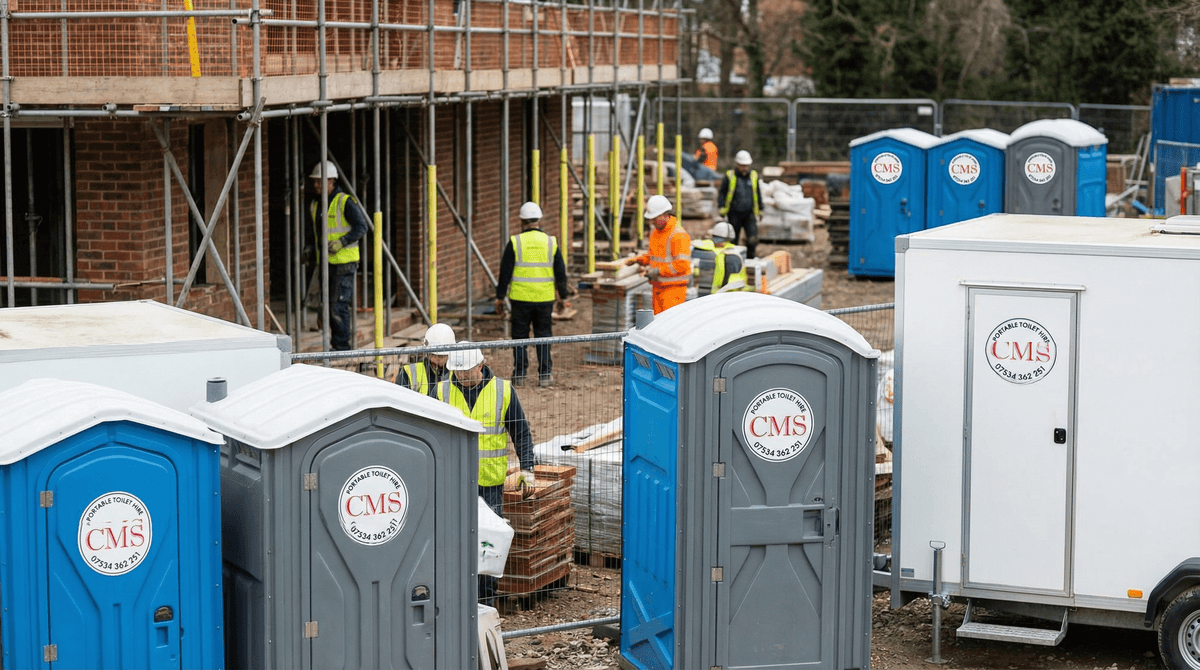
The toughest environment for portable toilet provision
Demolition sites are, by some margin, the most demanding environments in which portable toilets operate. The combination of extreme dust, heavy debris, ground vibration, rapidly changing site layouts, and aggressive machinery creates conditions that test both the equipment and the servicing arrangements far beyond what a standard construction site demands.
Despite this, the welfare requirements under CDM 2015 are identical. Your demolition crew needs toilet facilities that are safe, accessible, hygienic, and properly maintained — regardless of what is being demolished around them.
This guide covers the specific challenges of providing portable toilet hire on demolition sites and how we adapt our service to meet them.
Demolition-specific challenges
Dust and debris accumulation
Demolition generates extraordinary quantities of airborne particulate matter. Concrete dust, brick dust, plaster, insulation fibres, and general debris settle on every surface on site — including the inside and outside of portable toilets.
On a standard construction site, a weekly service visit is sufficient to maintain the unit in good condition. On an active demolition site, the interior can be coated in a fine layer of dust within hours of the previous clean. By midweek, the accumulation affects the user experience noticeably.
We address this by adjusting the servicing frequency for demolition sites as standard. Depending on the intensity of the demolition work and the proximity of the unit to the active zone, this may mean twice-weekly servicing or, on particularly dusty sites, more frequent visits during peak demolition phases.
The additional servicing is discussed at the time of booking and factored into the pricing. There should be no surprises on the invoice.
Positioning away from the hazard zone
Portable toilets must be positioned outside the exclusion zone defined in the demolition method statement. This zone exists to protect workers from falling debris, structural collapse, the swing radius of excavators and demolition machinery, and the unpredictable behaviour of structures during demolition.
The positioning challenge is balancing safety with practicality:
- Too close to the demolition zone: The unit is at risk of damage from falling debris, dust ingress is maximised, and the safety exclusion is compromised
- Too far from the working area: Workers will not use the toilet because the walk takes too long, defeating the purpose of the provision
The practical approach is to position the unit outside the exclusion zone, upwind of the demolition area where possible, on firm stable ground that is not part of the demolition footprint. The ideal position is:
- Outside the exclusion zone as defined in the method statement
- Upwind of the active demolition area (to reduce dust exposure)
- On firm, stable ground away from any structures being demolished
- With clear, unobstructed pedestrian access for workers
- With clear vehicle access for our service team
Vibration and stability
Heavy demolition work — wrecking ball operations, mechanical breaking, pile extraction, and in some cases controlled explosive demolition — generates significant ground vibration. Portable toilets positioned on unstable or uneven ground can shift, lean, or topple during nearby operations.
We ensure units are placed on the firmest available ground and assess stability during every service visit. If the unit has moved or is showing signs of instability, we reposition it immediately.
On sites with particularly severe vibration, additional stabilisation measures may be appropriate — ground anchoring, boarding, or placement on a prepared hardstanding area.
Rapidly changing site layout
Demolition sites change fundamentally as the work progresses. The building that was standing last week is rubble this week. The access route has moved. The exclusion zone has shifted. The ground that was firm is now excavated.
This means the ideal toilet position changes too. We discuss repositioning proactively during service visits and can move units to better locations as the demolition progresses. Keeping the toilet in a practical, safe, and accessible position throughout the project — rather than where it was originally placed on day one — is part of the service.
CDM 2015 welfare requirements on demolition sites
The Construction (Design and Management) Regulations 2015 apply to demolition work exactly as they apply to construction. Schedule 2 welfare requirements are not reduced or modified for demolition:
- Suitable and sufficient sanitary conveniences
- Washing facilities with hot and cold running water
- Drinking water supply
- Rest facilities with seating and means to prepare food
- Changing rooms and drying facilities where needed
A portable toilet alone covers the sanitary convenience requirement. For larger demolition projects with substantial crews, a welfare unit provides the full range of facilities in a single secure, anti-vandal cabin.
Short-duration demolition hires
Many demolition projects are compact — a few days to a few weeks for a domestic or small commercial demolition. Our hire arrangements reflect this:
- No minimum hire beyond one week
- Delivery and collection included in the hire price
- Servicing frequency matched to the project intensity
- Flexible end dates — demolition timelines shift frequently due to weather, asbestos discovery, structural surprises, or regulatory requirements
We understand that demolition projects are inherently less predictable than new-build construction. Asbestos can extend a timeline by weeks. An unexpected structural condition can halt work entirely. We adjust the hire accordingly — extend when the project extends, collect promptly when it finishes.
Pairing with welfare units for major demolition projects
Large-scale demolition — multi-storey buildings, industrial plant, power stations, large commercial structures — involves substantial crews working over weeks or months. For these projects, a welfare unit provides the comprehensive welfare provision that CDM 2015 requires:
- Toilet and washing facilities with hot water
- Canteen with microwave, kettle, seating, and tables
- Drying room for PPE — particularly important on demolition sites where PPE becomes contaminated with dust
- Heating and hot water
- Secure, anti-vandal construction that withstands the demolition site environment
The welfare unit is positioned at the site compound, providing the main welfare hub. Additional portable toilets are positioned around the site to provide convenient toilet access for workers at remote parts of the demolition zone, reducing the walk back to the compound.
Decontamination considerations
Some demolition sites involve hazardous materials — asbestos, lead paint, contaminated soil, chemical residues. Where workers are required to decontaminate before using welfare facilities, the positioning and access arrangements for portable toilets need to account for the decontamination process.
We work with demolition contractors to ensure that our units are positioned appropriately within the site's contamination management plan. The units themselves are standard specification, but their placement and the access arrangements may need to accommodate specific decontamination requirements.
Our experience with demolition sites
Chelford Mobile Services has supplied toilet and welfare provision for demolition projects across Cheshire, Shropshire, Staffordshire, and Greater Manchester — from single-house demolitions to large commercial and industrial sites. We understand the specific demands of demolition environments and adjust our service accordingly.
If you are planning a demolition project and need welfare provision, call us on 07534 362 251. We will discuss the site conditions, recommend the appropriate provision, and agree a servicing schedule that keeps the facilities in proper condition throughout the project.