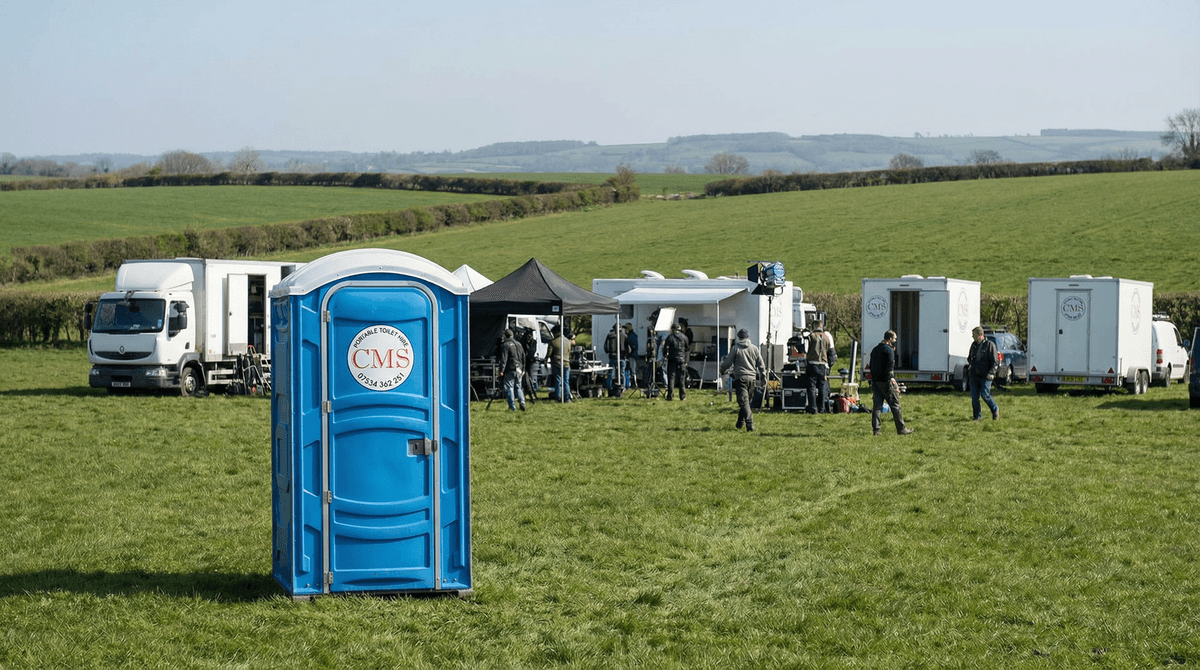
Film sets and TV production locations have a legal obligation to provide welfare facilities for cast and crew. This is not optional — the Health and Safety at Work Act 1974 and the Workplace (Health, Safety and Welfare) Regulations 1992 apply to every workplace, including temporary film locations. Beyond the legal requirement, comfortable, well-maintained facilities keep morale high during long shooting days and contribute to an efficient production.
This guide covers the specific requirements for portable toilet hire on film and TV sets, from small indie shoots to large-scale productions.
Legal Requirements
Every employer must provide adequate toilet and washing facilities for workers. On a film set, this means:
- Sufficient toilets for the number of people on site. The Approved Code of Practice suggests at least 1 toilet per 7 workers for sites with up to 100 people.
- Separate facilities or adequate provision for mixed-gender crews. Individual lockable units satisfy this requirement.
- Accessible facilities where any cast or crew member has a disability.
- Hand-washing facilities — either integrated into the toilet unit or provided separately.
Location managers and production coordinators are responsible for ensuring compliance. Getting this wrong can result in enforcement action from the HSE.
What Types of Unit Are Used on Film Sets?
Standard Chemical Toilets
Functional, self-contained, and quick to deploy. These are the default for crew facilities on most productions. They require no mains connections and can be positioned anywhere with firm, level ground.
Typical use: Back-of-house crew facilities, remote locations, and smaller productions.
Luxury Toilet Trailers
Trailer-mounted units with flushing toilets, running water, mirrors, good lighting, and climate control. These provide a standard of facility comparable to a permanent building.
Typical use: Cast facilities, near-set provision for talent, and higher-budget productions where the standard of welfare facilities reflects the production's overall standards.
Welfare Units
Combined toilet, sink, kitchen area, and seating in a single portable unit. These require a power supply.
Typical use: Base camp facilities for productions with 20+ crew, providing a space for breaks as well as sanitation.
Disability-Accessible Units
Larger units with grab rails, wider doors, and lower thresholds. Required whenever a disabled cast or crew member is on set, and strongly recommended for any production as standard practice.
How Many Units Do You Need?
The number depends on the size of the crew and cast, the length of the shooting day, and the location.
Crew of 10 to 20
- 2 standard chemical toilets
- 1 accessible unit if required
- Consider a luxury unit for the principal cast if the budget allows
Crew of 20 to 50
- 3 to 5 standard chemical toilets
- 1 luxury trailer for cast (2 to 4 cubicle configuration)
- 1 accessible unit
- A welfare unit at base camp
Crew of 50+
- Scale up proportionally, maintaining 1 toilet per 7 to 10 crew members
- Separate cast and crew facilities
- Multiple accessible units
- Welfare units at base camp and near-set locations
Multi-Location Shoots
Productions that move between locations daily need portable toilets at each location. Some providers offer a "follow the shoot" service, delivering and collecting units at each location on the schedule. Discuss this with your provider during pre-production.
Positioning on Set
Near-Set vs Base Camp
- Near-set units are positioned close to the shooting location for quick access between takes. These should be quiet — no generator noise from luxury trailers near a sound-sensitive set.
- Base camp units are at the main crew parking and facilities area. These handle the bulk of usage and are where welfare units and catering are based.
Noise Considerations
Film sets are sensitive to noise. Generator-powered luxury trailers produce sound that will be picked up by location sound recording. Position these downwind and at a distance from the shooting area, or use mains power where available.
Visual Impact
Portable toilets should not be visible in shot. This sounds obvious, but on location shoots with wide establishing shots, toilet units in the background have ruined more takes than anyone likes to admit. Brief the locations department on exact positioning.
Ground Protection
Film productions are typically required to leave locations as they found them. Place ground protection (plywood sheets, ground mats) under and around toilet units to prevent damage to grass, verges, or sensitive surfaces.
Working with Location Managers
Location managers are the key contact for portable toilet logistics on a film set. They need to:
- Include sanitation in the location recce. Check access for delivery vehicles, identify suitable positions for units, and note any restrictions.
- Communicate requirements to the hire company during pre-production. Provide the shooting schedule, the number of people on set each day, and any location-specific challenges.
- Arrange permits if needed. Positioning portable toilets on public land or highway requires permission from the local authority.
- Coordinate delivery and collection timing. Units typically need to arrive before the first crew call and be collected after wrap on the last day at each location.
Servicing on Multi-Day Shoots
For shoots lasting more than one day at a single location, portable toilets need servicing. Standard chemical toilets should be serviced daily on a busy film set. Luxury trailers need their waste tanks emptied and fresh water replenished — frequency depends on usage and tank capacity.
Agree a servicing schedule with your provider that aligns with the shooting schedule. Early morning servicing (before crew call) is standard. Servicing during shooting can cause noise and disruption.
Cost Considerations
Film productions budget for facilities under the locations or production department. Typical costs:
- Standard chemical toilet: £40 to £60 per week, or £80 to £150 for a weekend hire including delivery and collection
- Luxury toilet trailer (2 to 4 cubicles): £300 to £800 per week depending on specification
- Welfare unit: £150 to £300 per week plus generator costs
- Delivery and collection: £50 to £150 per trip depending on distance
- Daily servicing: £30 to £50 per unit per visit
For short shoots (1 to 3 days), weekend event rates usually apply. For longer productions, negotiate a weekly or monthly rate.
Common Mistakes on Film Sets
- Not enough units. A crew of 30 sharing a single toilet creates queues and frustration that costs shooting time.
- Toilets visible in shot. Always check sight lines from every camera position.
- Generator noise from luxury trailers. Either use mains power or position generators well away from the set.
- Forgetting accessible provision. Even if no one on the current shoot requires it, best practice is to have at least one accessible unit available.
- Late booking. Film-friendly providers with experience on set get booked up. Contact them during pre-production, not the week before the shoot.
Summary
Portable toilet hire on film and TV productions is a welfare obligation, a practical necessity, and a contributor to crew morale. Get it right and nobody notices. Get it wrong and it affects productivity, compliance, and the reputation of your production. Brief your provider thoroughly, plan for the specifics of each location, and treat sanitation as a first-order logistical requirement — not an afterthought.