
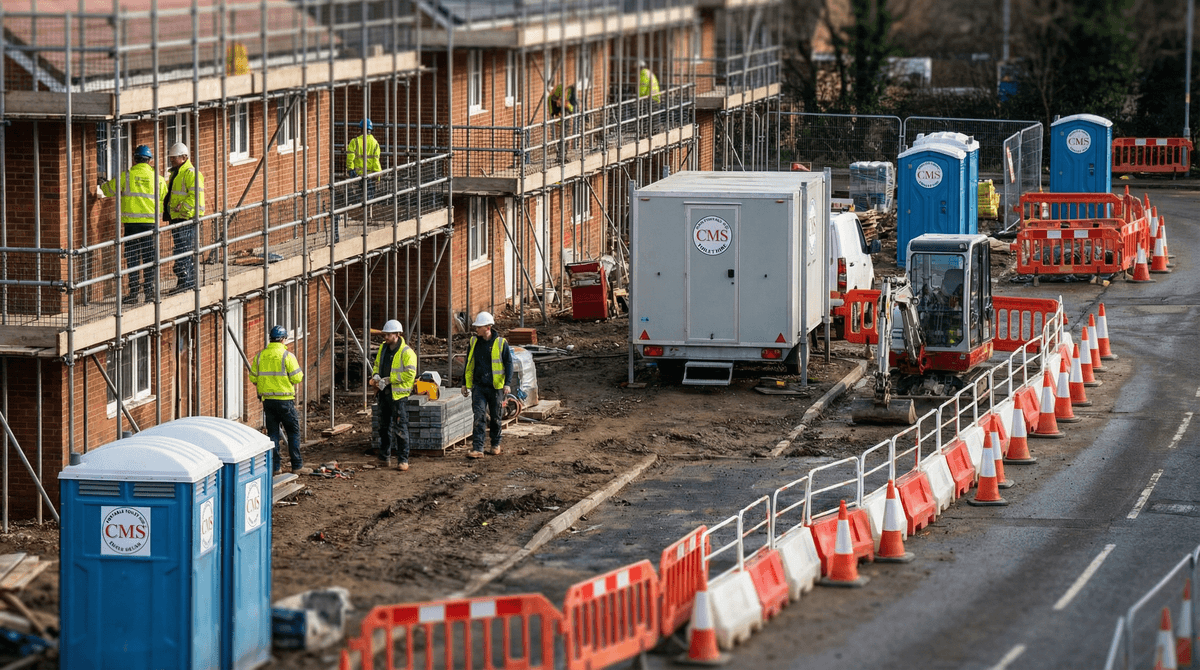
The problem with linear sites
Road works, pipeline installation, cable laying, drainage schemes, and utility trenching all share a fundamental characteristic that distinguishes them from conventional construction: the work moves. Every day, the active work front advances along a route, and the facilities that served the team yesterday become progressively less useful today.
On a standard building site, you position a portable toilet once and service it weekly until the project ends. On a linear project, a toilet planted at the starting point becomes a ten-minute walk within a fortnight and entirely impractical within a month. Workers who have to trek five hundred metres along a live carriageway to reach a toilet are workers who are not productive, not safe, and not compliant with HSE expectations.
This guide covers how portable toilet provision works on road works and utility projects — and how to avoid the common pitfalls.
How we handle moving work fronts
We reposition portable toilets as the work front advances along the route. This is coordinated with the site manager and built into the service schedule from the outset.
At the start of the project, we discuss the anticipated rate of progress, the route layout, and the key milestones. From that, we agree a repositioning schedule that keeps the unit within practical walking distance of the active work area throughout the project.
Repositioning typically happens during a scheduled service visit, combining the move with the normal emptying, cleaning, and restocking. This minimises disruption and avoids additional trips to site.
Dual-unit coverage for longer projects
For linear projects spanning several hundred metres or more, a single portable toilet — even with regular repositioning — may leave gaps in coverage. Workers at the far end of the active zone are always walking to the near end.
In these situations, we recommend two units: one at the current work front and one positioned ahead, ready for the next section. As the work progresses, the rear unit leapfrogs to the front, maintaining continuous coverage without dead zones.
This approach costs slightly more per week but eliminates the productivity losses associated with long walks to the toilet. On a project where every hour of labour is costed, the return on that investment is immediate.
Access challenges on road works
Road works create unique access difficulties for servicing. Traffic management schemes, lane closures, contraflow systems, and restricted parking all affect our ability to reach the unit with a service vehicle.
We coordinate with the site manager and the traffic management contractor to schedule service visits during quieter periods. Early morning — before the work starts and before traffic builds — is typically the most practical window.
What we need from you
- Advance notice of any changes to the traffic management layout that affect our access route
- A named contact on site who can authorise vehicle access through the works
- Guidance on any specific requirements from the highways authority regarding service vehicle movements
The better the communication, the smoother the servicing. Surprises on arrival — a new road closure, a moved access point, a gate that nobody mentioned — waste time and may force a rescheduled visit.
Utility projects across multiple sites
Utility companies — water, gas, electricity, telecoms — frequently operate on multiple small sites simultaneously across a region. A fibre optic contractor might have teams working in three different towns in the same week. A water company might have fifteen open excavations across a county.
We supply and service portable toilets across multiple locations under a single contract. This simplifies your administration, provides consistent pricing across all sites, and gives you a single point of contact for deliveries, collections, servicing, and any issues.
How multi-site contracts work
- We agree a schedule of sites, with delivery and collection dates for each
- All sites receive the same service standard — weekly servicing, full documentation
- New sites can be added to the contract at short notice as work programmes develop
- Completed sites are collected promptly when the work finishes
- Invoicing is consolidated into a single account
For utility contractors managing dozens of open sites across Cheshire, Shropshire, and the wider region, this consolidated approach saves significant administrative time compared to arranging individual hires for each location.
Compliance documentation for highways and utility work
Highways contractors and utility companies face particularly rigorous compliance requirements. Principal contractors expect documented evidence of welfare provision across every site, and HSE can request records during inspections.
Every service visit we carry out is logged with the date, time, technician name, and services performed. For multi-site contracts, we maintain records for each location individually, making it straightforward to demonstrate compliance on a per-site basis.
We can provide service records in whatever format suits your reporting requirements — individual site reports, consolidated summaries, or access to our digital service log.
CDM 2015 and highways work
CDM 2015 applies to all construction work, and road works and utility projects fall squarely within scope. The welfare requirements are the same as for any construction site: suitable and sufficient sanitary conveniences, washing facilities, drinking water, and rest areas.
On linear highway projects, the practical challenge is ensuring that facilities remain accessible as the work moves. A toilet that was compliant on day one becomes non-compliant if it is now three hundred metres from the nearest worker.
Our repositioning service addresses this directly, ensuring that compliance is maintained throughout the project rather than just at the start.
Planning your provision
The key information we need to plan portable toilet provision for a road works or utility project:
- The route or list of site locations
- The anticipated start and end dates for each section or site
- The number of workers on each site
- Access arrangements and any traffic management constraints
- The name and contact details of the site manager for each location
With this information, we can build a delivery, servicing, and repositioning schedule that covers the entire project from start to finish.
Chelford Mobile Services supplies portable toilets to road works and utility projects across Cheshire, Shropshire, Staffordshire, and Greater Manchester. Call 07534 362 251 to discuss your project requirements.