
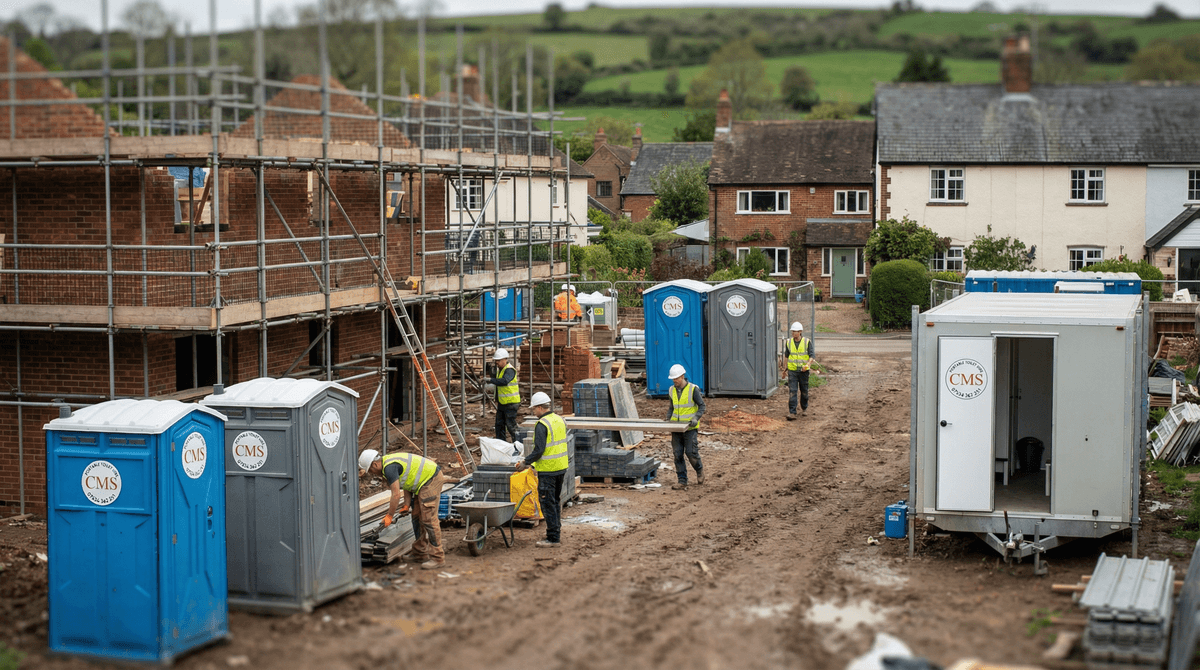
Your build, your responsibility
Building your own home is one of the most ambitious projects most people will ever undertake. The scale of the decisions is relentless — foundations, structural engineering, planning conditions, building control, materials, finishes, timelines, budgets. In the midst of all that, the question of where your contractors will use the toilet can feel almost absurdly mundane.
It is not. It is a legal requirement from day one, and getting it wrong creates problems that range from awkward to expensive.
Why a portable toilet is a legal requirement
CDM 2015 — the Construction (Design and Management) Regulations — applies to all construction projects, including domestic self-builds where you employ contractors. You do not need to be a commercial developer or a principal contractor for the regulations to apply. If you are paying people to build your house, the welfare obligations are yours.
Schedule 2 of the regulations requires suitable and sufficient sanitary conveniences at readily accessible places on the construction site. In practice, this means a portable toilet positioned on your plot from the day groundworks begin until the permanent plumbing is connected, tested, and functional.
For most self-builds, that window is six months at the very minimum. Complex builds, phased projects, and sites with planning delays routinely extend to twelve months or longer. The portable toilet needs to be there for the duration.
Common mistakes self-builders make
Assuming it can wait
The most frequent error is not ordering a portable toilet until the builders complain. By that point, groundworks may have been underway for weeks, and you have been in breach of welfare regulations for the entire period. The fact that nobody from HSE noticed does not make it acceptable — it makes it lucky.
Order the toilet before the first digger arrives on site. It should be waiting when the groundwork team shows up on day one.
Relying on the existing house
If you are building on a separate plot from your current home, your house's facilities do not satisfy the requirement. The regulations require provision at the construction site — not down the road, not across a field, not in a different building that requires crossing a public highway to reach.
Even if your existing house is adjacent to the build plot, consider the practical reality. Multiple contractors traipsing through your home several times a day, with site boots and dusty clothing, gets old very quickly. A dedicated on-site toilet keeps the construction world and your domestic world separate.
Underestimating the project timeline
Self-builds are notorious for overrunning. The optimistic twelve-month schedule becomes eighteen months. The kitchen supplier delays by six weeks. The building inspector requires modifications. Each extension pushes the point at which permanent plumbing is available further into the future, and the portable toilet needs to remain on site until that point.
We offer flexible hire terms specifically because self-builds rarely run to the original schedule. Extend when you need to, shorten if the project finishes ahead of plan. No penalties, no fixed contracts.
What you actually need
For most self-build projects with a small team of contractors — typically two to eight people — a single standard portable toilet is sufficient. The standard specification includes:
- Chemical flush
- Lockable door
- Ventilation
- Toilet paper, hand sanitiser, and hand wash
- Weekly servicing included in the hire price
Position the unit on level ground, accessible from the main working area, and within reach of our service vehicle (approximately fifteen metres from where the vehicle can park). Ideally, place it at the edge of the plot where it is accessible but not in the way of construction traffic.
When you might need more
If your project involves a larger team — ten or more workers during peak construction phases — consider a second portable toilet or an upgrade to a welfare unit. A provides the full welfare package: toilet, hot and cold running water for handwashing, a rest area with seating and a kettle, a drying room, and heating.
For remote self-build plots with no mains services, a welfare unit with on-board water tanks and generator power may be the most practical solution.
Servicing throughout your build
Every portable toilet hire from us includes weekly servicing at no additional charge. Our technician visits the site each week to:
- Empty and clean the waste tank
- Thoroughly clean the interior
- Restock toilet paper, hand sanitiser, and hand wash
- Check the lock, hinges, and structural condition
- Apply fresh chemical treatment
- Log the visit for your records
This continues for the full duration of your hire, whether that is three months or eighteen. The service standard does not diminish on longer hires — if anything, we monitor longer-term units more closely and replace them with fresh units if wear begins to affect the condition.
The cost in context
A portable toilet for a self-build typically costs between forty and sixty pounds per week, including servicing. Over a twelve-month build, that is roughly two thousand to three thousand pounds — a figure that sounds significant in isolation but is negligible against the total build cost.
Compare it to the other line items on your self-build budget: the cost of the foundations, the structural steel, the roof tiles, the kitchen. The toilet provision is a rounding error. But failing to provide it can result in contractors refusing to work on site, HSE enforcement action, and a project timeline that stalls until the issue is resolved.
Delivery and setup
We can usually deliver within twenty-four to forty-eight hours of your order. Tell us when groundworks begin and we will have the unit on site before the first contractor arrives.
Delivery is included in the hire price. Our driver positions the unit in the agreed location, and collection at the end of the hire is equally straightforward. The hire runs for as long as your build needs it.
Chelford Mobile Services supplies portable toilets to self-build projects across Cheshire, Shropshire, Staffordshire, and Greater Manchester. Call 07534 362 251 to arrange your hire.