
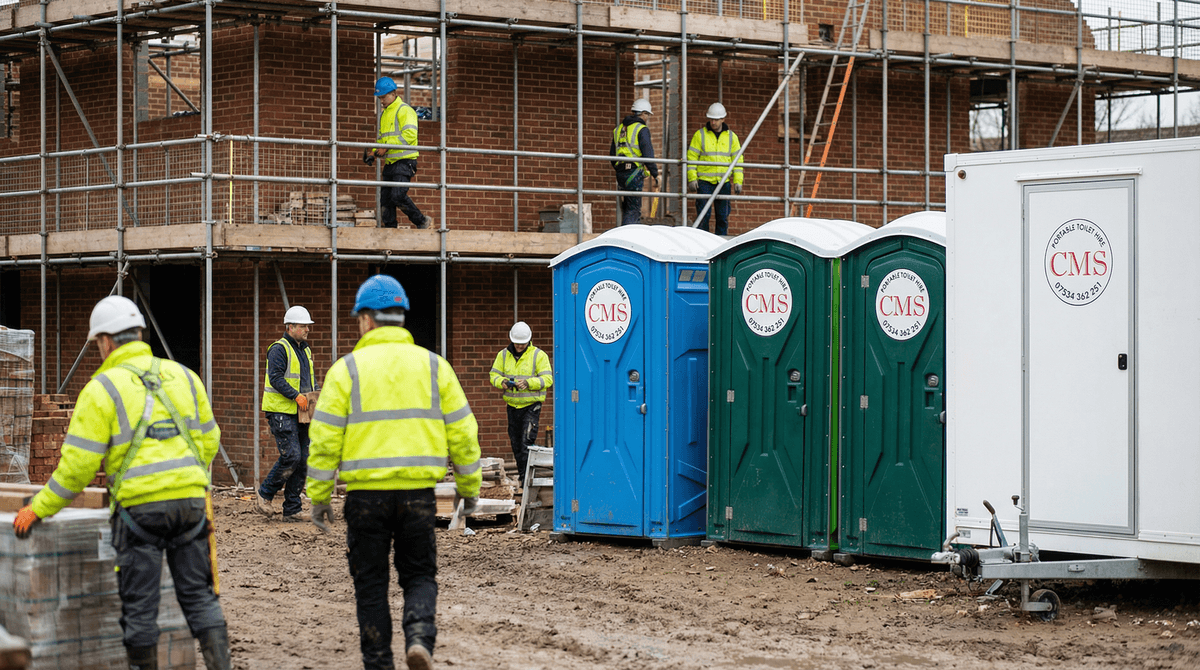
The welfare gap on residential streets
Roofers and scaffolders occupy a peculiar position in the construction industry. Their work takes place on residential streets, on top of houses, on commercial buildings, and at height on structures that have no site compound, no existing facilities, and often no space that obviously accommodates a portable toilet.
The crew arrives in the morning, works all day at height or erecting scaffold, and has nowhere to use the toilet except the client's house, a nearby pub, or the petrol station a quarter of a mile down the road. The client may be accommodating at first — but the arrangement rarely survives a fortnight. And HSE does not consider any of those alternatives to be acceptable welfare provision.
The legal position for small crews
There is a persistent and incorrect belief across the roofing and scaffolding trades that small crews are exempt from welfare requirements. Two roofers on a domestic re-roof, a scaffolding team of four erecting a temporary structure — these small teams assume that the regulations were written for larger sites and do not apply to them.
They are wrong.
The Workplace (Health, Safety and Welfare) Regulations 1992 require employers to provide adequate toilet facilities for all workers. CDM 2015 reinforces this for all construction work, regardless of team size or project duration. There is no minimum crew size below which the requirement disappears.
A single portable toilet positioned on the client's driveway or in the front garden satisfies the requirement for small roofing and scaffolding crews. It is clean, private, lockable, and available whenever needed. No knocking on the client's door, no walking to the nearest cafe, no improvising in a neighbour's garden.
Positioning on residential streets
Residential work requires sensitivity about where the portable toilet goes. You are working on someone's home, on their street, next to their neighbours. A well-positioned unit is unobtrusive and causes no issues. A poorly positioned one generates complaints that affect your relationship with the client and your reputation in the area.
Practical positioning options
- On the client's driveway: Close to the house wall where it occupies minimum space and is least visible from the street. This is the most common and least problematic position.
- In the front garden: On firm ground, set back from the pavement. If the garden has fencing or hedging, position the unit behind the natural screen.
- On the pavement: In some cases, the only practical option. Check whether the local authority requires a pavement licence or temporary obstruction permit. The unit must not block the pavement for pedestrians, particularly wheelchair users and pushchairs.
- In a rear garden: If vehicle access allows delivery through a side gate or from a rear lane. This position is ideal for minimising visual impact but requires adequate access for our delivery and service vehicles.
Key considerations for residential positioning
- Minimise visual impact: Position where the unit is least visible to neighbours and passing traffic
- Avoid pavement obstruction: The unit must not force pedestrians into the road
- Service vehicle access: Our technician needs to reach the unit with equipment. Approximately fifteen metres from where the vehicle can park.
- Proximity to the work area: Close enough that the crew actually uses it, rather than reverting to less appropriate alternatives
- Client agreement: Confirm the positioning with the homeowner before delivery. Their driveway, their garden, their choice.
Short-duration hire for roofing and scaffolding
The majority of roofing and scaffolding jobs are measured in days or weeks, not months. A domestic re-roof might take two to three weeks. A scaffold erection or dismantle might take two to five days. A commercial roofing project might run four to eight weeks.
Our hire arrangements are designed for this pattern of short, intensive engagements:
- One-week minimum hire: The minimum practical period that includes delivery, use, and collection
- Delivery and collection included: No separate transport charges
- Weekly servicing included: For hires of two weeks or more, the unit is serviced weekly — cleaned, emptied, and restocked — at no additional cost
- Flexible end dates: Call us when the job is finished and we collect within one to two working days. There is no penalty for finishing early, and if the job overruns, the hire extends at the same weekly rate.
For a typical re-roofing job lasting two to three weeks, the total hire cost — including delivery, weekly servicing, and collection — is a modest figure relative to the project value. It is demonstrably cheaper than the alternatives: lost productive time from workers leaving site, the risk of an HSE improvement notice, or the reputational damage from a complaint.
Keeping the neighbours onside
Neighbourly relations matter, particularly for roofing and scaffolding companies that work on residential streets regularly and depend on local reputation for referrals and repeat business.
A few straightforward steps prevent complaints about the portable toilet:
- Position thoughtfully: As far from neighbouring boundaries as the site allows. The driveway rather than the front lawn if possible.
- Keep the unit clean: Our weekly servicing handles this. Between services, keep the door closed and the area around the unit tidy.
- Remove promptly: Do not leave the unit on site for days after the job is finished. Call us as soon as the work is complete and we will collect within a day or two.
- Communicate if asked: If a neighbour asks about the unit, a simple explanation — temporary welfare provision during the roofing/scaffolding work — is understood and accepted by most reasonable people.
Most neighbours recognise a portable toilet as a normal, temporary feature of construction work. A clean, well-positioned unit causes far less disruption and complaint than workers using nearby gardens, alleyways, or being seen urinating behind a van.
Delivery and collection logistics
Our delivery process for residential sites is designed to be quick and unobtrusive:
- We deliver the unit on a vehicle equipped for safe offloading — typically a small lorry or large van
- The driver positions the unit in the agreed location
- Delivery typically takes fifteen to twenty minutes including positioning
- Collection follows the same process in reverse — the unit is loaded, the area left clean
- We coordinate timing with you to minimise disruption to the work and the street
Multiple site coverage for roofing and scaffolding companies
Many roofing and scaffolding companies operate across several sites simultaneously — three roofing teams working on three different properties across town, a scaffolding company with erections and dismantles running concurrently across the region.
We support multi-site operations with coordinated delivery and servicing:
- Single account: All sites managed under one account with one invoice
- Coordinated scheduling: Delivery and collection timed to match your work programme
- Consistent service: Every site receives the same servicing standard
- Flexible management: Add new sites as jobs start, remove sites as they finish
- Single point of contact: One phone number for all site welfare across your operation
This approach simplifies welfare management for businesses that would otherwise need to arrange individual hires, track multiple invoices, and coordinate with multiple service schedules.
The commercial reality
A portable toilet for a two-week roofing job costs less than a single day's materials on most re-roofing projects. For a scaffolding company, it costs less than the hire of one scaffold fitting tool for the same period.
Against that modest outlay, the benefits are concrete:
- HSE compliance — a portable toilet on site means the welfare box is ticked during any inspection
- Client confidence — professional provision demonstrates professional standards
- Worker satisfaction — a basic facility that makes the working day more dignified
- Productivity — no time lost leaving site to find a toilet
- Reputation — no complaints from neighbours about workers using gardens or alleyways
It is, by any commercial measure, money well spent.
Chelford Mobile Services supplies portable toilets to roofing and scaffolding teams across Cheshire, Shropshire, Staffordshire, and Greater Manchester. Call 07534 362 251 to arrange delivery to your current site.