
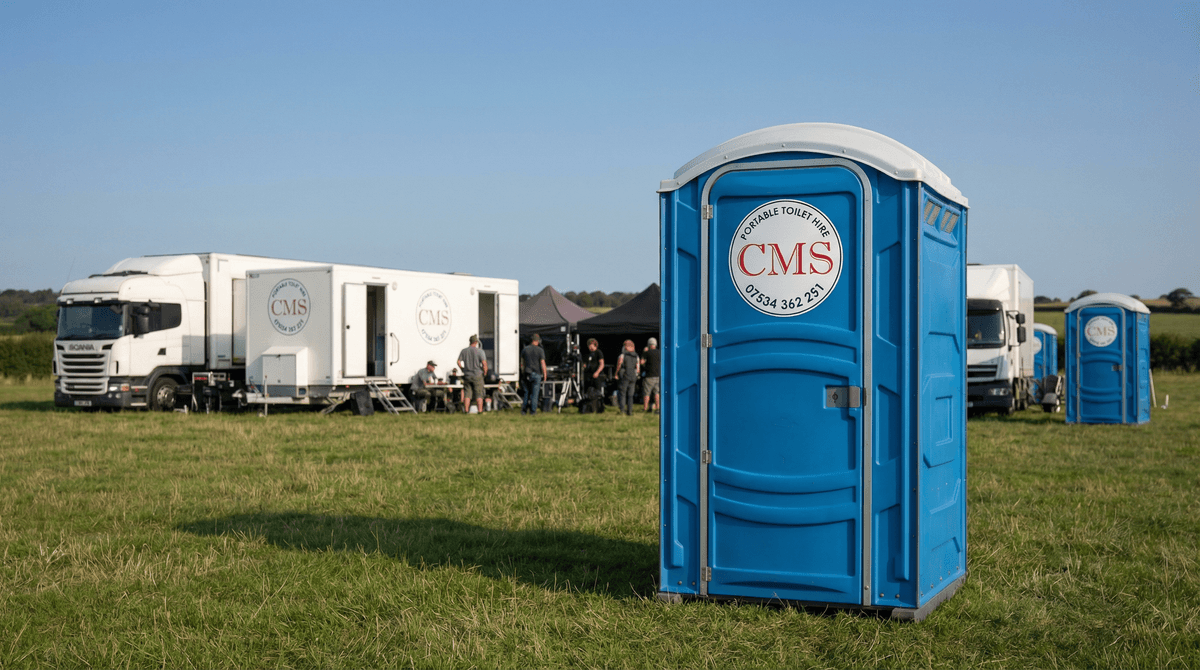
Whether you are running a commercial film shoot, a documentary production, a fashion editorial, or a corporate photography day, you have a duty to provide welfare facilities for everyone on location. The scale varies enormously — a crew of five on a half-day product shoot is a different proposition from a 60-person film unit on a week-long location schedule — but the principle is the same: people need toilets, and most locations do not have them.
This guide covers the practical side of organising portable toilet provision for film and photography work.
The Legal Position
The Health and Safety at Work Act 1974 requires employers to provide adequate welfare facilities for workers. The Workplace (Health, Safety and Welfare) Regulations 1992 specify that this includes suitable and sufficient toilets, washing facilities, and drinking water.
These regulations apply to temporary workplaces, including film and photography locations. The size of the crew does not matter — even a two-person shoot is covered.
Non-compliance can result in enforcement action from the HSE. More practically, inadequate facilities damage morale, slow the shoot down, and make it harder to attract experienced crew to future productions.
What You Need: Small Shoots (Up to 10 People)
For small commercial photography shoots, corporate video productions, and indie film units:
- 1 standard chemical toilet covers a crew of up to 7 people for a full day
- 2 units for a crew of 8 to 10 or for shoots running longer than 8 hours
- Hand sanitiser is built into standard units, but a standalone hand-wash station is a welcome addition
Standard chemical toilets are the practical choice for small shoots. They require no power or water connections, arrive on a flatbed vehicle, and can be positioned on any firm, level surface.
Cost
A weekend hire for a single standard unit, including delivery and collection, typically costs £80 to £150 depending on location.
What You Need: Medium Shoots (10 to 30 People)
For larger photography productions, commercial shoots with multiple setups, and mid-budget film and TV work:
- 2 to 4 standard chemical toilets for crew
- 1 luxury toilet trailer for talent and clients (optional but increasingly expected)
- 1 accessible unit where any cast or crew member has a disability, or as standard good practice
- A welfare unit at base camp for shoots with a full catering setup
Talent Facilities
On commercial and fashion shoots, the talent (models, actors, presenters) and clients expect a higher standard of facility than the crew. A luxury toilet trailer with flushing toilets, running water, mirrors, and climate control addresses this without friction.
Base Camp vs Near-Set
Position the main facilities at base camp. For near-set provision (within quick reach of the shooting location), a single standard unit avoids lost time walking back to base.
What You Need: Large Productions (30+ People)
For major film and TV productions, large commercial shoots, and multi-day location work:
- 4 to 8 standard chemical toilets for crew, scaled at 1 per 7 people
- 1 to 2 luxury toilet trailers for cast and principals
- Accessible units as standard
- Welfare units at base camp with hot water, kitchen area, and seating
- Daily servicing for multi-day shoots
Multi-Location Shoots
Productions that move between locations daily need facilities at each location. Discuss a "follow the shoot" arrangement with your provider — units delivered to each day's location and collected afterwards.
Positioning on Location
Out of Shot
This is the primary concern on any film or photography location. Portable toilets must not be visible in any frame. Check sight lines from every camera position during the recce, and mark approved toilet positions on the location plan.
Wide establishing shots are the biggest risk. A portable toilet on a hilltop half a mile away can still appear in a wide landscape shot.
Noise
Generator-powered luxury trailers produce noise. If you are recording sync sound on location, position generators downwind and at a distance from the shooting area. Battery-powered units are available for sound-sensitive locations.
Ground Protection
Most location agreements require you to leave the site as you found it. Place ground protection boards or mats under and around toilet units. This prevents damage to grass, verges, and sensitive surfaces. Document the condition of the ground on arrival with photographs.
Access for Servicing
If the shoot extends beyond one day, servicing vehicles need access to the units. Factor this into your location plan. Early-morning servicing before crew call is standard practice.
Working with Location Managers
On any professional production, the location manager coordinates facilities. Key responsibilities:
- Include portable toilets in the location recce. Identify positions, access routes, and any restrictions.
- Communicate requirements to the hire company during pre-production. Provide the schedule, crew numbers, and location-specific details.
- Obtain permits. Placing portable toilets on public land, in car parks, or on highways requires permission from the landowner or local authority.
- Coordinate delivery timing. Units must be in position before the first crew member arrives.
For Productions Without a Location Manager
Smaller shoots often do not have a dedicated location manager. The producer, production coordinator, or photographer takes on this role. The same principles apply — plan the position, arrange delivery, and confirm the logistics in advance.
Photography-Specific Considerations
Fashion and Editorial Shoots
- Changing facilities are as important as toilets. A welfare unit or dedicated changing tent near the toilet provision keeps everything in one area.
- Client and agency visitors expect good facilities. A luxury unit makes a positive impression.
Product Photography on Location
- Often small crews on tight schedules. A single standard unit is usually sufficient.
- If shooting on a client's premises, check whether existing facilities are available before hiring.
Wedding Photography
- The wedding couple and venue handle sanitation provision. The photographer does not normally need to arrange separate facilities.
- For pre-wedding shoots at separate locations, a portable toilet may be needed if the location is remote.
Drone and Landscape Photography
- Typically solo or very small crews. A portable toilet may be unnecessary for a few hours, but full-day shoots in remote locations benefit from a unit at the parking point.
Costs
| Crew Size | Recommended Setup | Typical Weekend Cost |
|-----------|------------------|---------------------|
| 1–5 | 1 standard unit | £80–£150 |
| 5–10 | 2 standard units | £150–£250 |
| 10–20 | 3 standard + 1 luxury trailer | £400–£700 |
| 20–30 | 4 standard + 1 luxury trailer + welfare unit | £700–£1,200 |
| 30+ | Scale proportionally | £1,000+ |
Multi-day hires, daily servicing, and remote locations increase costs. Get a written quote covering the full schedule.
Common Mistakes
- No toilets at all. Still surprisingly common on smaller shoots. It is not acceptable.
- Toilets visible in shot. Check every camera angle.
- Generator noise spoiling sound recording. Position generators away from set.
- Not enough units for the crew size. Queuing costs shooting time.
- Forgetting about delivery access. A flatbed lorry needs a route to the position.
- No lighting at night. If the shoot runs after dark, light the path to the facilities.
Summary
Portable toilet provision on film and photography locations is a basic professional requirement. Match the number and type of units to your crew size, position them out of shot and away from sound recording, and arrange logistics during pre-production — not the day before the shoot. The cost is modest relative to the production budget, and the alternative — no facilities — is unprofessional, unlawful, and counterproductive.