
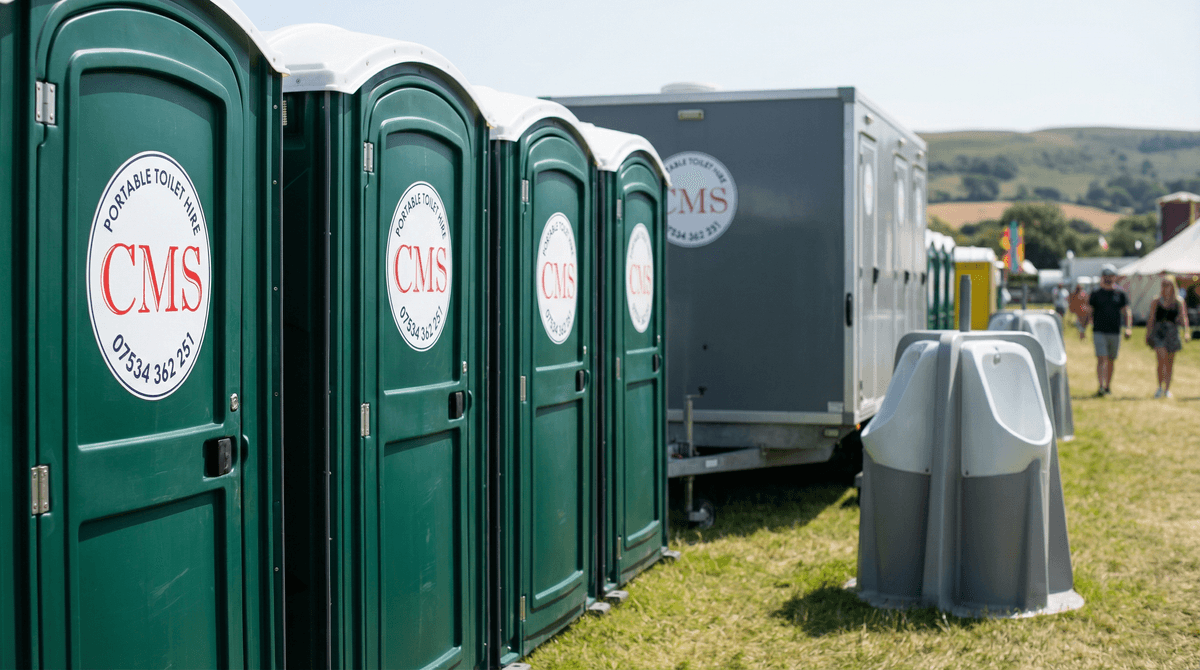
Urinals are not glamorous. They are, however, remarkably effective at reducing queues, lowering costs, and improving the overall sanitation experience at events and on construction sites. A single urinal bay handles significantly more throughput per hour than a standard portable toilet cubicle, and the cost per user is a fraction of the equivalent provision in individual units.
This guide explains when portable urinal hire makes sense, what types are available, and how to integrate them into your sanitation plan.
How Urinals Reduce Queues
The maths is straightforward. A standard portable toilet cubicle handles approximately 20 to 25 uses per hour. A single urinal bay handles approximately 60 uses per hour. A 6-bay urinal block therefore provides the equivalent throughput of roughly 15 standard cubicles — in a fraction of the space and at a fraction of the cost.
For any event with a significant proportion of male attendees, urinals dramatically reduce queue times. They also extend the effective capacity of your standard toilet units by diverting male users who only need to urinate.
When You Need Portable Urinals
Events With 200+ Attendees
Once your event exceeds approximately 200 people, urinal provision becomes highly advisable. Below this threshold, standard portable toilets alone can typically cope.
Events Serving Alcohol
Alcohol is a diuretic. Events where alcohol is consumed see significantly higher toilet usage rates than equivalent dry events. Beer festivals, wine fairs, pub events, and any celebration with a bar should include urinal provision as standard.
Festivals and Multi-Day Events
Festival-goers use toilets more frequently than attendees at shorter events. The combination of all-day attendance, food and drink consumption, and camping means usage rates are substantially higher. Urinals are essential at any festival.
Sporting Events
Football matches, rugby matches, cricket fixtures, and any spectator sport with large crowds benefit from urinal provision — particularly during half-time intervals, when usage spikes dramatically.
Construction Sites
Construction site welfare regulations do not specifically require urinals, but on sites with predominantly male workforces, urinals reduce the number of cubicle units required and keep things moving during break times.
Types of Portable Urinal
Freestanding Urinal Blocks
The most common type. A self-contained unit with 4 to 8 bays arranged in a circular or linear configuration. These require no water or power connections. Chemical deodoriser in the collection tank controls odour.
Specifications:
- Typically 4-bay or 6-bay configurations
- Footprint approximately 1.5m x 1.5m for a 4-bay unit
- Self-contained waste tank, emptied during servicing
- No mains connections required
Trough Urinals
A simpler design — an open trough with a privacy screen. Lower cost and higher capacity than bay urinals, but less private. Suitable for festivals and large outdoor events where throughput is the priority.
Trailer-Mounted Urinals
Urinal bays mounted on a wheeled trailer for easy delivery and repositioning. These are convenient for events that require quick setup and removal.
Waterless Urinals
Some modern urinal systems use no water or chemicals, relying instead on a gravity-fed waste system with a biological cartridge. These are more environmentally friendly and produce less odour, but are more expensive to hire.
How Many Urinal Bays Do You Need?
The Calculation
Start with the total number of male attendees expected. For events where the gender split is unknown, assume 50/50.
- Standard events (no alcohol): 1 urinal bay per 50 to 75 male attendees
- Events with alcohol: 1 urinal bay per 30 to 50 male attendees
- Festivals and all-day events: 1 urinal bay per 25 to 40 male attendees
Example
A beer festival expecting 1,000 attendees with a 60/40 male/female split:
- 600 male attendees
- At 1 bay per 40: 15 urinal bays needed
- This equates to approximately 2 to 3 six-bay urinal blocks
You still need standard toilet cubicles for female attendees and for male attendees who need a cubicle. The urinals supplement — they do not replace — your standard toilet provision.
Positioning
Visibility vs Privacy
Urinals need to be easy to find but not prominently visible from the main event area. A position behind a marquee, along a boundary fence, or at the edge of the event footprint typically works well. Clear signage directs users.
Separate from Standard Toilets
Position urinals separately from the main toilet bank. This prevents male users who only need a urinal from joining the main queue, which is the whole point of providing urinals.
Spread Across the Site
For larger events, distribute urinal blocks across multiple locations rather than concentrating them in one spot. This reduces walking distances and balances usage.
Away from Food Areas
As with all sanitation, position urinals at least 20 metres from food preparation and serving areas.
Drainage Considerations
Urinals on sloping ground can overflow or drain in unwanted directions. Position them on level ground and confirm that any overflow or splash is directed away from pedestrian areas.
Servicing
Portable urinals need servicing during multi-day events or extended hire periods:
- Emptying the waste tank. Capacity varies by unit size, but a 6-bay urinal block at a busy event may fill within a single day.
- Cleaning and deodorising. The unit is cleaned, and fresh chemical deodoriser is added.
- Checking for blockages. Debris (cigarette ends, food waste) can block urinal drains.
For single-day events, pre-event preparation is usually sufficient. For multi-day events, daily servicing is essential.
Cost
Portable urinals are cost-effective relative to the throughput they provide:
- 4-bay urinal block (weekend event hire): £80 to £150 including delivery and collection
- 6-bay urinal block (weekend event hire): £100 to £200
- Trough urinal (weekend event hire): £60 to £120
- Weekly construction hire: £40 to £70 including servicing
- Delivery and collection: Typically included in the event hire rate or charged at £30 to £60
Compare this with the cost of the 10 to 15 standard toilet cubicles you would need to achieve equivalent male throughput.
Common Mistakes
Not providing urinals at all
The most common mistake. Event organisers calculate the number of standard cubicles needed and stop there. Adding urinals is the single most cost-effective improvement to any event sanitation plan.
Positioning urinals next to the main toilet queue
This defeats the purpose. Male users see the main queue and join it rather than walking to the urinals. Separate the urinals and sign them clearly.
Insufficient signage
Urinals only work if people know where they are. Use clear, prominent signs — "Urinals this way" with an arrow — at the main event area and along the route.
No lighting after dark
Unlit urinals at a night-time event are a safety hazard and an invitation for misuse. Light the area adequately.
Forgetting about servicing
A full urinal tank overflows. At a busy event, this happens faster than most organisers expect. Arrange servicing for any event longer than 6 hours.
Integrating Urinals Into Your Sanitation Plan
The best approach is to calculate your total sanitation requirement first (based on attendance, duration, and alcohol consumption), then allocate a proportion to urinals:
1. Calculate the total number of toilet units needed using standard ratios
2. Identify the proportion of male attendees
3. Convert a portion of the male provision to urinals (typically 50% to 70% of the male requirement)
4. Retain sufficient cubicle units for female attendees and male cubicle needs
5. Add accessible units (at least 1 per event)
6. Position urinals separately from the main toilet bank
This approach optimises cost, reduces queues, and improves the experience for all attendees.
Summary
Portable urinals are one of the most underused tools in event sanitation. They handle high throughput in a small footprint at a low cost. For any event with more than 200 attendees — and for any event serving alcohol — urinals should be part of the plan. Position them separately, sign them clearly, service them regularly, and watch the queue times fall.