
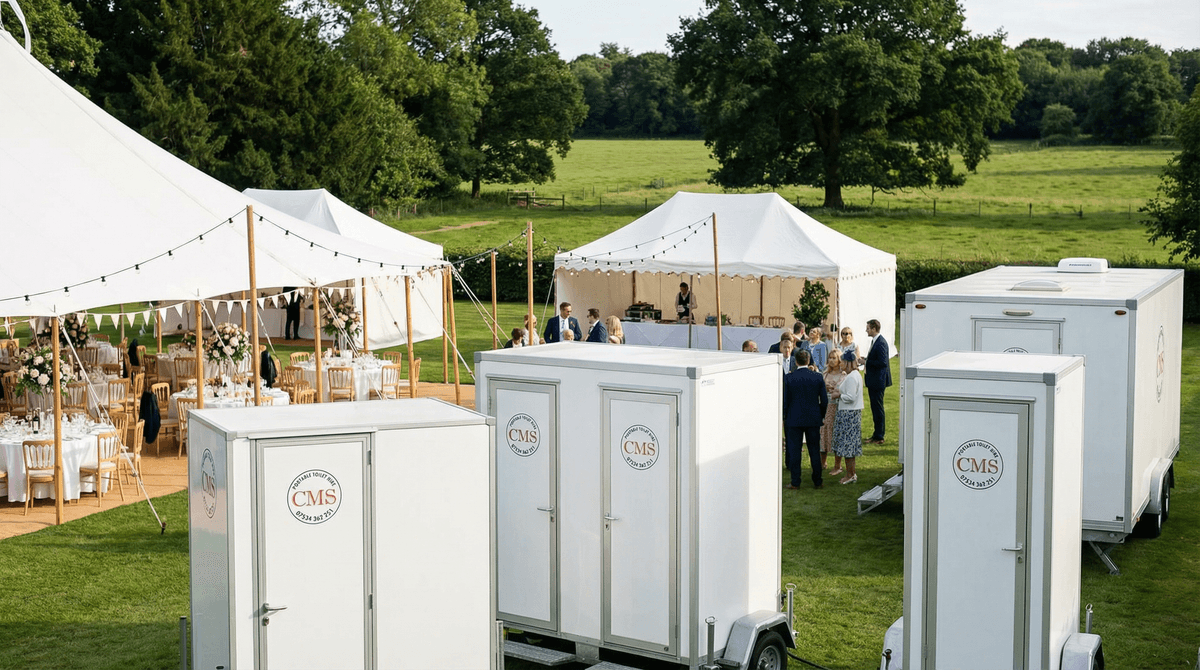
Nobody puts "portable toilets" on their wedding mood board. But toilet hire etiquette is a genuine consideration for any couple hosting a wedding at a venue without substantial permanent facilities — and getting it wrong creates the kind of memories that last far longer than the first dance.
Here is a straightforward guide to the etiquette of wedding toilet hire, covering what to provide, how to present it, and the social pitfalls to avoid.
---
Do You Actually Need Portable Toilets?
The Quick Answer
If your venue is a barn, marquee, field, tipi, garden, or any location where the permanent toilet provision is fewer than 1 toilet per 25-30 guests, yes — you need portable toilet hire.
The Nuance
Even venues with permanent toilets may need supplementary provision:
- If the permanent toilets are in the main building but the reception is outside
- If the evening guest list significantly exceeds the daytime number
- If the permanent facilities are a long walk from the event area
- If you simply do not want 120 guests using the venue's two domestic bathrooms for 10 hours
---
The Etiquette of Provision
Match the Standard to the Event
This is the first rule of wedding toilet etiquette: the facilities should match the occasion. A couple who has spent months planning every detail of the décor, food, and entertainment should not let the standard drop at the toilet door.
For most weddings, this means a luxury toilet trailer rather than standard portable units. The cost difference is modest — typically a few hundred pounds — and the impact on guest experience is significant.
Luxury Trailers for Guests
- Flushing toilets, hot running water, mirrors, proper lighting
- Interior finish comparable to a good restaurant or hotel bathroom
- Climate control for comfort in any weather
- A clean, pleasant experience that does not jar against the rest of the day
Standard Units for Staff
If you are providing separate facilities for caterers, band, photographer, and other suppliers, standard portable toilets are perfectly acceptable. These are professionals who are accustomed to them, and using a different standard for staff is practical, not discourteous.
---
Placement Etiquette
Discreet but Accessible
The ideal placement balances invisibility with convenience:
- Within a 2-minute walk of the reception area
- Not visible from the dining area, dance floor, or welcome area
- Downwind of the event and food service
- Screened by hedging, fencing, fabric, or planting
Signage
- Provide clear, tasteful signage directing guests to the facilities
- Avoid clinical or institutional signs — a handwritten or printed sign that matches the wedding stationery is a nice touch
- Include directions in the order of service or table plan if the layout is complex
Lighting
- The path to the toilets must be lit from dusk onwards
- Festoon lights, lanterns, or solar stake lights create an attractive and safe route
- Avoid harsh floodlights, which create a "building site" atmosphere
---
Who Pays?
The Hosts
In traditional wedding etiquette, the hosts (usually the couple or the couple's parents) pay for all guest facilities, including toilets. This is not an area where costs should be passed on to guests.
Splitting with the Venue
Some venues include a contribution towards toilet hire in the venue fee, or offer the use of their own portable facilities. Check what is included before arranging your own hire.
---
The Accessible Unit
It Is Not Optional
Providing an accessible toilet unit is both a legal requirement (under the Equality Act 2010, where you are providing services to the public) and basic courtesy. Even if you are not aware of a specific accessibility need among your guests, someone may have an undisclosed condition, or a guest may be accompanied by an elderly relative who benefits from the extra space and grab rails.
Etiquette Points
- Position the accessible unit on the most level, accessible ground
- Ensure the approach path is suitable for a wheelchair or walking frame
- Sign it clearly — but do not make it the only unit with signage, or guests will assume it is the designated toilet for everyone
- Do not lock it or restrict access — accessible units should be available to anyone who needs them
---
Baby Changing
If your guest list includes families with babies and toddlers, provide baby changing facilities:
- A fold-down changing shelf in at least one unit (the accessible unit works well, as it has more space)
- Nappy bags and a lined bin
- Signage indicating which unit has changing facilities
Failing to provide changing facilities forces parents to improvise on the grass, in the car, or on a dining table. None of these is ideal.
---
Timing
Delivery
Have the toilet trailer delivered the day before the wedding. This avoids morning-of complications (late delivery, positioning issues, power problems) and gives you time to dress the approach with lighting, signage, and screening.
Availability
The toilets should be available from the moment the first guest arrives and remain available until the last guest leaves. Do not have them locked or inaccessible during the ceremony, even if the ceremony is indoors — someone will need them.
Collection
Arrange collection for the morning after the wedding. The hire company will empty and clean the units at collection.
---
Maintaining Facilities During the Day
Assign Someone
Brief a member of the wedding party, the venue coordinator, or a hired attendant to check the toilets every 1-2 hours:
- Restock toilet paper, soap, and towels
- Wipe down mirrors and surfaces
- Empty waste bins
- Report any problems
Who Should Not Do This
The bride. The groom. The parents of the bride or groom. The best man's speech should not include a request for the congregation to go easy on the toilet paper.
Assign someone discreet, reliable, and ideally someone who is not a close family member or member of the wedding party.
---
Extras That Elevate the Experience
Inside the Trailer
- A small vase of fresh flowers
- A basket of toiletries: hand cream, breath mints, hair spray, sewing kit, plasters
- A scented diffuser or candle (LED candle for safety)
- A sign or framed quote that ties in with the wedding theme
Outside
- A welcome mat or rug at the entrance
- Potted plants or flowers flanking the approach
- Ambient music from a small waterproof speaker
These touches cost very little but transform the experience from "functional portable toilet" to "thoughtful part of the wedding."
---
What Guests Should Know
Guests at a wedding with portable toilets should:
- Use the facilities provided — do not wander into the venue building looking for indoor toilets
- Report any problems to a member of the wedding party or event staff, not the bride or groom
- Treat the facilities with the same respect as they would any other part of the venue
- Leave the unit clean for the next person
If you want to communicate any of this to guests, a discreet sign inside the trailer is more effective (and less awkward) than a verbal announcement.
---
Common Etiquette Mistakes
Mistake 1: Not Providing Enough
Underestimating the number of units needed leads to queues, frustration, and guests giving up and finding their own solutions. Use the ratios in this guide and err on the side of generosity.
Mistake 2: Using Standard Units for Guests
Standard chemical toilets at a formal wedding create a jarring contrast with the rest of the event. A luxury trailer costs more, but the investment is proportionate to the overall wedding budget.
Mistake 3: Hiding the Toilets Too Well
Discretion is good. Invisibility is not. If guests cannot find the toilets, they will wander, ask repeatedly, or not go at all. Clear signage and a well-lit path strike the right balance.
Mistake 4: Forgetting the Approach
A beautiful luxury trailer at the end of a dark, muddy, unsigned path is a wasted investment. The approach is part of the experience.
Mistake 5: Not Briefing Staff
Your caterers, bar staff, and venue coordinator should know where the toilets are and be able to direct guests. Nothing undermines professionalism like a blank look in response to "Where are the loos?"
---
Summary
Wedding toilet hire etiquette comes down to three principles:
- Provide generously — enough units, the right standard, properly equipped
- Present thoughtfully — screened, signed, lit, and dressed to match the day
- Maintain quietly — checked, restocked, and managed without fuss
Get these three things right, and the toilet provision will be one of those details that guests appreciate without ever having to think about. Which is, ultimately, the definition of good etiquette.