
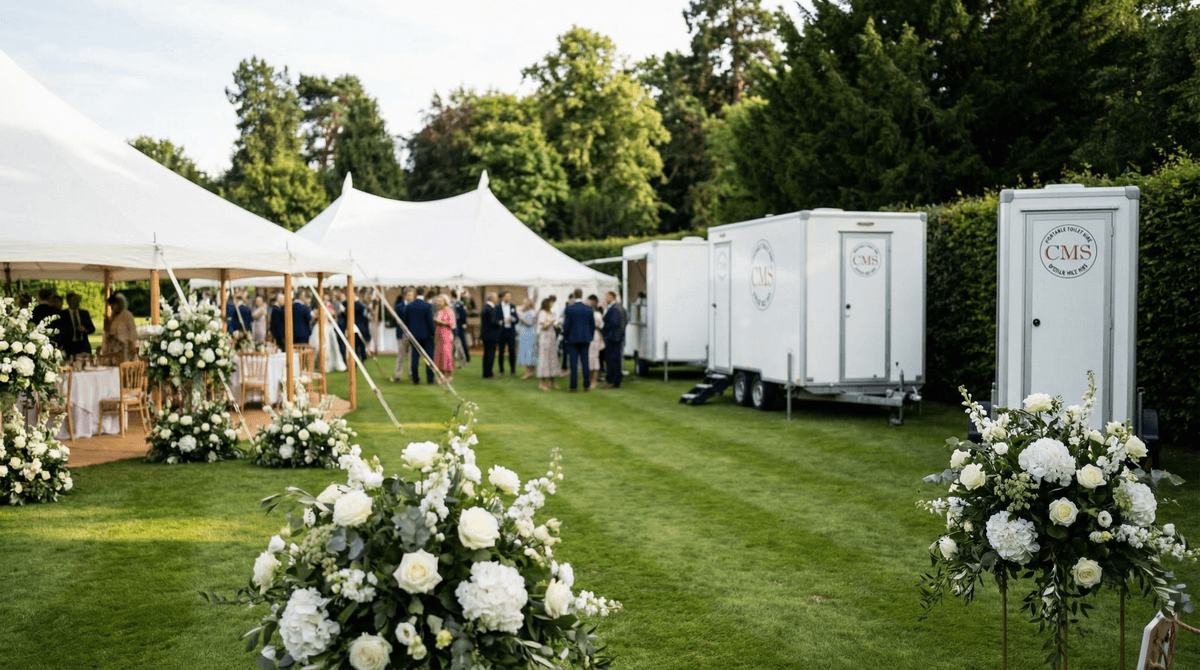
It is one of the least glamorous questions in wedding planning, but getting the toilet provision wrong will generate more complaints than a bad DJ or a late caterer. If your venue is a barn, a marquee, a country garden, or anywhere else without substantial permanent facilities, you need to work out how many portable toilets to hire — and the answer is more nuanced than you might expect.
---
The Basic Formula
The starting point is your guest count and the duration of the event. Industry guidance (based on the Purple Guide and BS 6465) suggests the following minimums for events with food and alcohol service:
- Female guests: 1 toilet per 25 guests
- Male guests: 1 toilet per 50 guests (if urinals are available) or 1 per 35 (if not)
Example: 100-Guest Wedding
For a wedding with 50 female and 50 male guests:
- Female provision: 2 toilets
- Male provision: 1 toilet plus 1 urinal, or 2 toilets without urinals
- Total minimum: 3-4 units
Example: 150-Guest Wedding
For 75 female and 75 male guests:
- Female provision: 3 toilets
- Male provision: 2 toilets (with urinal) or 3 toilets (without)
- Total minimum: 5-6 units
These are minimums. Several factors push the number upward.
---
Factors That Increase the Number
Alcohol Consumption
A free bar or generous wine service increases toilet usage significantly. Guests drink more at weddings than at almost any other type of event. If you are planning an open bar, add 15-20% to the base provision.
Duration
A wedding that runs from a 2pm ceremony to midnight is a long event. The longer guests are on site, the more visits they make. All-day weddings with both daytime and evening guests need to account for the peak period when both groups overlap — typically between 7pm and 9pm.
Evening Guests
Many weddings have a smaller daytime guest list and a larger evening party. The peak toilet demand occurs when the evening guests arrive and the combined attendance is at its highest. Plan your provision for this peak, not the average.
Older Guests and Families
Older guests and families with young children tend to use facilities more frequently. If your guest list skews older or includes significant numbers of children, adjust upward.
Venue Facilities
If the venue has some permanent toilets (as most barns and country houses do), these supplement your portable provision. But do not rely on them entirely — permanent facilities in converted barns are often limited to one or two toilets, which is nowhere near sufficient for 100+ guests.
---
What Type of Unit?
Luxury Toilet Trailers
For most weddings, luxury toilet trailers are the right choice. They offer:
- Flushing toilets with porcelain-effect fittings
- Hot and cold running water at proper basins
- Full-length mirrors
- Interior lighting and heating (or cooling)
- A clean, attractive interior that does not detract from the wedding atmosphere
A typical luxury toilet trailer provides 2-3 cubicles for women and 1-2 cubicles plus urinals for men, serving approximately 80-120 guests comfortably.
Standard Portable Toilets
Standard units are more appropriate as supplementary provision — for example, positioned near the car park for arriving and departing guests, or as overflow for the evening party. They are functional but lack the finish expected at a wedding.
Accessible Units
At least one accessible unit should be included in any wedding toilet provision. This is both a legal requirement under the Equality Act 2010 (if any guest has a mobility impairment) and good practice regardless.
---
Placement
Where you position the toilets is almost as important as how many you hire.
Do
- Place units within a 2-3 minute walk of the main reception area
- Position them downwind of the event and food service
- Choose firm, level ground accessible for delivery vehicles
- Screen units with planting, fencing, or fabric if they are visible from the reception area
- Ensure the path is well lit for evening use
Do Not
- Position units directly adjacent to the dining or dance area
- Place units on soft ground without trackway or matting (especially in spring and autumn)
- Obstruct the approach path with cars, equipment, or decorations
- Forget to sign the route — guests will ask where the toilets are, and your bridesmaids should not have to answer
---
Power and Water
Luxury toilet trailers typically require:
- Electrical power for internal lighting, water pumps, and heating. A 16-amp supply is standard, but some trailers run on a 13-amp domestic supply. If the venue cannot provide mains power at the required location, a generator can be arranged.
- Water supply for hand-washing basins. Many trailers carry their own water tanks, but a mains connection is preferable for all-day events. If no mains supply is available, a water bowser can be provided.
Discuss power and water requirements with your hire provider at the time of booking, and confirm with the venue what is available.
---
Servicing
For a single-day wedding, the units should be serviced and restocked immediately before delivery. A professionally cleaned and supplied luxury trailer will last a full wedding day (12-16 hours) for up to 150 guests without requiring a mid-event service.
For larger weddings or multi-day celebrations:
- Arrange a mid-event service or stock check
- Keep spare toilet paper, soap, and hand towels on site
- Brief a reliable member of the wedding party or venue staff to check the facilities every couple of hours
---
Timing
When to Book
The wedding season and portable toilet hire season overlap. For summer Saturday weddings, book 6-12 months in advance to secure the trailer you want. Spring, autumn, and midweek weddings offer more flexibility, but do not leave it later than 6-8 weeks before the date.
Delivery and Collection
- Delivery: Ideally the day before the wedding, to avoid morning-of complications
- Collection: The morning after, or as agreed with the venue
- Access: Confirm that the delivery vehicle can reach the placement location — gate widths, weight limits, overhead clearances, and turning circles all matter
---
Cost
Luxury toilet trailer hire for a wedding typically costs between £500 and £1,500 depending on the size of the trailer, the hire duration, and travel distance. This includes delivery, collection, servicing, and consumables.
In the context of an average UK wedding budget of £20,000-30,000, toilet provision represents 2-5% of the total. It is one of the most cost-effective ways to improve the guest experience — and one of the most noticed when it goes wrong.
---
Quick Reference Table
| Guest Count | Minimum Units (Mixed Gender) | Recommended |
|-------------|------------------------------|-------------|
| 50 | 2 | 1 luxury trailer (2+1) |
| 80 | 3 | 1 luxury trailer (3+1) |
| 100 | 4 | 1 luxury trailer (3+1) plus 1 standard |
| 150 | 6 | 2 luxury trailers or 1 large trailer plus 2 standard |
| 200 | 8 | 2 luxury trailers plus 2-3 standard |
---
Summary
Work out your peak guest count. Apply the formula. Adjust for alcohol, duration, and the venue's existing facilities. Book a luxury trailer for the main provision, supplement with standard units if needed, and include an accessible unit as standard.
Plan the placement, confirm the power and water, and book early. Your guests will thank you — or, more accurately, they will not mention the toilets at all, which is the best outcome you can hope for.