
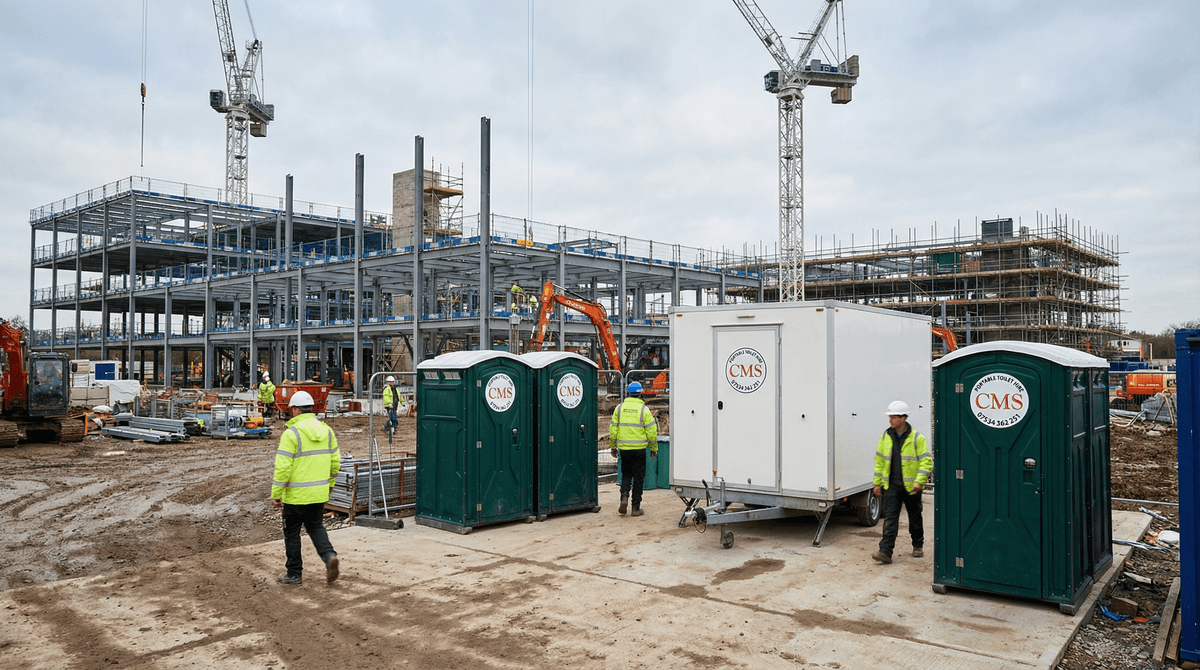
Where welfare provision matters most — and is hardest to arrange
A new-build on a greenfield plot with no services. A barn conversion at the end of a single-track lane. Infrastructure work on moorland where the nearest mains connection is two miles away. A forestry operation accessible only by unsurfaced track.
These are the sites where welfare provision is most critical, precisely because there is nothing else. No pub down the road. No building with a toilet. No cafe for a hot drink at break time. If the welfare is not on site, it does not exist.
Remote sites also present the greatest logistical challenges for delivery, servicing, and power supply. This guide covers how we handle those challenges and what you need to consider when planning welfare for a remote construction project.
No mains water — not a problem
Our welfare units carry on-board fresh water tanks and waste water tanks. They are designed to operate independently of a mains water supply, making them suitable for sites where no water infrastructure exists.
The on-board system provides:
- Hot and cold running water for handwashing
- Drinking water
- Water for the canteen kettle
Tank capacity and replenishment
Tank capacity is sufficient for a team of ten to fifteen workers for a full working week between service visits. The fresh water tank holds enough for daily use across the team, and the waste water tank has equivalent capacity.
During each service visit, our technician refills the fresh water tanks and empties the waste water tanks as part of the standard service. There is no additional charge for water replenishment — it is built into the service schedule.
For larger teams (fifteen-plus), or for sites with particularly high water usage, we schedule more frequent service visits to ensure the tanks do not run dry mid-week.
No mains power — several options
Remote sites rarely have a mains electrical connection, and welfare units need electricity for heating, hot water, lighting, refrigeration, and the canteen appliances. The solution is a generator, and there are several approaches depending on your site setup:
Dedicated generator hire
A small diesel generator dedicated to the welfare unit is the most common arrangement. The specification is straightforward — a 10kVA to 15kVA single-phase generator is typically sufficient for a standard . Options include:
- Hiring a generator from a specialist provider (we can advise on the specification)
- We can arrange generator hire alongside the welfare unit as a single package
Site generator
If your site already has a generator powering tools, lighting, or other equipment, the welfare unit can often be connected to the same supply, provided there is sufficient spare capacity. This avoids the cost of a second generator.
Fuel consumption
A small diesel generator powering a welfare unit during working hours uses approximately five to ten litres of fuel per day. Over a working week, that is twenty-five to fifty litres — a modest ongoing cost that is well within the operational budget of most construction projects.
The generator only needs to run during working hours. Outside those hours — evenings, weekends, shutdowns — it can be switched off, though in winter, keeping the heating on overnight prevents pipe freeze-ups.
Vehicle access for delivery
Welfare units are delivered on a flatbed vehicle equipped with a crane or HIAB for offloading. This is a substantial vehicle — similar in size to a skip lorry — and getting it to a remote site requires careful planning.
Access requirements
- Route width: Minimum three metres, ideally wider for safe manoeuvring
- Height clearance: No low bridges, overhead cables, or obstructions below four metres
- Ground conditions: The delivery point needs firm ground capable of supporting the combined weight of the vehicle and the welfare unit during offloading
- Turning space: The vehicle needs room to position for offloading and to leave the site. A turning circle or a straight run long enough for reversing
What we do before delivery
For remote sites where access is uncertain, we conduct a site visit before committing to delivery. Our driver or a member of the team visits the site, assesses the access route, identifies any potential obstacles, and confirms that delivery is feasible.
If the access is marginal — a narrow lane, a soft track, a tight gateway — we will tell you honestly rather than attempting a delivery that risks the vehicle getting stuck, the load being undeliverable, or damage to your access route.
Seasonal access considerations
Access conditions on remote sites can change dramatically with the seasons. A track that is firm and passable in July may be a muddy trench in November. If your hire spans multiple seasons, keep us informed about access condition changes so we can plan service visits accordingly.
In extreme conditions — prolonged rain, snow, frozen ground — we may need to adjust service timing to coincide with better conditions. We always prioritise getting the service done, but not at the cost of vehicle damage or site access damage.
Servicing logistics on remote sites
Weekly servicing continues regardless of how remote the site is. Our service vehicle follows the same access route as the delivery vehicle, and the service visit covers the full scope:
- Cleaning the toilet area and canteen
- Emptying waste water tanks
- Refilling fresh water tanks
- Restocking consumables — toilet paper, soap, paper towels
- Checking heating, hot water, and appliances
- Inspecting the unit for any damage or maintenance issues
Service scheduling
Remote sites are factored into our service routes. The additional travel time is accounted for in the scheduling, and the site receives the same service frequency and quality as any other location.
If access conditions change during the hire — a track deteriorates in wet weather, a gate arrangement changes, a new obstacle appears on the route — let us know promptly so we can adjust.
CDM compliance in remote locations
CDM 2015 welfare requirements apply equally to every construction site, regardless of location. There is no exemption for remote sites, and no reduced standard for sites that are difficult to access.
In fact, remote sites are precisely where full welfare provision is most important. When there are no alternative facilities within walking distance — no nearby building, no pub, no shop, no public toilet — every welfare requirement must be met on site. A welfare unit provides that comprehensive provision in a single, self-contained cabin.
HSE expects to see appropriate welfare on every construction site. On a remote site, a welfare unit demonstrates compliance clearly and unambiguously. An inspector arriving at a remote site and finding a properly equipped, well-maintained knows that the welfare obligations are being taken seriously.
What a welfare unit provides on a remote site
The welfare unit becomes the operational heart of a remote construction site. Beyond the regulatory requirements, it provides:
- A warm, dry space for breaks in all weather
- Hot drinks and food preparation facilities
- Somewhere to dry wet clothing and PPE — essential in the exposed conditions that remote sites often experience
- A place to store personal belongings securely
- Basic sanitation and hygiene facilities that would otherwise be entirely absent
For workers spending months on a remote site, the welfare unit is not an administrative box-ticking exercise — it is the facility that makes the working day bearable.
Our coverage area for remote sites
Chelford Mobile Services delivers welfare units to remote sites across Cheshire, Shropshire, Staffordshire, and Greater Manchester. This includes the rural areas that many providers avoid or surcharge — the Shropshire hills, the Staffordshire moorlands, the Cheshire plain, the fringes of the Peak District, and the agricultural areas between the major population centres.
If you are planning a project on a remote site, call us on 07534 362 251 to discuss access, power, and logistics. We will arrange a site visit to assess the practicalities before you commit.