The decision framework for site managers and principal contractors
This is the question we hear most often from site managers, principal contractors, and domestic clients setting up construction projects. The terminology is used loosely across the industry, which does not help — a welfare unit is not simply a bigger portable toilet, and choosing between them involves more than just comparing weekly rates.
This guide walks through the decision in a structured way, covering legal requirements, practical considerations, cost implications, and the scenarios where each option is the right choice.
The fundamental difference
A portable toilet provides one facility: a toilet. It is a self-contained, chemical-flush unit with hand sanitiser, toilet paper, and a lockable door. No mains water, no electricity, no heating. It serves one purpose and serves it well.
A welfare unit provides a comprehensive range of facilities in a single secure cabin: toilet cubicles, hot and cold running water for handwashing, a canteen or rest area with seating and a kettle, a drying room for wet PPE and clothing, heating, and lighting. It requires a power supply — either mains or a generator.
The difference is not just scale — it is scope. A portable toilet covers one regulatory requirement. A welfare unit covers all of them.
What CDM 2015 actually requires
The Construction (Design and Management) Regulations 2015 set out specific welfare requirements for construction sites in Schedule 2:
- Sanitary conveniences: Toilets at readily accessible places, adequate in number for the workforce, properly maintained
- Washing facilities: Hot and cold running water, soap, and towels or hand dryers, in the immediate vicinity of the sanitary conveniences and changing rooms
- Drinking water: Readily available, clearly marked, and with cups or a drinking fountain
- Rest facilities: A suitable place to rest during breaks, with adequate seating and tables, and means to prepare and heat food
- Changing rooms: Where workers need to change into or out of special clothing (PPE, site clothing), and facilities to store clothing not worn during working hours
- Drying facilities: Somewhere to dry wet clothing and PPE
A portable toilet satisfies the sanitary convenience requirement only. A welfare unit satisfies all six.
The question, therefore, is whether a portable toilet alone is sufficient for your site — or whether the regulations require the full provision that a welfare unit delivers.
When a portable toilet alone is sufficient
The following scenarios typically support a portable toilet as the sole dedicated welfare provision:
Small domestic sites
Sites with fewer than ten workers where the homeowner provides access to their kitchen for tea-making and rest breaks, their bathroom for handwashing, and where workers are not required to change into special clothing on site.
HSE applies the welfare requirements proportionately on small domestic sites. An inspector visiting a three-person extension project and finding a portable toilet on the driveway, combined with access to the client's kitchen, will typically consider the provision adequate.
Short-duration projects
Projects lasting days rather than weeks, where the brevity of the work makes full welfare provision disproportionate. A two-day repair job or a one-week groundworks contract, supplemented by access to nearby facilities, is a reasonable application of proportionality.
Sites adjacent to existing buildings
Where workers can access a nearby building for washing, rest, and meals — the client's office, an existing building on the same compound, a permanent facility within walking distance — a portable toilet provides the missing sanitary element.
Self-build projects on residential plots
Where the self-builder's existing home provides supplementary facilities and the construction team is small.
When you need a welfare unit
Ten or more workers with no alternative facilities
The more workers on site, the greater the welfare obligation. A team of fifteen with no nearby building has no access to hot water, no rest area, no drying facility, and no means of preparing food. A portable toilet alone leaves five of the six CDM welfare requirements unmet.
Remote sites
If the site is in a location with no buildings, no facilities, and no infrastructure within practical walking distance, every welfare requirement must be met on site. A welfare unit provides everything in one self-contained cabin.
Projects lasting months
Extended projects justify and require the investment in full welfare. Workers spending six months on a site need proper rest areas, hot water for washing, and drying facilities for wet clothing. A portable toilet alone is not acceptable for this duration and scale.
Principal contractor requirements
On larger commercial and infrastructure projects, the principal contractor's construction phase plan specifies welfare requirements. These are increasingly prescriptive, and many principal contractors now require full welfare units on any site with more than a handful of workers, regardless of what the minimum legal threshold might allow.
Meeting these requirements is not optional — it is a condition of your subcontract agreement.
HSE expectations
On a site of meaningful scale — significant workforce, substantial duration, complex operations — an inspector arriving to find only a portable toilet and no other welfare provision will ask pointed questions. The assessment is practical: could a reasonable person expect full welfare on a site like this? If the answer is yes, the absence of a welfare unit is an issue.
The detailed cost comparison
Portable toilet
- Weekly hire: £40 to £60, including weekly servicing
- No power requirement
- Minimal space requirement (1.2m x 1.2m)
- Standard delivery vehicle
- No infrastructure needed at the site
Welfare unit
- Weekly hire: £150 to £300, depending on specification
- Generator hire (if no mains): £50 to £100 per week
- Delivery and collection: £100 to £200 (one-off)
- Larger footprint (typically 6m x 2.4m)
- Heavier delivery vehicle (HIAB or crane-equipped)
- Electrical connection required
The real comparison
The welfare unit is three to five times the weekly cost of a portable toilet. But it replaces multiple separate provisions. Without a , you would need to arrange:
- A portable toilet
- A separate handwashing station with hot and cold running water
- A sheltered rest area with seating and food preparation facilities
- A drying space for wet clothing and PPE
- A heating source
Assembled individually, these provisions are more expensive, more difficult to manage, take more space, and look less professional than a single welfare unit.
Combining both on larger sites
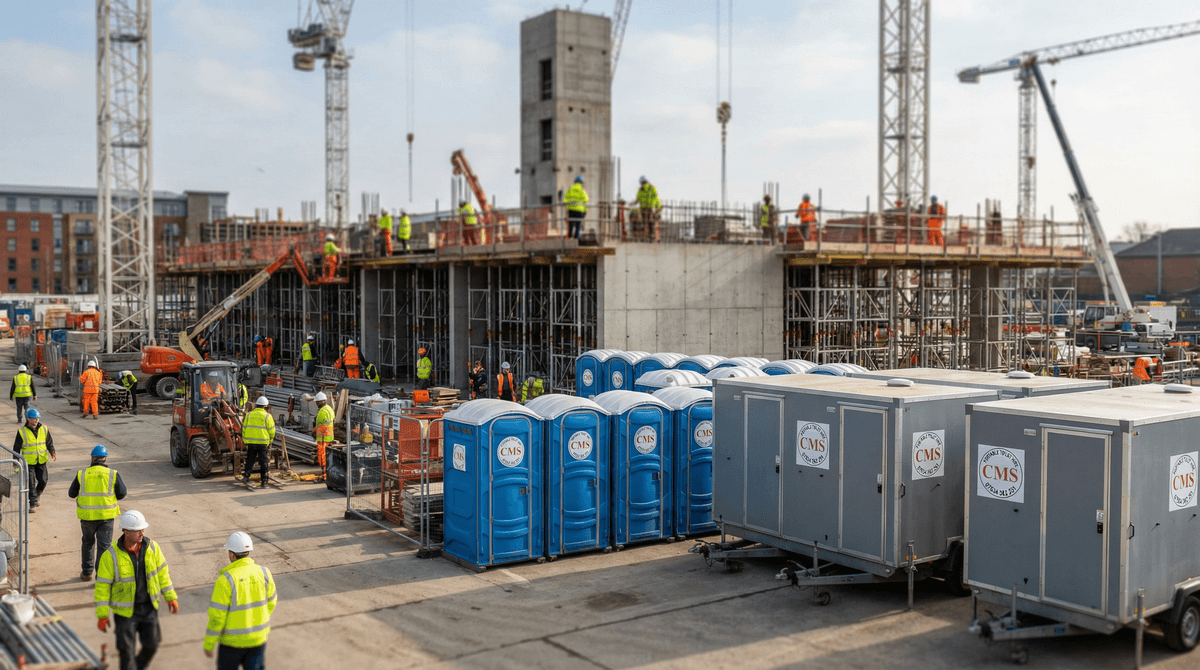
The most effective arrangement on larger sites combines a welfare unit at the main compound with portable toilets positioned at remote working areas:
- The welfare unit provides the full range of facilities — toilet, washing, rest, drying, heating — for the core team at the compound
- Portable toilets at working areas across the site provide convenient toilet access without the long walk back to the compound
- The combination ensures full CDM compliance across the entire project
This is the standard arrangement on major construction sites, housing developments, and infrastructure projects. It provides comprehensive welfare at the compound and practical toilet access everywhere else.
Our recommendation process
If you are unsure which option your site needs, the conversation is straightforward. Call us and tell us:
- How many workers will be on site
- How long the project will last
- Whether there are any existing facilities nearby
- What the principal contractor or client requires
- The site location and access conditions
We supply both portable toilets and welfare units across Cheshire, Shropshire, Staffordshire, and Greater Manchester. Our recommendation is based on what the site actually needs — not on maximising the hire value.
Call 07534 362 251.