Two different things that solve different problems
The terms get used interchangeably on construction sites, in tender documents, and even by some hire companies. But a portable toilet and a welfare unit are fundamentally different products that serve different purposes, and choosing the wrong one wastes money or leaves you non-compliant.
This guide sets out the differences clearly, so you can make the right decision for your site without overspending or under-providing.
What is a portable toilet?
A single, self-contained unit with a chemical flush, a lockable door, hand sanitiser, toilet paper, and ventilation. No water connection, no electricity, no heating. It provides one thing: a toilet. It does that one thing reliably and affordably.
The unit is approximately 1.2 metres square and 2.3 metres tall. It can be positioned on any firm, level surface, and serviced weekly by a technician with a purpose-built vehicle. No infrastructure is required at the site.
What is a welfare unit?
A larger cabin — typically the size of a shipping container or a towable trailer — that provides a comprehensive range of facilities in a single, secure structure:
- Toilet cubicles (often multiple)
- Hot and cold running water for handwashing
- A canteen or rest area with seating, a kettle, and a microwave
- A drying room for wet clothing and PPE
- Heating
- Lighting
- In some specifications, a changing area
Welfare units require an electrical connection — either a mains supply or a generator. They need more space for delivery and positioning, and the delivery vehicle is substantially larger than a standard portable toilet delivery.
CDM 2015: what the law actually requires
The Construction (Design and Management) Regulations 2015 set out specific welfare requirements for construction sites in Schedule 2. These include:
- Suitable and sufficient sanitary conveniences
- Washing facilities including hot and cold running water
- A supply of drinking water
- Rest facilities with seating and a place to prepare and eat food
- Changing rooms and facilities for drying clothing where needed
A portable toilet satisfies the sanitary convenience requirement — and only that requirement. It does not provide washing facilities with running water, a rest area, a canteen, or a drying room.
A welfare unit satisfies all of these requirements in a single cabin.
The question, then, is whether a portable toilet alone is sufficient for your site, or whether you need the full welfare provision that a welfare unit delivers.
When a portable toilet is enough
A portable toilet is typically sufficient in the following situations:
- Small domestic sites (fewer than ten workers): Where the homeowner provides access to kitchen and bathroom facilities for handwashing, rest breaks, and meals. The portable toilet covers the sanitary requirement; the client's house covers the rest.
- Short-duration projects (days to a few weeks): Where the brevity of the work makes full welfare provision disproportionate to the project scale.
- Sites adjacent to existing buildings: Where workers can access nearby facilities for washing, rest, and meals — a client's office, an existing building on the same compound, or similar.
- Self-build projects on residential plots: Where the self-builder's existing home provides the supplementary facilities.
In these cases, a portable toilet at forty to sixty pounds per week is the right, proportionate, cost-effective solution.
When you need a welfare unit
A welfare unit becomes necessary when:
- You have ten or more workers and no access to alternative facilities: The more workers on site, the greater the welfare obligation. A team of fifteen with no nearby buildings cannot rely on a portable toilet alone.
- The site is remote: If there are no buildings within practical walking distance, every welfare requirement must be met on site. A welfare unit provides everything in one place.
- The project lasts months, not weeks: Extended projects justify the investment in full welfare. Workers spending six months on a site need proper rest areas, hot water, and drying facilities.
- The principal contractor requires it: On larger commercial and infrastructure projects, the principal contractor's construction phase plan will specify welfare requirements. Increasingly, full welfare is expected regardless of the minimum legal threshold.
- HSE would reasonably expect to see it: On a site of meaningful scale, with a substantial workforce, for a significant duration, an inspector arriving to find only a portable toilet and no other welfare provision will ask questions.
At one hundred and fifty to three hundred pounds per week (plus power), a welfare unit costs more than a portable toilet — but it replaces multiple separate provisions that would collectively cost more and create logistical headaches.
The cost comparison in detail
Portable toilet
- Weekly hire: £40 to £60
- Includes: weekly servicing, consumables, delivery, and collection
- No power required
- Minimal space required
Welfare unit
- Weekly hire: £150 to £300
- Includes: regular servicing, consumables, routine maintenance
- Generator hire (if no mains): £50 to £100 per week additional
- Delivery and collection: £100 to £200 (one-off)
- Larger footprint and heavier delivery vehicle required
The real comparison
A welfare unit is three to five times the weekly cost of a portable toilet. But consider what you would need to replicate its facilities without one:
- A portable toilet (£40-60/week)
- A separate handwashing station with hot water
- A gazebo, cabin, or sheltered area for rest breaks and meals
- Somewhere to dry wet clothing and PPE
- A power supply for heating and appliances
Assembled individually, these provisions cost more, take more space, require more management, and look less professional than a single welfare unit. For sites that need full welfare, the unit is the most efficient solution.
Pairing both together on larger sites
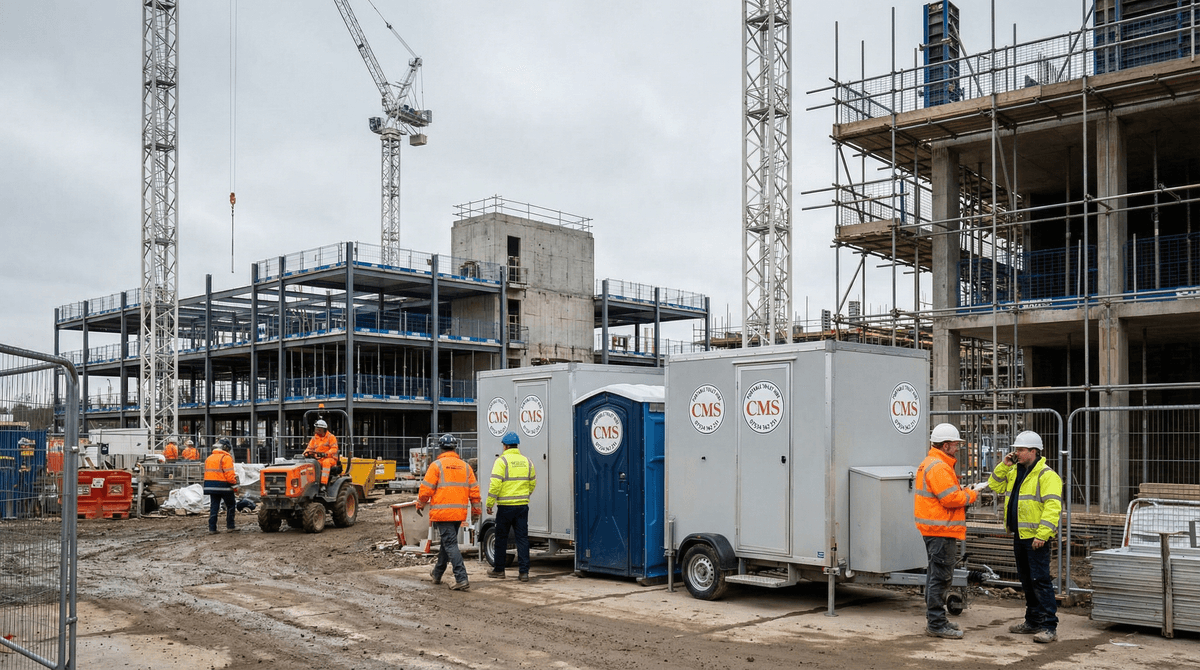
For larger construction sites, the most common and effective arrangement combines both:
- A welfare unit positioned at the main compound, providing the full range of facilities for the core team
- Additional portable toilets positioned at remote working areas around the site, providing convenient toilet access without the long walk back to the compound
This configuration ensures CDM compliance across the entire project while respecting the practical reality that workers fifty or a hundred metres from the compound need a toilet closer to hand.
Our recommendation
If you are uncertain which option suits your site, call us. We supply both portable toilets and welfare units across Cheshire, Shropshire, Staffordshire, and Greater Manchester, and our advice is based on what your site actually needs — not on maximising the hire value.
Tell us the site size, the team size, the project duration, the location, and whether there are any existing facilities nearby. We will recommend the right solution and give you a firm price.
Call 07534 362 251.