
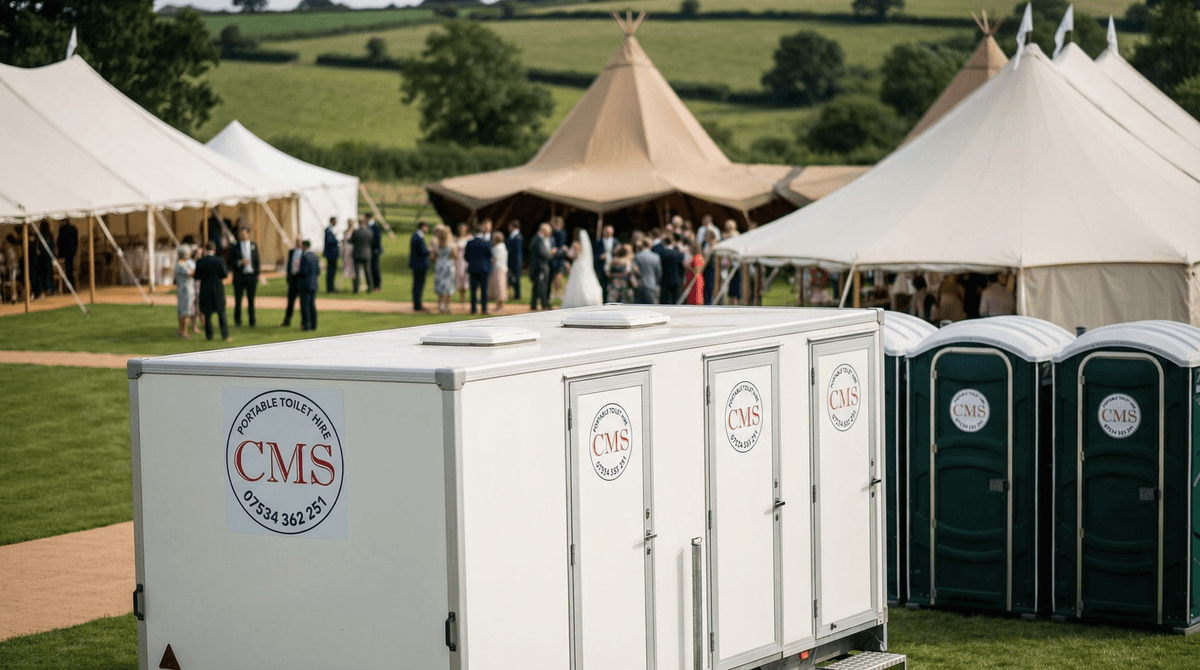
Large outdoor events — festivals, county shows, sporting fixtures, community celebrations — share one common logistical challenge that can make or break the guest experience: toilet provision. Get it right and nobody notices. Get it wrong and it becomes the defining memory of the day.
Planning toilet provision for a large event (500+ guests) is more complex than simply ordering a block of units. It requires understanding demand patterns, site logistics, regulatory requirements, and the difference between adequate and excellent provision.
---
Step 1: Establish Your Numbers
Attendance
Start with your expected total attendance, then determine the peak concurrent attendance — the maximum number of people on site at any one time. For gated events, this is your licensed capacity. For free-entry events, use your best estimate based on previous years or comparable events.
Duration
A 4-hour event generates different demand from a 12-hour event. Longer events mean more visits per person, which means more capacity is needed.
Demographics
The age and gender split of your audience affects toilet demand:
- Female attendees require more provision (approximately 2:1 compared to male provision with urinals)
- Family events with young children and older guests generate higher per-person demand
- Events with a young adult audience and heavy alcohol service generate the highest peak demand
---
Step 2: Calculate the Requirement
The Purple Guide (the industry standard for event safety in the UK) provides the following ratios:
Female Provision
- 1 toilet per 100 female attendees
Male Provision
- 1 toilet per 500 male attendees, plus
- 1 urinal per 150 male attendees
Accessible Provision
- At least 1 accessible unit per toilet cluster
- A minimum of 1 accessible unit per 75 disabled attendees (if known)
Adjustments
Increase provision by:
- 15-20% for events with significant alcohol consumption
- 10-15% for events lasting more than 8 hours
- 10% for events in hot weather (guests drink more fluids)
- An additional margin if the nearest alternative facilities are more than a few minutes' walk away
Example: 5,000-Person Festival (12 Hours, Licensed Bar)
Assuming a 50/50 gender split:
- Female: 2,500 ÷ 100 = 25 toilets, adjusted +20% = 30 toilets
- Male: 2,500 ÷ 500 = 5 toilets + 2,500 ÷ 150 = 17 urinals, adjusted +20% = 6 toilets + 20 urinals
- Accessible: minimum 3-4 units
- Total: approximately 36 toilets, 20 urinals, 4 accessible units
---
Step 3: Choose the Right Mix of Units
Standard Chemical Toilets
The workhorse of event toilet provision. Self-contained, no mains connections required, easy to position. Best for:
- General public provision at festivals and large outdoor events
- Supplementary provision at sporting events
- Locations where mains water and drainage are not available
Urinal Blocks
Essential for reducing queue times at male-heavy or mixed events. A 6-position urinal block processes visitors approximately three times faster than individual toilet units.
Luxury Toilet Trailers
For VIP areas, sponsor hospitality, and premium ticket holders. Provide a higher-quality experience with flushing toilets, hot water, and a more finished interior.
Accessible Units
Larger units with grab rails, wheelchair turning space, and wide doors. Required by law under the Equality Act 2010 and essential for any public event.
Baby Changing
At least one unit with a fold-down changing shelf for family events. Can be incorporated into the accessible unit or provided separately.
---
Step 4: Plan the Layout
Multiple Clusters, Not One Block
Distribute toilets in multiple clusters around the site rather than concentrating them in one location. This:
- Reduces walking distances for guests
- Prevents a single bottleneck
- Allows underused clusters to absorb overflow from busy ones
- Makes servicing more manageable
Cluster Placement
Position clusters near:
- Main stage or activity areas
- Food and drink concessions
- Entrance and exit points
- Camping areas (for multi-day events)
Separation
- Keep toilets downwind of food service and main activity areas
- Maintain a buffer zone of at least 20-30 metres from food preparation areas
- Ensure the approach to each cluster is clearly signed from the nearest pathway
Access for Servicing
Every cluster must be accessible to servicing vehicles without disrupting the event. Plan service routes that avoid pedestrian areas and do not cross vehicle exclusion zones.
---
Step 5: Arrange Servicing
Frequency
- Single-day events (up to 8 hours): Pre-event service plus one mid-event service
- Full-day events (8-16 hours): Pre-event service plus servicing every 4-6 hours during the event
- Multi-day events: At least once daily, with additional service during peak hours
What Servicing Includes
- Emptying waste tanks
- Cleaning interiors
- Restocking toilet paper, soap, and hand sanitiser
- Checking and repairing any damage
- Treating units with deodoriser
On-Site Attendants
For events over 1,000 guests, consider deploying on-site toilet attendants. Their role is to:
- Monitor cleanliness and supply levels throughout the event
- Carry out quick cleans between services
- Report and isolate damaged units
- Manage queues during peak periods
- Provide a visible reassurance to guests that facilities are being maintained
---
Step 6: Address Regulatory Requirements
Licensing Conditions
Your premises licence or temporary event notice may include specific conditions relating to toilet provision. Check with your local authority licensing team early in the planning process.
Environmental Health
The local authority environmental health team may require details of your toilet provision as part of the event management plan. They can also advise on ratios and placement.
Waste Disposal
All waste must be collected by a registered waste carrier and disposed of at a permitted facility. Waste transfer notes must be completed and retained for at least two years.
Equality Act 2010
Accessible toilet provision is a legal requirement for public events. Failure to provide adequate accessible facilities is unlawful discrimination.
---
Step 7: Prepare for the Unexpected
Weather
Rain transforms ground conditions and can make toilet areas inaccessible without preparation:
- Lay trackway or ground mats around and between units
- Have additional matting available as a contingency
- Consider raised platforms for units in flood-prone areas
Increased Attendance
If attendance exceeds expectations, you may need additional units:
- Agree a call-out arrangement with your hire provider for emergency delivery
- Identify locations on site where additional units could be placed at short notice
Equipment Failure
Units can be damaged by misuse, weather, or mechanical failure:
- Carry basic repair supplies (cable ties, duct tape, padlocks)
- Have a process for taking damaged units out of service and redirecting guests
- Know your hire provider's emergency response time
---
Step 8: Communicate
Signage
- Directional signs at every major junction on site
- Clear cluster identification ("Toilet Area A," "Toilet Area B")
- Accessible unit signage with the International Symbol of Access
- Hand-washing signage
Event Map
Include all toilet locations on the event site map, with cluster names that match the signage.
Staff Briefing
Every member of event staff should know:
- The location of every toilet cluster
- The location of the nearest accessible unit
- Who to contact if there is a problem with the facilities
- The servicing schedule and who is responsible
---
Summary Checklist
- Peak concurrent attendance calculated
- Toilet numbers calculated using Purple Guide ratios, adjusted for duration, alcohol, and demographics
- Mix of unit types determined (standard, urinals, luxury, accessible, baby changing)
- Multiple clusters positioned around the site
- Servicing schedule arranged with the hire provider
- On-site attendants deployed for events over 1,000 guests
- Licensing and regulatory requirements confirmed
- Ground protection and weather contingencies in place
- Emergency call-out arrangement agreed with the hire provider
- Signage, site map, and staff briefing complete
Toilet provision is a logistics problem, and like all logistics problems, it responds to planning. The time you invest before the event pays for itself many times over on the day.