
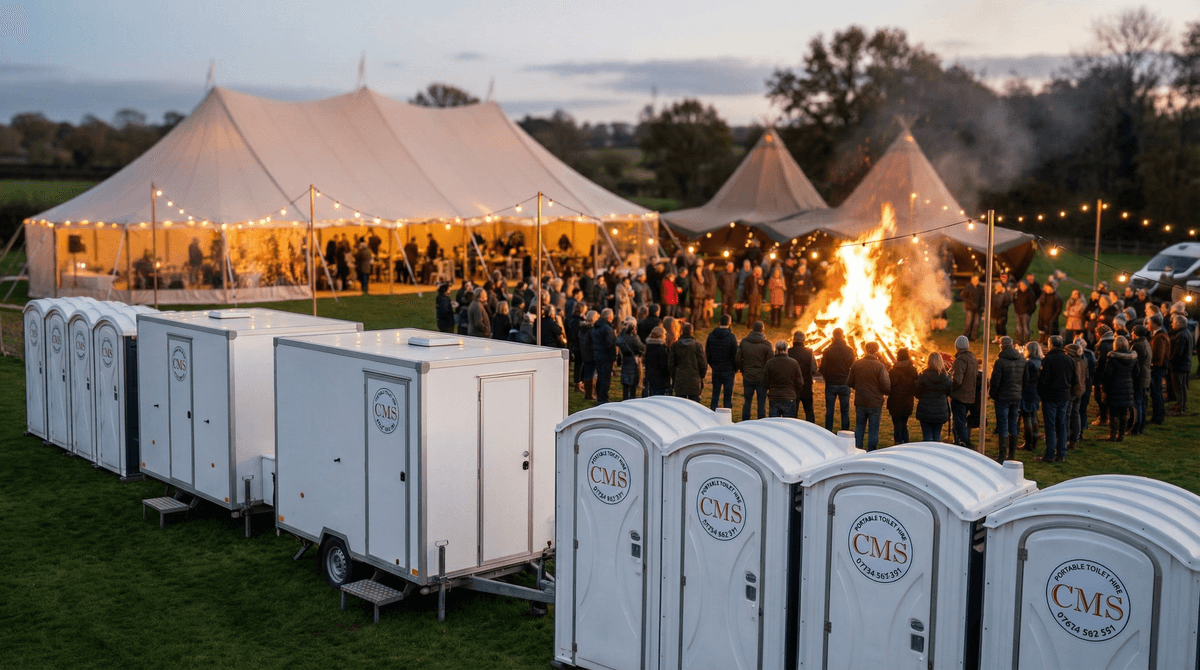
Bonfire night and firework events draw large crowds to open spaces that rarely have permanent toilet facilities. Fields, parks, recreation grounds, and private estates host thousands of spectators for a few intense hours — and the toilet provision needs to match the scale of the event, not the usual footfall of the site.
Here is what organisers need to know to get the toilet provision right for bonfire and firework events.
---
Why Bonfire Events Are Different
Short, Intense Demand
Most bonfire and firework events last 2-4 hours. Guests arrive within a 30-60 minute window, the display runs for 15-45 minutes, and then everyone leaves at once. Toilet demand peaks in the pre-display period and again immediately afterwards.
Cold Weather
November events mean cold temperatures, rain, and early darkness. Cold weather increases toilet demand — guests drink hot beverages and need the loo more frequently.
Dark Conditions
Bonfire events happen in the dark by definition. Toilet areas need robust lighting, clear signage, and safe pathways.
Alcohol
Many bonfire events include a bar or allow guests to bring their own drinks. Alcohol increases toilet demand significantly and changes the pattern of use — expect heavier demand later in the evening.
Mixed Demographics
Bonfire nights tend to attract families with young children alongside adults. This means a wide range of needs: standard units, accessible units, and facilities for families with babies and toddlers.
---
How Many Units Do You Need?
The Calculation
For a bonfire event with a licensed bar:
- Female guests: 1 toilet per 100 attendees
- Male guests: 1 toilet per 500 plus 1 urinal per 150
- Accessible units: At least 1 per toilet cluster
Example: 2,000-Person Bonfire Night
Assuming a 50/50 gender split:
- Female: 1,000 ÷ 100 = 10 toilets
- Male: 1,000 ÷ 500 = 2 toilets + 1,000 ÷ 150 = 7 urinals
- Accessible: 2 units
- Total: 12 toilets, 7 urinals, 2 accessible units
Adjust upward for heavy alcohol consumption and factor in the short, intense usage window.
---
Placement
Position Relative to the Display
- Place units a safe distance from the bonfire and firework launch area — your safety steward or fireworks contractor will advise on exclusion zones
- Choose a location that is accessible throughout the event, not one that gets blocked when the crowd gathers for the display
- Avoid placing units directly downwind of the bonfire — smoke drift makes the toilet area unpleasant and can obscure signage
Multiple Clusters
For events over 1,000 attendees, use at least two toilet clusters:
- One near the entrance/car park for arriving and departing guests
- One closer to the main spectator area
Ground Conditions
November ground is often soft and wet. Plan for mud:
- Lay trackway or heavy-duty ground mats on approach paths and around units
- Place units on the highest, best-drained ground available
- Have extra matting available in case conditions deteriorate during the event
---
Lighting and Safety
Pathway Lighting
The route from the event area to the toilets must be lit. Options include:
- LED festoon lights strung along the path
- Solar stake lights (less reliable in November due to short daylight hours — consider battery alternatives)
- Freestanding LED floodlights at the toilet cluster
Area Lighting
The toilet cluster itself needs ambient lighting so guests can see the units, read signage, and navigate safely. Battery-powered LED floodlights or tower lights are effective.
Trip Hazards
- Mark or remove guy ropes, tent pegs, and cable runs near the path
- Cover any power cables crossing the path with cable protectors
- Ensure the path is free from debris, equipment, and parked vehicles
Fire Safety
At a bonfire event, fire safety is paramount:
- Position toilet units well away from the bonfire and any secondary fires
- Ensure no flammable materials are stored near the units
- Keep a fire extinguisher at each toilet cluster
- Brief stewards on the fire evacuation route from the toilet area
---
Servicing
For a 2-4 hour event, units should be serviced and fully stocked immediately before the event. A mid-event service is not usually necessary unless attendance exceeds 2,000 or the event runs longer than 4 hours.
However:
- Station a volunteer or steward at the toilet area to monitor supplies and cleanliness
- Keep spare toilet paper, hand sanitiser, and bin liners on site
- Check units every 30-45 minutes during peak use periods
---
Family Provision
Bonfire nights are family events. Consider:
- A well-lit, clearly signed family toilet area separate from the main provision
- At least one unit with a baby changing shelf
- A family-friendly accessible unit large enough for a parent with a pushchair
- Hand-washing stations with soap and warm water (not just sanitiser)
---
Accessible Provision
The Equality Act 2010 requires accessible toilet provision at public events. For bonfire nights:
- Include at least one accessible unit per toilet cluster
- Place it on the firmest, most level ground available
- Ensure the approach path is accessible — no steps, steep gradients, or loose surfaces
- Sign the unit clearly with the International Symbol of Access
- Check that the internal lighting works and the lock is functional
---
After the Event
Collection Timing
Arrange collection for the morning after the event. Leaving units on site for longer than necessary incurs additional hire costs and may not be permitted by the landowner.
Site Reinstatement
Remove any trackway, matting, and signage from the toilet area. Check the ground for damage and report to the landowner if reinstatement work is needed.
Waste
All waste from the units is handled by the hire company as part of the service. Ensure that any litter around the toilet area is collected as part of the general site clear-up.
---
Checklist
- Attendance estimated and toilet numbers calculated
- Units ordered at least 4-6 weeks in advance (bonfire night dates are busy)
- Accessible units included
- Placement confirmed — clear of exclusion zones, downwind of bonfire, on firm ground
- Trackway or matting laid on approach paths and around units
- Pathway and area lighting installed and tested
- Fire extinguisher at each toilet cluster
- Signage in place — directional, accessible unit, hand washing
- Spare supplies on site — toilet paper, sanitiser, bin liners
- Steward or volunteer assigned to monitor the toilet area
- Collection arranged for the morning after
Bonfire nights are exciting, atmospheric, community events. The toilet provision should be invisible — well planned, well lit, and well maintained, so your guests can focus on the display.