
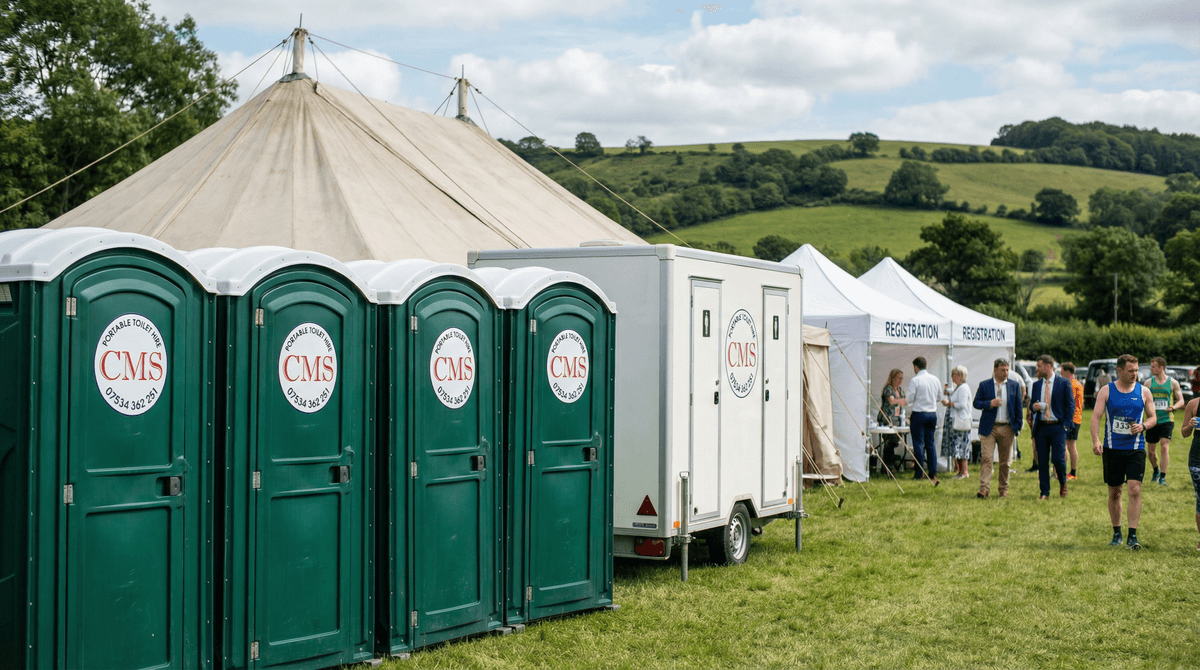
Charity runs, park runs, triathlons, obstacle courses, and community sports days have one thing in common: participants need toilet facilities before, during, and after the event, and most venues do not have nearly enough permanent provision to cope.
Getting the toilet provision right at a sporting event is not just about comfort — it is about logistics, runner welfare, and meeting your obligations as an organiser.
---
Pre-Event Demand: The Critical Window
The most intense period of toilet demand at a charity run or sporting event is not during the race — it is in the 30-90 minutes before the start. Participants arrive, register, warm up, and then queue for the toilets. Nervous pre-race visits are a universal phenomenon, and the queue at the start area toilet block is one of the defining images of mass-participation events.
Planning for the Start
- Place the majority of your toilet provision near the start area, registration zone, and warm-up area
- Calculate on the basis that 60-80% of participants will use the toilets at least once in the hour before the start
- Provide urinal blocks for male participants — they are significantly faster than individual cubicles and reduce queue times dramatically
- Open the toilets at least 60-90 minutes before the race start to spread demand
Numbers for the Start Area
As a guideline:
- Up to 500 participants: 8-10 standard units plus 1-2 urinal blocks
- 500-1,000 participants: 15-20 standard units plus 3-4 urinal blocks
- 1,000-5,000 participants: 30-50 standard units plus 6-10 urinal blocks
- Accessible units: minimum 1 per cluster, plus additional units if the event has a significant number of wheelchair participants or spectators
These numbers may seem high, but the compressed window of demand means that anything less results in queues that delay the start and frustrate participants.
---
During the Event
Route Provision
For events covering a distance of more than 5km, toilet provision along the route is important — particularly for longer events (half marathons, marathons, endurance races).
- Place units at approximately 5km intervals along the route, ideally near water stations
- 2-3 units per location is usually sufficient for events under 2,000 participants
- For larger events, increase to 4-6 units per location
- Position units at the side of the route with clear signage and easy entry/exit that does not disrupt the flow of runners
Spectator Provision
Do not forget the spectators. At popular charity runs and major sporting events, the spectator crowd can be as large as the field of participants. Provide toilet facilities near:
- The start/finish viewing area
- Key spectator points along the route
- Food and drink concessions
---
Post-Event Demand
After the finish, participants want to use the toilets again — and this time, they may also want to change clothes and clean up. Post-event demand is typically lower than pre-event demand but extends over a longer period as participants finish at different times.
Finish Area Provision
- Provide a cluster of units near the finish area, separate from the start area provision (even if the start and finish are at the same location)
- Include changing facilities if the event involves muddy conditions (obstacle courses, cross-country runs)
- Ensure units are serviced or checked between pre-event and post-event use — a unit that was full before the start will not last the finish
---
Shower Provision
For endurance events, obstacle courses, and muddy runs, shower facilities are highly valued by participants. Options include:
- Portable shower units — individual cubicles with hot water, similar in size to a standard portable toilet
- Shower trailers — multi-position trailers with changing areas, hot water, and drainage
Shower provision is not a regulatory requirement, but it significantly enhances the participant experience and is increasingly expected at ticketed events.
---
Accessible Provision
Charity runs and sporting events attract participants and spectators with a wide range of abilities. Accessible toilet provision is a legal requirement under the Equality Act 2010 and a practical necessity.
- Include at least 1 accessible unit at the start area, 1 at the finish area, and 1 at each major spectator point
- Place accessible units on firm, level ground with clear approach paths
- Ensure the route from the accessible parking area to the accessible toilet is barrier-free
Many charity runs include wheelchair categories or disabled participant entries. Confirm the specific needs of your event and adjust provision accordingly.
---
Placement and Ground Conditions
Start/Finish Areas
- Position units on firm, dry ground — car parks, hard standing, or well-drained grass
- Lay trackway or matting if the ground is soft, particularly for autumn and winter events
- Ensure servicing vehicle access without disrupting the event setup
Route Provision
- Position units at the side of the route on firm ground
- Avoid placing units at the bottom of hills, in gullies, or in areas prone to waterlogging
- Ensure units are visible from the route with clear signage
Spectator Areas
- Place units within easy walking distance of the main spectator areas
- Position downwind of food service
- Ensure adequate lighting for events that extend into the evening
---
Servicing
Before the Event
Units should be delivered fully serviced and stocked the day before the event (or early on the morning of the event if same-day delivery is necessary).
During the Event
For events with more than 1,000 participants:
- Arrange a mid-event service of the start/finish area units
- Station a volunteer or staff member at the main toilet cluster to monitor supplies and cleanliness
- Keep spare toilet paper, hand sanitiser, and bin liners on site
After the Event
Units should remain on site until the post-event period is complete — typically 2-3 hours after the last finisher. Arrange collection for the day after the event.
---
Regulatory Considerations
Event Licence
Your event licence or local authority approval may include conditions relating to toilet provision. Check with the relevant authority during the planning stage.
Environmental
All toilet waste must be disposed of legally — collected by a registered waste carrier and taken to a permitted facility. This is handled by the hire company as part of the service.
Health and Safety
As the event organiser, you have a duty of care under the Health and Safety at Work Act 1974 to provide adequate welfare facilities. This includes toilets, hand washing, and drinking water.
---
Communication
Participant Information
Include toilet locations in:
- Pre-event communications (entry confirmation email, event pack)
- The event map or site plan
- Signage at the venue
Volunteer Briefing
Brief your volunteer team on:
- The location of all toilet clusters
- The location of the accessible units
- Who to contact if a unit needs attention
- Where spare supplies are stored
---
Checklist
- Participant and spectator numbers estimated
- Toilet numbers calculated for start area, route, finish area, and spectator areas
- Accessible units included at every cluster
- Urinal blocks included for male provision at the start area
- Ground protection planned for soft ground
- Servicing arranged — pre-event, mid-event (if needed), and post-event
- Spare supplies on site
- Shower provision considered for endurance/obstacle events
- Toilet locations included in participant communications and event map
- Volunteer team briefed on toilet locations and contact procedures
- Collection arranged for the day after the event
Getting toilet provision right at a charity run or sporting event is logistics, not guesswork. Plan for the peak, provide enough units, and maintain them throughout the day.