
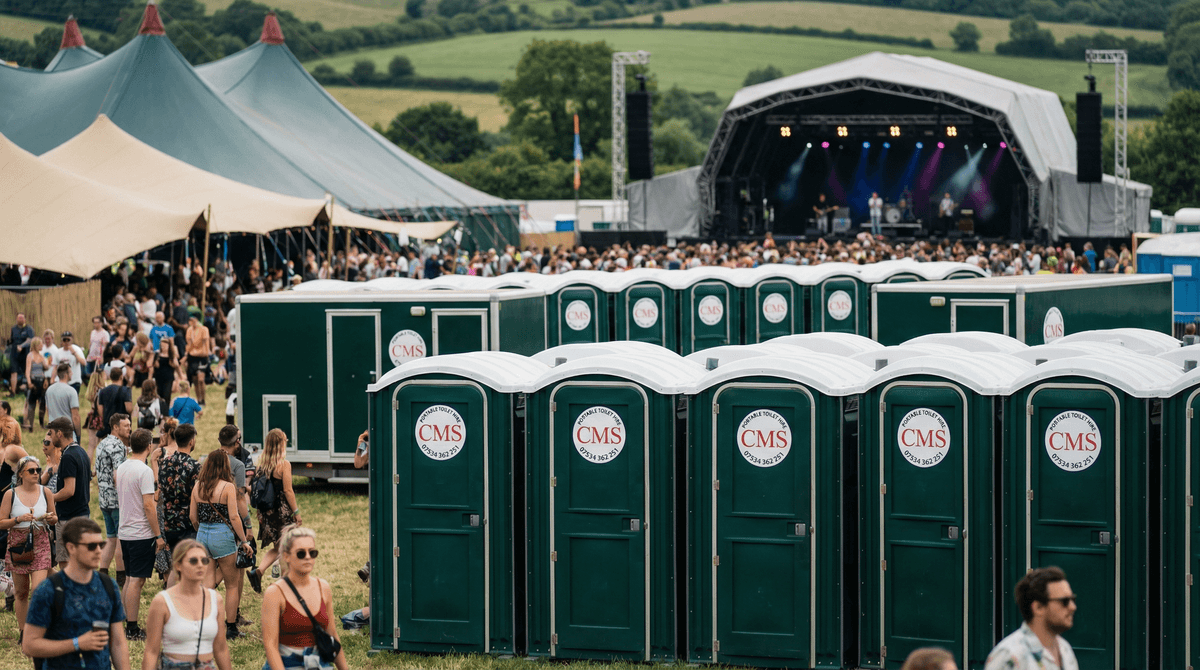
Festival toilet provision is one of the most consequential decisions a promoter makes. It shapes the attendee experience, drives social media sentiment, determines whether your event is remembered fondly or with disgust, and — critically — affects whether people buy tickets the following year.
This is a practical guide for promoters and production managers who need to get it right.
---
The Numbers
Purple Guide Ratios
The Event Safety Guide (the Purple Guide) provides the following baseline ratios for events with licensed alcohol sales:
- Female attendees: 1 toilet per 100
- Male attendees: 1 toilet per 500 plus 1 urinal per 150
- Accessible units: At least 1 per toilet cluster, or 1 per 75 disabled attendees (whichever is greater)
Adjustments for Festival Conditions
Festivals have characteristics that push demand above the baseline:
- All-day alcohol consumption: Increase provision by 20-25% above the Purple Guide ratios
- Camping festivals: Campers need facilities 24 hours a day, not just during performance hours. Provide separate campsite toilet clusters in addition to arena provision.
- Multi-day events: Cumulative use over 3-5 days puts additional strain on facilities. Higher servicing frequency and spare units are essential.
- Long travel distances: If the nearest toilet is a 10-minute walk, people will not use it. Multiple clusters distributed across the site are more effective than one large block.
Example: 10,000-Capacity Festival (3 Days, Licensed Bar, Camping)
Assuming a 50/50 gender split:
Arena provision:
- Female: 5,000 ÷ 100 = 50 toilets × 1.2 (alcohol adjustment) = 60 toilets
- Male: 5,000 ÷ 500 = 10 toilets + 5,000 ÷ 150 = 34 urinals × 1.2 = 12 toilets + 40 urinals
- Accessible: 6-8 units
Campsite provision:
- Additional cluster of 20-30 toilets and 10-15 urinals per 2,000-3,000 campers
Total arena provision: approximately 72 toilets, 40 urinals, 8 accessible units plus campsite clusters
---
Types of Unit
Standard Chemical Toilets
The backbone of festival toilet provision. Robust, self-contained, and available in large quantities.
Urinal Blocks
Essential for managing male queue times. A 6-position urinal block processes visitors approximately three times faster than individual cubicles. Deploy them throughout the arena, especially near stages and bars.
Compost Toilets
An increasingly popular option for festivals with environmental commitments. They use no water or chemicals and produce compost as a by-product. They require different management (sawdust replenishment, different servicing) but can significantly reduce the environmental impact of the event.
Luxury Toilet Trailers
For VIP, backstage, artist, and hospitality areas. The standard expected by artists, sponsors, and premium ticket holders.
Accessible Units
Larger units with grab rails, wheelchair space, and wide doors. Position these on the most level, accessible ground at each cluster.
---
Site Layout and Placement
Arena Clusters
- Place a toilet cluster within a 2-3 minute walk of every point in the arena
- Position clusters between stages, near bars and food concessions, and at arena entrances/exits
- Use multiple smaller clusters rather than one or two large ones — this distributes demand and reduces queue lengths
- Position downwind of food and seating areas
Campsite Clusters
- Distribute toilet clusters throughout the campsite, aiming for no more than a 3-minute walk from any tent
- Position near campsite entrance/exit points and communal areas
- Provide adequate lighting — campers use facilities throughout the night
Backstage and Artist Area
- Dedicated luxury toilet trailers accessible only to artists, crew, and authorised personnel
- Position near the production office, green rooms, and catering area
- Higher servicing frequency than general provision
Car Parks and Arrival Areas
- Toilet provision near the main car parks and at the entrance queue area
- Arriving festival-goers have often been travelling for hours and need facilities before they reach the arena
---
Servicing
Frequency
Festival toilet servicing is intensive:
- Arena toilets: Service every 4-6 hours during operating hours, or when waste tanks reach 75% capacity
- Campsite toilets: Service at least twice daily — early morning and late afternoon
- Backstage/VIP: Service 2-3 times daily
- Urinal blocks: Service at least twice daily; more often for high-traffic positions
Night Service
For camping festivals, nighttime servicing is important. Campsite toilets see heavy use during the small hours. A nighttime servicing pass (around 2-3am) keeps facilities usable through to morning.
Servicing Infrastructure
For a 10,000+ capacity festival, you need:
- A dedicated servicing crew on site throughout the event
- Vacuum tanker(s) for waste removal
- A supply of chemicals, toilet paper, hand sanitiser, and cleaning materials
- Spare units to replace any that are damaged or overflow
---
Hygiene and Cleaning
On-Site Attendants
For festivals over 5,000 capacity, deploy on-site toilet attendants:
- At least 1 attendant per toilet cluster during peak hours
- Duties include spot cleaning between services, restocking, reporting damage, and managing queues
- Attendants should have radio contact with the production office
Cleaning Supplies
Maintain a central store of:
- Toilet paper (in bulk — festivals go through vast quantities)
- Hand sanitiser refills
- Cleaning chemicals and spray bottles
- Disposable gloves and aprons
- Bin liners
- Emergency repair supplies (cable ties, duct tape, padlocks)
---
Ground and Access
Ground Protection
Festival sites take a battering, and the toilet areas are among the worst affected:
- Lay heavy-duty trackway on all approach paths and around clusters
- Use mesh matting or rubber mats at unit entrances
- Have additional matting available for deployment as conditions deteriorate
- In extreme conditions, consider moving units to alternative locations
Servicing Access
- Plan service vehicle routes that avoid pedestrian areas and do not cross safety zones
- Service routes should be documented in the event management plan
- Briefing for servicing drivers should include speed limits, one-way routes, and timings to avoid peak pedestrian flow
---
Environmental Considerations
Waste Disposal
All festival toilet waste must be collected by a registered waste carrier and disposed of at a permitted facility. For a multi-day festival, this means multiple tanker loads during the event, plus a final clear-out after the festival ends.
Environmental Impact
Festival toilet provision generates significant waste. Consider:
- Compost toilets for part of the provision — they produce no liquid waste and create a useful by-product
- Biodegradable chemicals in standard units
- Reducing single-use plastics (soap dispensers, sanitiser bottles) where possible
- Tracking and reporting waste volumes as part of the festival's environmental management plan
---
Health and Safety
Risk Assessment
The toilet provision must be covered in the event risk assessment, including:
- Slip, trip, and fall hazards around the toilet area
- Fire risk (especially near generators and fuel stores)
- Lone working risk for servicing crew and attendants
- Manual handling risk for servicing operations
- Biological hazard risk from waste spillage
Licensing Conditions
The event's premises licence or temporary event notice may include specific conditions relating to toilet provision. Check with the local authority licensing team and the Safety Advisory Group (SAG).
Emergency Plan
Include the toilet areas in the event emergency plan:
- Evacuation routes from toilet clusters
- Fire extinguisher provision at each cluster (especially near generators)
- Medical access to the toilet area
- Communication plan for toilet attendants in an emergency
---
Post-Festival
De-Rig
- All units must be emptied and removed after the festival
- Trackway and matting must be lifted and the ground inspected for damage
- Any waste spillage must be cleaned up and the area left in its pre-event condition (or as close as possible)
Review
After every festival, review the toilet provision:
- Were there queues that exceeded acceptable lengths? Where and when?
- Did any clusters run out of supplies or become unusable?
- What was the feedback from attendees, staff, and the servicing crew?
- What would you change next year?
This review feeds directly into the planning for the next edition and is one of the most valuable tools for improving the attendee experience year on year.
---
Checklist
- Capacity and demographics confirmed
- Unit numbers calculated with festival-specific adjustments
- Mix of unit types confirmed (standard, urinals, compost, luxury, accessible)
- Clusters positioned across arena, campsite, backstage, and car park
- Servicing schedule confirmed — frequency, crew, tanker, supplies
- On-site attendants recruited and briefed
- Ground protection planned and delivered
- Lighting at every cluster (especially campsite)
- Signage at every pathway junction and cluster
- Emergency plan includes toilet areas
- Environmental management plan includes waste disposal
- Licensing conditions reviewed and complied with
- Post-festival review scheduled
Festival toilets are logistics at scale. The difference between a festival people love and one they vow never to return to often comes down to the quality of the sanitary provision. Invest the time, invest the money, and get it right.