
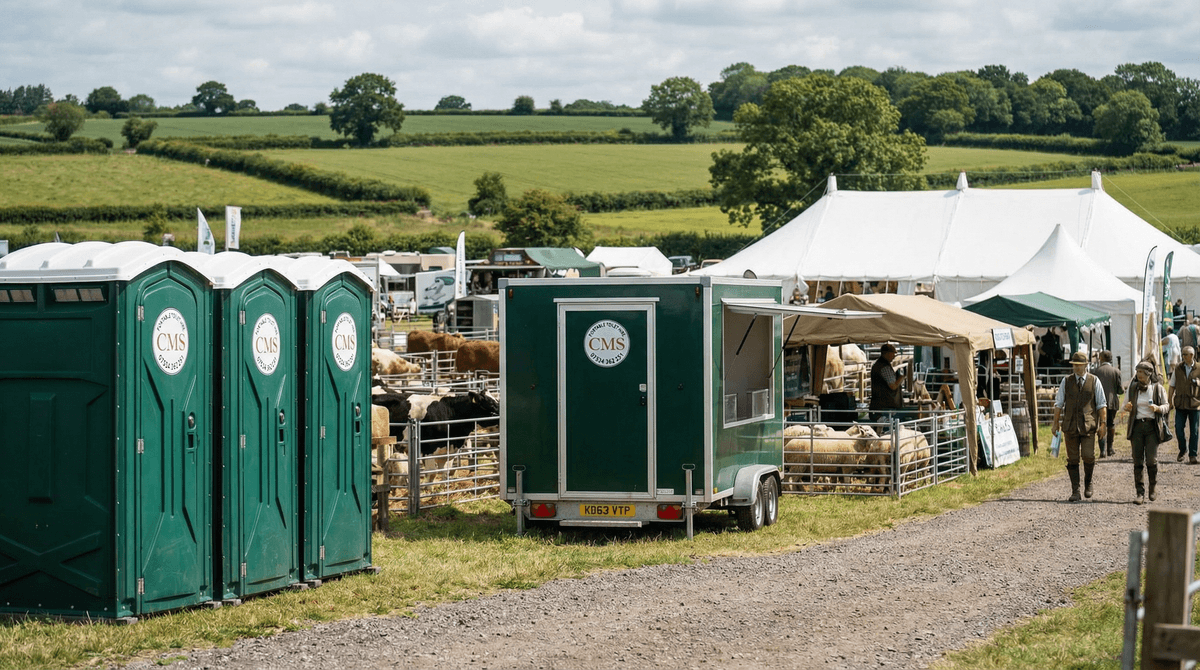
Equestrian events — from local riding club shows to major championship competitions — present specific challenges for toilet provision. The combination of long days, mixed user groups (competitors, grooms, officials, and spectators), rural settings, and the ever-present reality of British weather means that the usual rules of thumb need adapting.
Here is what organisers need to get right.
---
Who Needs Facilities?
Unlike a music festival or community event, an equestrian event has distinct groups of users with different needs and different patterns of use.
Competitors and Grooms
- Arrive early (often 6-7am) and stay all day
- Spend time in the lorry park, warm-up arenas, and collecting ring
- Need facilities close to the competition area, available from the moment they arrive
- May need to wash hands after handling horses and tack
Officials and Volunteers
- Stewards, judges, arena party, and medical staff may be on site for 10-12 hours
- Often stationed in specific locations (ringside, scorers' tent, secretary's office) and need nearby facilities
- A dedicated unit near the officials' area is appreciated and practical
Spectators
- Arrive later, stay for a shorter period, but may attend in large numbers — particularly at major shows
- Need facilities near the main spectator areas, trade stands, and food concessions
- Include families, older visitors, and people with disabilities
---
How Many Units?
Calculating the Requirement
Work out the peak concurrent number of people on site at any one time, broken down by user group.
Competitor and staff provision:
- 1 toilet per 25-30 competitors and grooms
- Place in or near the lorry park and warm-up area
Spectator provision:
- Female spectators: 1 toilet per 100
- Male spectators: 1 toilet per 500 plus 1 urinal per 150
- At least 1 accessible unit per cluster
Officials and volunteers:
- 1 toilet per 15-20 officials/volunteers, positioned near their work area
Example: County-Level Horse Show
- 200 competitors and grooms, 1,500 spectators, 50 officials
- Competitor area: 7-8 toilets
- Spectator area: 8 female toilets, 2 male toilets, 10 urinals, 2 accessible units
- Officials: 3 toilets
- Total: approximately 20 toilets, 10 urinals, 2 accessible units
---
Placement
The Lorry Park
The lorry park is the hub of activity for competitors. Place a cluster of toilets at the edge of the lorry park, accessible without walking through the main event area.
- Choose firm ground (lorry parks are often on grass that gets churned up by heavy vehicles)
- Ensure units are positioned away from horse trailers and loading ramps
- Provide hand-washing facilities — competitors handle horses, tack, and feed
The Main Arena and Spectator Area
The primary spectator toilet cluster should be visible and well-signed from the main grandstand or viewing area, but positioned:
- Downwind of the food concessions and seating
- Away from the collecting ring and warm-up arenas (horses and crowds do not mix well in narrow spaces)
- On firm, dry ground with a well-defined path
Trade Stand Area
For larger shows with a significant trade village, consider a small additional cluster near the trade stands, particularly if the trade area is some distance from the main spectator facilities.
---
Hand Washing
Equestrian events require proper hand-washing facilities, not just hand sanitiser. Visitors may touch horses, handle hay and feed, and walk through areas contaminated with horse droppings.
What to Provide
- Portable hand-wash stations at every toilet cluster
- Hot and cold (or warm) running water
- Liquid soap in dispensers
- Paper towels
- Additional hand-wash stations near the horse lines and petting or meet-the-horse areas
Regulatory Note
If the event includes food concessions, food hygiene regulations require separate hand-washing facilities for food handlers with hot water and soap. These are in addition to the public hand-wash stations.
---
Ground Conditions
Equestrian events often take place on farmland or showground grass. Ground conditions can deteriorate rapidly, particularly:
- In the lorry park (heavy vehicles churn up the surface)
- On approach paths to toilet areas (foot traffic concentrates wear)
- Around water troughs and wash-down areas (water runoff softens the ground)
Solutions
- Lay trackway or heavy-duty ground mats on all approach paths and around units
- Position units on the highest, best-drained ground available
- Have additional matting available as a contingency
- Place entrance mats at each unit door to reduce mud being tracked inside
- For multi-day events, rotate mat placement if possible to allow ground recovery
---
Accessible Provision
Equestrian events attract a wide range of visitors, including people with disabilities. The Equality Act 2010 requires accessible toilet provision at public events.
- Include at least 1 accessible unit in each toilet cluster
- Place it on the firmest, most level ground available
- Ensure the approach path is free from obstacles, steps, and loose surfaces
- Sign clearly with the International Symbol of Access
- Consider the needs of visitors with assistance animals — the accessible unit should accommodate them
Para-equestrian competitions have additional requirements. If your event includes para classes, consult with the governing body (British Equestrian) on specific welfare provision for para riders and their support teams.
---
Servicing
Frequency
Equestrian events run long days — often 7am to 6pm or later. This demands robust servicing:
- Single-day shows: Pre-event service plus a mid-day service for shows over 6 hours
- Multi-day shows: Daily professional servicing plus volunteer checks during the day
- Major championships: Twice-daily servicing plus on-site attendants
Monitoring
Station a volunteer at the main toilet clusters, particularly during peak periods (lunchtime, between classes, prize-giving). Their job is to:
- Check and replenish supplies
- Report any damage or blockages
- Manage queuing if needed
- Keep the area tidy and safe
---
Weather
British equestrian events run in all weathers. Plan for:
Rain
- Additional trackway and matting
- Increased servicing frequency (wet footwear brings more dirt into units)
- Check drainage around units — standing water near the entrance is a hygiene and safety issue
Heat
- More frequent servicing to manage odour
- Additional drinking water provision
- Shade over hand-wash stations and queuing areas if possible
Wind
- Secure lightweight units with ground anchors or sandbags
- Position in sheltered locations where possible
- Check units after high winds for any movement or damage
---
Event-Specific Considerations
Horse Trials and Cross-Country Courses
Cross-country courses may extend over several kilometres. Consider providing a small number of units at key spectator viewing points along the course, as well as the main event area.
Dressage Championships
Dressage events attract a more formally dressed audience. Consider upgrading to luxury toilet trailers for the main spectator area.
Pony Club and Riding Club Shows
These are family-friendly events with a high proportion of young riders and their families. Include baby changing facilities and child-friendly hand-washing stations.
---
Checklist
- All user groups identified — competitors, grooms, officials, spectators
- Numbers calculated by group with appropriate ratios
- Toilet clusters positioned near lorry park, main arena, and trade area
- Accessible units included at every cluster
- Hand-washing stations at every cluster and near horse handling areas
- Ground protection in place — trackway, matting, entrance mats
- Servicing schedule confirmed — pre-event, mid-event, daily for multi-day shows
- Volunteer assigned to monitor and restock during the event
- Weather contingency plan in place
- Signage installed — directional, accessible, hand washing
- Food handler hand-washing provided separately where required
- Waste disposal confirmed with hire provider
Equestrian events test toilet provision with long hours, diverse user groups, and unpredictable ground conditions. Thorough planning ensures the facilities match the professionalism of the competition.