
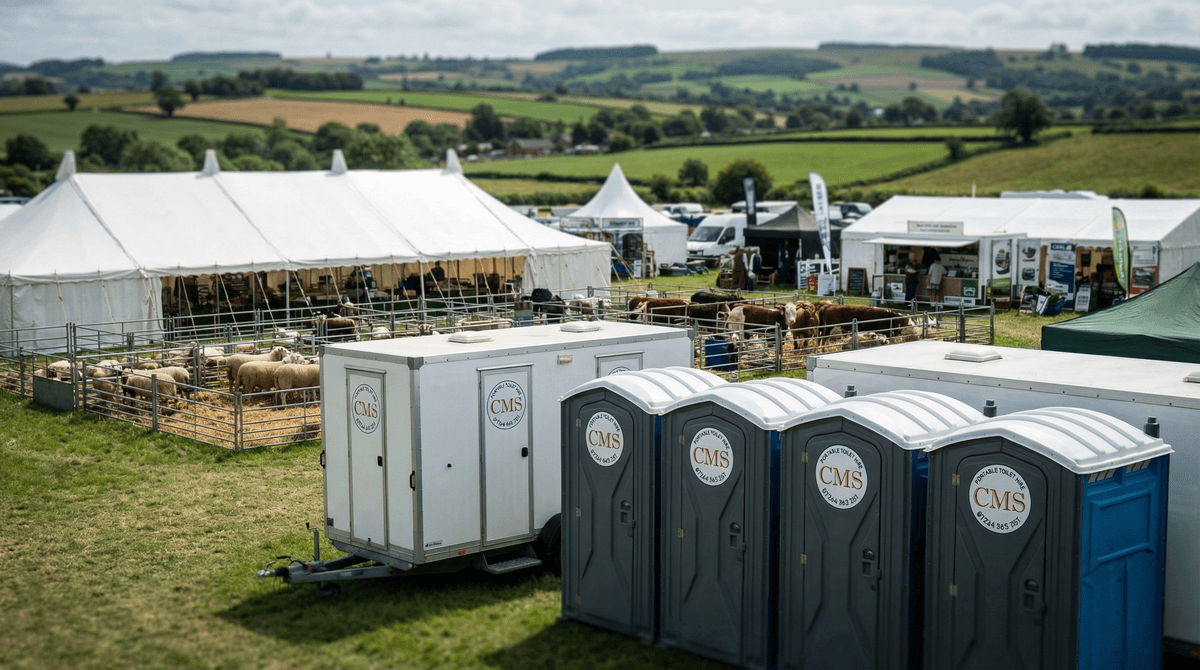
Agricultural shows, country fairs, and rural events are a cornerstone of the British calendar. From county shows attracting tens of thousands of visitors over multiple days to small village produce competitions with a few hundred, they all share one logistical challenge: providing adequate toilet facilities on sites that were fields last week and will be fields again next week.
Here is what organisers need to get right.
---
The Unique Demands of Agricultural Shows
All-Day, Multi-Day Events
Agricultural shows typically run from early morning (8am or earlier for exhibitors) to late afternoon (5-6pm). Major shows run over two or three days. The toilet provision must serve visitors, exhibitors, judges, stewards, and trade stand operators for the full duration.
Multiple User Groups
- Visitors/spectators — arrive throughout the morning, peak at lunchtime, depart gradually through the afternoon
- Exhibitors — arrive before gates open, stay all day, need facilities near livestock lines and showgrounds
- Trade stand operators — set up the day before, stay all day, need nearby facilities
- Stewards and officials — stationed at specific locations around the site, need accessible provision nearby
- Contractors and crew — setup and breakdown teams who may be on site for several days before and after the public event
Animals and Hygiene
Where livestock, poultry, and other animals are present, hand-washing provision must go beyond the usual standard. The risk of zoonotic infection (E. coli, cryptosporidium, salmonella) at agricultural events is well documented. Defra and local authority environmental health teams expect robust hygiene measures.
Rural Sites
Most agricultural showgrounds are on farmland or rural parkland. Mains water, mains drainage, and mains power may not be available at all toilet locations. Self-contained chemical units are often the only practical option for peripheral locations.
---
How Many Units?
Visitor Provision
Use the Purple Guide ratios as a baseline:
- Female visitors: 1 toilet per 100
- Male visitors: 1 toilet per 500 plus 1 urinal per 150
- Accessible units: At least 1 per toilet cluster
Exhibitor and Staff Provision
Separate from visitor provision:
- 1 toilet per 25-30 exhibitors (available from setup time)
- 1 toilet per 20 trade stand operators
- 1 toilet per 15-20 stewards and officials
Example: County Show, 8,000 Daily Visitors
Assuming a 50/50 gender split:
- Female visitors: 4,000 ÷ 100 = 40 toilets
- Male visitors: 4,000 ÷ 500 = 8 toilets + 4,000 ÷ 150 = 27 urinals
- Accessible: 4-6 units
- Exhibitor/staff: 15-20 additional units
- Total: approximately 63-68 toilets, 27 urinals, 6 accessible units
---
Hand Washing: The Critical Issue
At any event involving animals, hand washing is a public health priority. HSE and local authority guidance is clear: hand-washing facilities with running water and soap must be available wherever the public has contact with animals.
Requirements
- Portable hand-wash stations at every toilet cluster, with warm running water, liquid soap, and paper towels
- Additional hand-wash stations at the exits of all animal contact areas (livestock lines, petting farms, animal handling areas)
- Signage prominently placed: "Wash Your Hands After Touching Animals"
Hand sanitiser is a useful supplement but does not replace hand washing with soap and water, particularly in the context of animal events where faecal contamination is a risk.
---
Placement
General Principles
Distribute toilet clusters around the showground, not concentrated in one location:
- Near the main ring and grandstand
- Adjacent to the food court and bar area
- Near the livestock lines (for exhibitors)
- Near the trade stand area
- At or near the main entrance and car parks
Separation from Animals and Food
- Maintain a buffer zone between toilet units and livestock holding areas
- Position toilets away from food preparation and service areas (but near enough for convenience)
- Ensure drainage from the toilet area does not flow towards animal or food areas
Ground Conditions
Agricultural showgrounds are vulnerable to weather:
- Lay trackway or heavy-duty matting on all approach paths
- Position units on the highest, best-drained ground available
- Have additional matting on standby
- After rain, check and reinforce paths before the gates open
---
Servicing
Multi-Day Shows
- Daily professional servicing before gates open
- Mid-day servicing on peak days (typically Saturday)
- On-site monitoring by a volunteer or staff member throughout the day
Single-Day Shows
- Pre-event service on the morning of the show
- Mid-day check and restock
- On-site monitor for larger events
Exhibitor Toilets
Exhibitor areas are in use from well before the public gates open. Ensure these units are serviced and stocked before exhibitors arrive, which may mean a very early service call.
---
Accessible Provision
Agricultural showgrounds can be challenging for wheelchair users and people with mobility impairments. Position accessible units:
- On the firmest, most level ground available
- Near the main entrance and main ring
- On hard paths or with trackway approaches
- With clear signage visible from a distance
If the showground has a designated disabled parking area, position an accessible toilet unit nearby.
---
Weather Planning
British agricultural shows take place from May to October, covering the full range of weather conditions:
Rain
- Additional trackway and matting — budget for more than you think you will need
- Drainage management around toilet clusters
- Increased cleaning frequency (mud tracked into units)
- Poncho or umbrella station near the toilet area (optional but appreciated)
Heat
- More frequent servicing to manage odour
- Additional drinking water provision
- Shade over hand-wash stations if practicable
Wind
- Secure lightweight units with ground anchors or sandbags
- Position in sheltered locations where possible (lee of buildings, hedges, or vehicles)
- Check units after gusts for movement or damage
---
Regulatory Considerations
Environmental Health
The local authority environmental health team is likely to inspect the event. They will check:
- The number and condition of toilet facilities
- Hand-washing provision, particularly in relation to animal contact areas
- Food handler hygiene facilities (separate from public provision)
- Waste disposal arrangements
Defra Guidance
Where livestock is present, Defra's guidance on preventing E. coli and other zoonotic infections at animal events applies. Key requirements include:
- Dedicated hand-washing stations at every exit from animal contact areas
- Clear signage advising hand washing
- No eating, drinking, or smoking in animal areas
- Adequate toilet provision separate from animal areas
Waste Disposal
All toilet waste must be collected by a registered waste carrier and disposed of at a permitted facility. For multi-day shows, waste collection may need to take place during the event, not just at the end.
---
Checklist
- Attendance estimated — visitors, exhibitors, staff, trade stands
- Toilet numbers calculated for each user group
- Clusters positioned around the showground
- Hand-wash stations at every cluster AND at animal contact area exits
- Accessible units included at every cluster
- Ground protection in place — trackway, matting, entrance mats
- Servicing schedule confirmed — daily for multi-day shows, plus mid-day for peak days
- On-site monitor assigned for each day
- Weather contingency plan in place
- Environmental health requirements confirmed
- Defra guidance on animal events followed
- Food handler hygiene facilities arranged separately
- Waste disposal arrangements confirmed
- Signage in place — directional, hand washing, accessible
Agricultural shows are a celebration of rural life. The toilet provision should support that celebration by keeping visitors comfortable, healthy, and free to enjoy the event without a second thought about the facilities.