Accessible Portable Toilets: Understanding Your Legal Obligations
If you are organising an event, managing a construction site, or running any operation where the public or workforce needs toilet facilities, accessibility is not optional. UK law is clear on this point, and the consequences of getting it wrong range from enforcement action to reputational damage that no business can afford.
This guide sets out exactly what the law requires, what accessible portable toilets look like in practice, and how to make sure your provision meets the standard.
---
What the Law Actually Says
The Equality Act 2010
The Equality Act 2010 is the primary piece of legislation governing accessibility in the UK. Under this Act, service providers and employers have a duty to make reasonable adjustments to ensure that disabled people are not placed at a substantial disadvantage compared to non-disabled people.
This duty applies to:
- Employers providing welfare facilities on construction sites or other workplaces
- Event organisers offering facilities to the public
- Any business or organisation providing services to the public
The key phrase is "reasonable adjustments." What counts as reasonable depends on the context, but providing at least one accessible toilet unit where toilets are offered is almost always considered reasonable.
Building Regulations and British Standards
BS 8300 sets out design recommendations for accessible toilet facilities. While portable toilets are not permanent structures, the principles in BS 8300 inform what is considered adequate provision. Key points include:
- Minimum internal dimensions of 1500mm x 2200mm
- A turning circle of at least 1500mm diameter
- Grab rails on both sides of the toilet
- A door that opens outwards or slides, with a minimum clear opening width of 900mm
- A flush mechanism and lock that can be operated with a closed fist
CDM Regulations 2015
On construction sites, the Construction (Design and Management) Regulations 2015 require that welfare facilities are suitable and sufficient. Schedule 2 of the CDM Regulations specifically requires that facilities are accessible to all workers, including those with disabilities.
---
How Many Accessible Units Do You Need?
There is no single formula that applies to every situation, but the following guidelines are widely accepted:
- Events: At least one accessible unit per event, with a ratio of approximately 1 accessible unit for every 10-15 standard units
- Construction sites: At least one accessible unit where workers with disabilities are present or may be present
- Public-facing sites: At least one accessible unit wherever standard toilets are provided
Practical Considerations
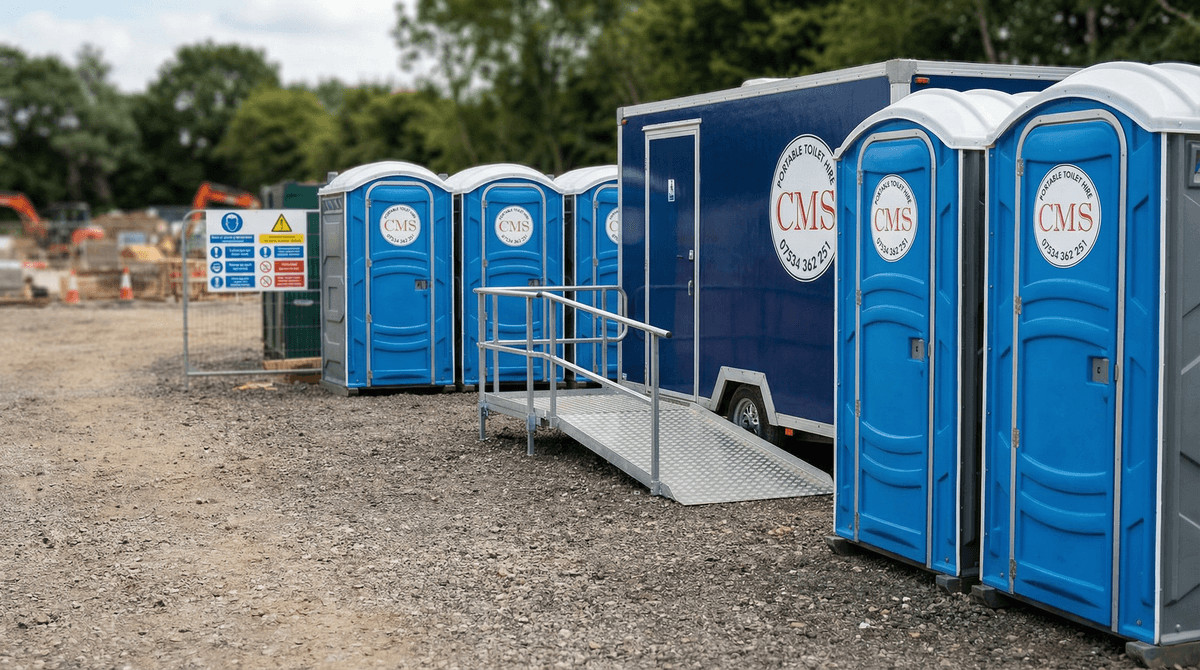
- Place accessible units on firm, level ground with a clear, unobstructed path of travel
- Ensure the route to the accessible unit is free from steps, steep gradients, and loose surfaces
- Position the unit close to the main activity area — do not tuck it away in a far corner
- Provide adequate lighting around the unit and along the approach path
---
What Makes a Portable Toilet Genuinely Accessible
Not all units marketed as "accessible" meet the legal standard. Here is what to look for:
Internal Space
- Enough room for a wheelchair user to enter, turn, and transfer to the toilet
- No internal obstructions such as hand sanitiser dispensers mounted at the wrong height
- A flat, non-slip floor
Grab Rails
- Horizontal and vertical grab rails positioned to assist transfer from a wheelchair
- Rails that are firmly fixed and can support a person's full body weight
- Ideally, a drop-down rail on at least one side
Door
- A door wide enough for a standard wheelchair (minimum 900mm clear opening)
- A lock that can be operated with one hand and without gripping or twisting
- An emergency release mechanism accessible from outside
Fixtures
- A toilet seat at standard wheelchair transfer height (approximately 480mm)
- A hand wash basin that can be reached from the toilet seat
- Toilet paper and hand drying facilities within easy reach
---
Common Mistakes and How to Avoid Them
Mistake 1: Assuming One Size Fits All
Standard portable toilets are not accessible. Full stop. A standard unit is too narrow for wheelchair access, the door is too small, and there are no grab rails. If you only provide standard units, you are not meeting your legal obligations.
Mistake 2: Poor Placement
An accessible unit placed on rough ground, up a slope, or behind a barrier is not genuinely accessible. The approach matters as much as the unit itself.
Mistake 3: Using the Accessible Unit as Storage
This happens more often than it should. Accessible units are sometimes used to store cleaning supplies, signage, or equipment. This is unacceptable and potentially unlawful.
Mistake 4: No Signage
Accessible units must be clearly signed with the International Symbol of Access. The signage should be visible from a distance and from the approach path.
Mistake 5: Failing to Maintain the Unit
An accessible unit that is dirty, has a broken lock, or has run out of supplies is not fit for purpose. Maintenance checks should be more frequent, not less, for accessible units.
---
Enforcement and Consequences
Local authorities and the Health and Safety Executive have the power to take enforcement action where toilet provision fails to meet legal requirements. On construction sites, HSE inspectors can issue improvement notices or, in serious cases, prohibition notices that halt work entirely.
For event organisers, local authority licensing conditions often include specific requirements for accessible toilet provision. Failure to comply can result in:
- Licence conditions being breached
- Future licence applications being refused
- Civil claims from individuals who were unable to access facilities
- Negative publicity and reputational damage
---
Practical Checklist
Before your event or project begins, run through this checklist:
- At least one accessible toilet unit is included in your provision
- The unit meets the dimensional and fixture requirements set out above
- The approach path is level, firm, and free from obstructions
- Signage is clear and visible
- A maintenance schedule is in place, with more frequent checks for accessible units
- Staff are briefed on the location of accessible units and how to assist if needed
- The unit is not being used for any purpose other than its intended one
---
Getting It Right
Meeting your legal obligations on accessible toilet provision is not difficult or expensive. It requires planning, the right equipment, and a commitment to treating accessibility as a baseline requirement rather than an afterthought.
If you are unsure about what your specific situation requires, speak to your hire provider. A reputable company will be able to advise on the right number and type of units, placement, and maintenance — and will ensure that what arrives on site actually meets the standard.