
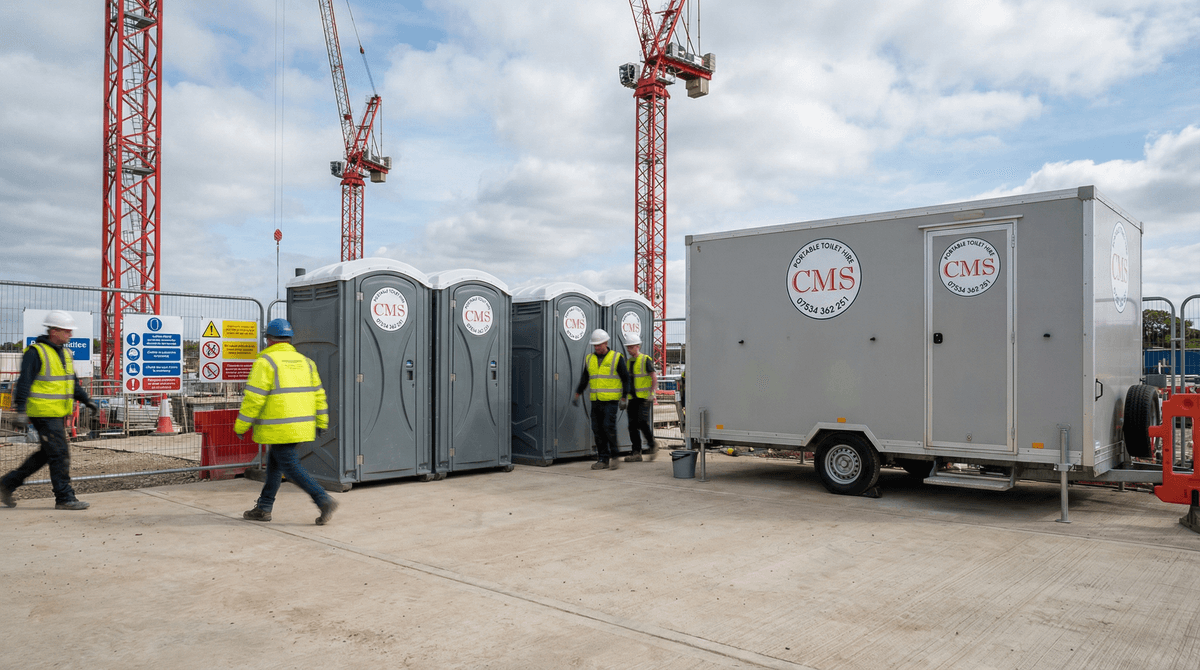
Small construction sites are not exempt from welfare requirements. Whether you are a sole trader fitting a kitchen extension or a team of five laying foundations, the law applies to you just as firmly as it does to a major housebuilder. HSE inspectors visit small sites regularly — and welfare provision is consistently one of the top areas where they find failings.
This guide explains what the HSE requires for toilet provision on small sites, what counts as "small," and how to meet the standard without overcomplicating things.
---
What Counts as a Small Construction Site?
There is no formal legal definition of a "small" construction site. For practical purposes, we are talking about:
- Sites with fewer than 20 workers at any one time
- Projects lasting days or weeks rather than months
- Domestic extensions, renovations, landscaping, and similar works
- Small commercial fit-outs and refurbishments
The legal requirements are the same regardless of size. What changes is the scale and type of provision needed.
---
The Legal Requirements
CDM 2015
The Construction (Design and Management) Regulations 2015 apply to all construction work in Great Britain. There is no exemption for small sites.
Schedule 2 of the CDM Regulations sets out the welfare facilities that must be provided:
- Toilets
- Washing facilities
- Drinking water
- Changing rooms (where needed)
- Rest facilities
For small sites, the key provisions are toilets, washing, and drinking water. Changing rooms and formal rest areas are less likely to be required but should be considered depending on the nature of the work.
Regulation 13: The Duty on Contractors
On projects with only one contractor (no principal contractor appointment), that contractor is responsible for providing welfare facilities. On domestic projects, this responsibility falls to the contractor by default.
HSG150 Guidance
HSE's guidance document HSG150 provides the practical detail. For small sites, the relevant ratios are:
- 1 to 7 workers: 1 toilet and 1 wash station
- 8 to 20 workers: 2 toilets and 2 wash stations
These are bare minimums. If your workforce fluctuates, plan for the peak number.
---
Practical Options for Small Sites
Chemical Portable Toilets
The standard solution for most small construction sites. A single chemical portable toilet is affordable, easy to deliver, and requires no mains connections.
Key points:
- Delivery and collection can usually be arranged within 24-48 hours
- Weekly servicing is the standard interval — the hire company empties the waste tank, cleans the unit, and restocks consumables
- Units need to be placed on firm, level ground with reasonable access for the servicing vehicle
Using the Client's Facilities
On domestic projects, it is common for the homeowner to offer use of their own toilet. This is acceptable under the regulations provided:
- The homeowner genuinely consents (do not assume)
- The route to the toilet does not involve walking through living areas in dirty boots and work clothes
- The toilet is available throughout the working day, not just at the homeowner's convenience
- Washing facilities with soap and towels are available
In practice, this arrangement works for very small, short-duration projects. For anything lasting more than a few days or involving more than two or three workers, a portable toilet is the sensible choice.
Nearby Public Facilities
Using public toilets, café toilets, or facilities in nearby buildings is not acceptable as your primary provision. The regulations require facilities to be readily accessible from the site. "There is a pub 10 minutes down the road" does not meet the standard.
---
Washing Facilities
Toilets alone are not sufficient. The regulations require washing facilities in the immediate vicinity of the toilet, with:
- Hot and cold (or warm) running water
- Soap
- Towels or another means of drying
How to Provide Washing on a Small Site
- Portable wash stations can be hired alongside the toilet unit. These are standalone units with a foot-pump or battery-powered tap, a water tank, and a soap dispenser.
- Mains-connected taps — if the site has a water supply, a simple temporary tap with a basin can suffice.
- Jerry cans and basins — in the very short term, clean water in a container with soap and paper towels can serve as a stopgap, but this should not be the permanent arrangement.
The water must be warm or hot. Cold water and no soap is not compliant.
---
Drinking Water
A supply of wholesome drinking water must be available to all workers. This can be:
- A mains tap clearly labelled as drinking water
- Bottled water in sufficient quantities
- A water cooler or dispenser
The key requirement is that it is clearly distinguished from non-potable water (e.g. water used for construction processes) and that cups or bottles are available.
---
Placement and Access
Where you put the toilet matters:
- Level ground — a portable toilet on a slope is a safety risk and will not function properly
- Accessible location — within a reasonable walk from the main working area, not on the far side of a muddy field
- Servicing access — the hire company's vehicle needs to reach the unit for weekly servicing. Discuss access arrangements at the time of ordering.
- Away from food — do not place the toilet immediately adjacent to the area where workers eat or prepare food
- Stable surface — plywood boards or a concrete pad can provide a stable base on soft ground
---
Servicing
Chemical portable toilets require regular servicing. For a small site, weekly servicing is the norm. The service visit includes:
- Emptying and treating the waste tank
- Cleaning the interior
- Restocking toilet paper, hand sanitiser, and other consumables
- Checking the unit for damage or wear
If the unit is being used heavily (more workers than expected, or in hot weather), you may need more frequent servicing. Speak to your hire provider if the unit is not lasting the week.
---
What HSE Inspectors Look For
HSE visits to small sites are not rare. Inspectors check welfare provision as a matter of routine, and the following are common findings:
- No toilet at all — still the most common failing on small domestic sites
- Toilet present but not serviced — a unit that has not been cleaned for weeks is not compliant
- No washing facilities — a toilet without adjacent hand washing is a frequent issue
- No drinking water — workers relying on buying their own water is not acceptable
- Dirty or damaged units — a toilet that is unpleasant to use is one that workers will avoid, creating hygiene problems elsewhere
Consequences of Non-Compliance
On a small site, the most likely enforcement actions are:
- Verbal advice and a follow-up inspection
- An improvement notice requiring you to provide facilities within a specified period
- Fee for intervention — HSE charges for the time spent investigating and following up, at the current hourly rate (£163/hour in 2024)
- Prosecution in cases of persistent or deliberate failure
Beyond enforcement, the practical consequences are clear. Workers without proper facilities are less productive, less likely to return to your site, and more likely to raise complaints.
---
Cost
The cost of providing a portable toilet on a small construction site is modest:
- Hire costs for a standard chemical portable toilet are typically in the range of £60-90 per week, including weekly servicing
- Delivery and collection charges vary but are usually in the region of £50-100 each way
- Portable wash stations can be hired for a similar weekly rate
For a four-week domestic project, you are looking at a total cost of a few hundred pounds. Set against the cost of an HSE improvement notice, the loss of a day's work, or the reputational damage of a complaint, it is not a significant expense.
---
Checklist for Small Sites
- At least one portable toilet on site before work begins
- Washing facilities with warm water, soap, and drying adjacent to the toilet
- Drinking water clearly labelled and available to all workers
- Toilet placed on firm, level ground within easy reach of the working area
- Weekly servicing arranged with the hire provider
- Consumables checked daily
- Arrangement reviewed if workforce numbers change
Small sites deserve the same standard of welfare provision as large ones. The requirements are proportionate, the solutions are practical, and the cost is negligible compared to the consequences of ignoring them.