
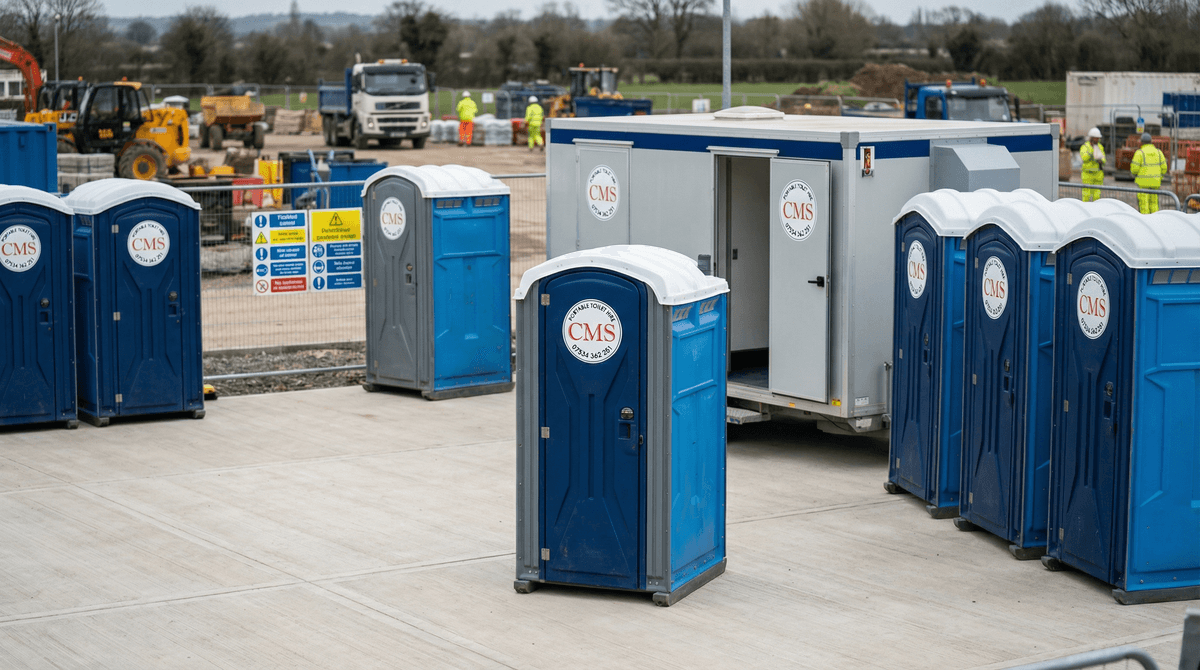
There is a surprising amount of law governing portable toilets in the UK. It spans health and safety legislation, environmental law, planning regulations, and licensing requirements. Most people only encounter one or two of these areas, but if you are hiring, operating, or providing , you need a working knowledge of all of them.
This guide sets out the key regulations, what they require, and where the common pitfalls lie.
---
Health and Safety Legislation
The Workplace (Health, Safety and Welfare) Regulations 1992
These regulations require every employer to provide suitable and sufficient sanitary conveniences and washing facilities at any workplace. "Suitable and sufficient" means:
- Enough toilets for the number of people using the workplace
- Toilets that are adequately ventilated and lit
- Separate facilities for men and women (unless each facility is a lockable room for one person)
- Washing facilities adjacent to toilets, with hot and cold water, soap, and towels
This applies to permanent workplaces, temporary workplaces, and any location where people work.
Construction (Design and Management) Regulations 2015
For construction sites, CDM 2015 sets out specific welfare requirements in Schedule 2. These are broadly the same as the Workplace Regulations but are tailored to the construction environment. Key points:
- The client has a duty to ensure welfare facilities are provided before work starts
- The principal contractor must plan, manage, and monitor welfare provision
- Facilities must include toilets, washing, drinking water, changing rooms, and rest areas
- Minimum numbers are set out in HSE guidance (HSG150)
The Health and Safety at Work Act 1974
The umbrella legislation for workplace health and safety. Section 2 imposes a general duty on employers to ensure, so far as is reasonably practicable, the health, safety, and welfare of their employees. This includes the provision of adequate toilet and washing facilities.
---
Event Licensing and Local Authority Requirements
The Licensing Act 2003
Events that involve the sale of alcohol, regulated entertainment, or late-night refreshment require a premises licence or temporary event notice under the Licensing Act 2003. Toilet provision is a standard condition of many premises licences and a key consideration in the licensing process.
Local authorities assess:
- Whether the number of toilets is adequate for the expected attendance
- Whether accessible toilets are provided
- The location and lighting of toilet facilities
- Arrangements for servicing and waste removal during the event
Event Safety Guide (The Purple Guide)
The Purple Guide is the industry-standard reference for event safety in the UK. Chapter 17 covers sanitary provision and recommends:
- For male attendees: 1 toilet per 500 plus 1 urinal per 150
- For female attendees: 1 toilet per 100
- Accessible toilets at a ratio of at least 1 per cluster of standard units
- Baby changing facilities at family events
These are recommendations rather than legal requirements, but local authorities and licensing bodies use them as benchmarks. Falling significantly below these ratios will raise questions.
Public Health Acts
Local authorities have powers under various public health statutes to require adequate sanitary provision at events and public gatherings. In practice, these powers are exercised through the licensing and event planning process rather than through standalone enforcement.
---
Environmental Regulations
Waste Management
Portable toilet waste is classified as controlled waste under the Environmental Protection Act 1990. The legal requirements for waste disposal include:
- Collection by a registered waste carrier
- Disposal at a facility holding an appropriate environmental permit
- Completion and retention of waste transfer notes
- A duty of care on everyone in the waste chain
Illegal disposal of portable toilet waste is a criminal offence carrying penalties of up to 5 years' imprisonment and unlimited fines.
Water Pollution
The Water Resources Act 1991 and the Environmental Permitting Regulations 2016 prohibit the discharge of polluting matter into controlled waters without a permit. Portable toilet waste discharged into rivers, streams, ditches, or surface water drains constitutes a criminal offence.
---
Planning Regulations
Temporary Structures
Portable toilets are generally classified as temporary structures and do not require planning permission for short-term use (typically up to 28 days). However:
- Longer-term placements may require planning permission or a Certificate of Lawful Use
- Sites in conservation areas, Areas of Outstanding Natural Beauty, or near listed buildings may have additional restrictions
- Some local authorities impose conditions on the placement of temporary structures through local planning policies
Highways
Portable toilets placed on or adjacent to the public highway require permission from the highways authority. This typically involves a temporary licence under the Highways Act 1980.
---
Disability and Accessibility
The Equality Act 2010
The Equality Act requires service providers and employers to make reasonable adjustments to avoid placing disabled people at a substantial disadvantage. In the context of portable toilets, this means:
- Providing at least one accessible unit wherever toilets are offered to the public or workforce
- Ensuring the accessible unit meets dimensional and fixture requirements (BS 8300 provides guidance)
- Placing the accessible unit on level ground with an unobstructed approach path
- Maintaining the accessible unit to the same (or higher) standard as standard units
Failure to provide accessible facilities where it would be reasonable to do so is unlawful discrimination.
---
Specific Sector Requirements
Schools and Educational Establishments
The School Premises (England) Regulations 2012 set out specific requirements for toilet provision in schools. Where portable toilets are used (e.g. during building works or for outdoor events), they must meet the same standards of privacy, hygiene, and accessibility as permanent facilities.
Healthcare Settings
Portable toilets used at healthcare facilities or medical events must meet additional infection control standards. This may include more frequent servicing, provision of alcohol-based hand sanitiser, and separate facilities for patients and staff.
Food Events
Events involving food preparation or service are subject to food hygiene regulations. The Food Safety Act 1990 and the Food Hygiene Regulations require adequate hand-washing facilities for food handlers. Portable toilets serving food events should include hand-washing stations with hot water and soap — hand sanitiser alone is not sufficient.
---
Hire Company Obligations
If you operate a portable toilet hire business, your regulatory obligations include:
- Waste carrier registration with the Environment Agency (or equivalent body in Scotland, Wales, or Northern Ireland)
- Compliance with the Carriage of Dangerous Goods Regulations where chemical concentrations exceed specified thresholds
- Vehicle compliance — vehicles used to transport waste must meet MOT and operator licensing requirements
- Health and safety — risk assessments for manual handling, chemical exposure, and lone working during servicing operations
- Insurance — public liability and employer's liability insurance appropriate to the nature of the work
---
What Happens When Things Go Wrong
Regulatory breaches involving portable toilets are enforced by several different bodies:
- HSE enforces health and safety legislation on construction sites and in workplaces. Powers include improvement notices, prohibition notices, fee for intervention, and prosecution.
- Local authorities enforce health and safety in non-construction workplaces, licensing conditions, and public health requirements. Powers include licence revocation, fixed penalty notices, and prosecution.
- The Environment Agency (and equivalent bodies) enforces environmental legislation. Powers include enforcement notices, fixed penalty notices, vehicle seizure, and prosecution.
Penalties are significant:
- Health and safety offences carry unlimited fines and, for the most serious breaches, imprisonment
- Environmental offences carry unlimited fines and up to 5 years' imprisonment
- Licensing breaches can result in licence revocation and restrictions on future applications
---
Practical Compliance Checklist
Whether you are hiring portable toilets for an event, managing a construction site, or operating a hire business, this checklist covers the essentials:
- Sufficient toilets for the expected number of users
- At least one accessible toilet unit
- Washing facilities with hot and cold water, soap, and drying
- Drinking water available
- Waste collected by a registered carrier and disposed of at a permitted facility
- Waste transfer notes completed and retained for two years minimum
- Placement on level ground with unobstructed access
- Adequate lighting and signage
- Regular servicing and maintenance schedule
- Compliance with any licensing or planning conditions
The regulations are numerous but not complicated. Meeting them is a matter of planning, using reputable suppliers, and maintaining standards throughout the duration of the hire.